

The ovations would not end. Gripped and transported, the audience at this year’s Polish Dance Platform in Wrocław brought Polish-Japanese choreographer Hana Umeda to the stage for four curtain calls after her solo Rapeflower. For the final one, the bow was different: instead of simply bending down, she knelt and then pressed herself to the floor, arms stretched out – an acknowledgement of her roots in Japanese culture.
Viscerally approaching the topic of rape, Umeda’s choreography is built around the repetition and rigidity of Japanese jiutamai, exploring coping mechanisms embedded in this classical dance’s structure. At the same, Umeda constructs a new language to investigate a deeply personal experience; through innovative techniques that blend dance with fine art, moving image and text, she finds a way to inscribe her body within the larger and longer history of sexual violence against women.
After the performance, Umeda kindly agreed to talk with me about bringing classical Japanese dance to the contemporary scene, as well as creative decisions and underlying motifs behind Rapeflower.
You’re the first dancer of jiutamai in Poland. How did you arrive at it?
I actually started with nihon buyo, a different type of classical dance, connected with Kabuki theatre. In Kabuki theatre, only male actors perform, even the female roles. So, I always perceived the femininity of female nihon buyo dances as mediated through a male body that, in turn, represents a female body.
Jiutamai is different; it focuses on very small movements and emotionality. It is also rooted in the experience of women. Nowadays, it’s mainly performed by geishas, but also by some professional dancers.
I was introduced to this dance by my present master, Hanasaki Tokijyo. In 2020, I was symbolically adopted into the Hanasaki family, which means that I became a professional dancer and the teacher of this dance. Today, I mostly focus on introducing jiutamai to European contemporary dance and performance.
‘
I don’t intend for any additional, intercultural dialogue other than the one that is already happening within this body
A few years ago, I went to a workshop with nora chipaumire. I was amazed by how she uses traditional dances from Zimbabwe in their original form, refusing to get influenced by western dance.
So, this is how I approach jiutamai right now. I don’t change movements. I don’t try to imitate any technique other than jiutamai. I believe that it can still be contemporary if it speaks to the problems that we have right now.
What problems?
In the case of Rapeflower, it is sexual violence and rape culture, which has not changed for ages. Here, I was investigating sexual violence inscribed on the body performing jiutamai. Historically, in pre-modern Japan, this dance was also performed by sex workers. And in the times when women were forbidden from performing on stage, it was performed in closed rooms for a client who came to pay for pleasure provided by women.
So, in my research for Rapeflower, I was trying to recognise in the technique of jiutamai coping and surviving mechanisms connected to experiencing sexual violence. It’s based on my own experience of being raped and its aftermath. This is a kind of speculation; it’s not like I had access to documents that prove that jiutamai dancers were experiencing sexual violence. Although I think it is very unlikely that they did not.
I find it fascinating how Rapeflower is constructed on a dialogue between Polish and Japanese cultures. What emerges from this conversation?
I am half Polish, half Japanese. As a dancer, I’m educated in Japan; as a choreographer and maker in Germany. My way of thinking is shaped by what I received in Poland; my heart is a patchwork. I start from my own body. And this is just what this body is. In Rapeflower, I don’t intend for any additional, intercultural dialogue other than the one that is already happening within this body. It is not for me to say what emerges from it.
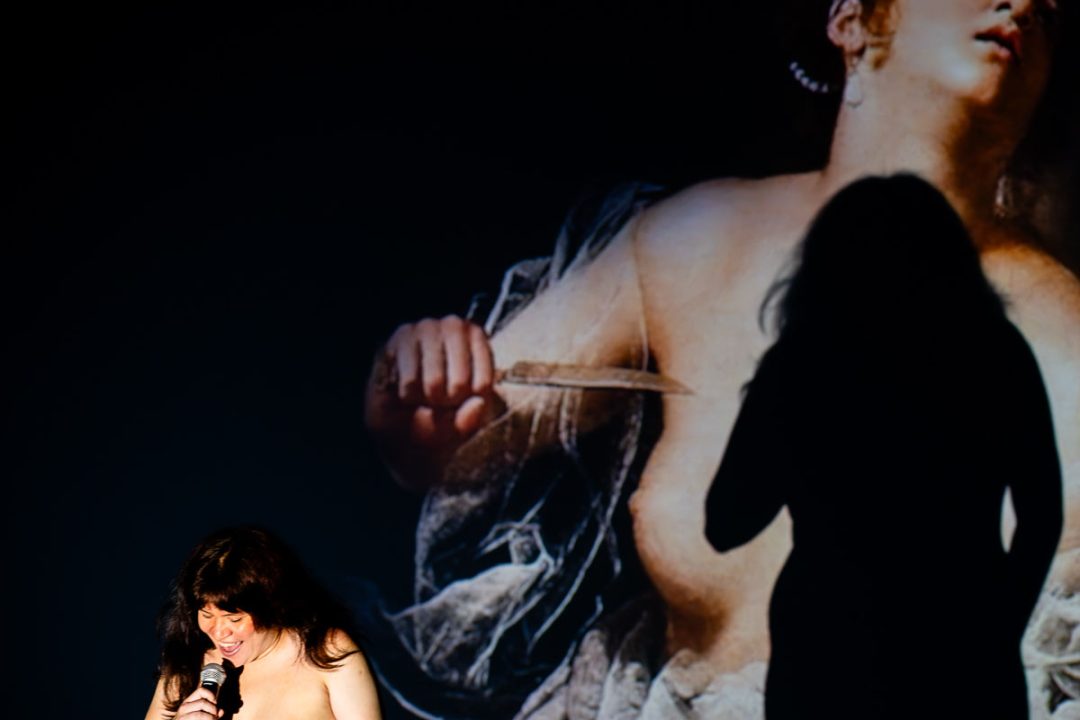
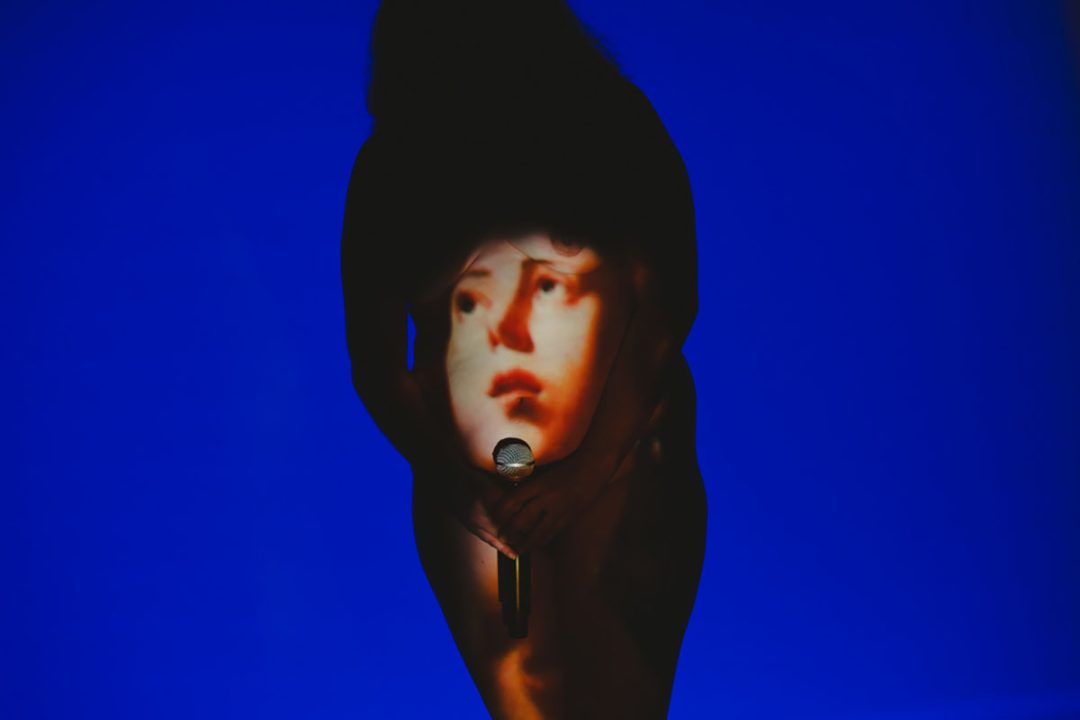
In Rapeflower, paintings by 17th-century Italian artist Artemisia Gentileschi are projected onto your undulating belly. It’s as if your body responds to the cultural; it animates it.
My body is an archive – of my own experiences, of the culture in which I grew up, of all the experiences of my ancestors and my artistic ancestors.
I invited Artemisia Gentileschi into the performance because she was an artist who was raped. In her art, she worked with her own experience of rape. But I was also thinking about all the things that are being projected onto the bodies of people who experienced sexual violence; particularly, the image of a victim.
We are afraid of being victims. We don’t want to put ourselves in this position. And this leads us to not talk about the experience – if I don’t want to be a victim of rape, then maybe I will not say that I was raped because everybody will pity me. What I understood is that a victim of rape is dead. If you live – you’re a survivor. Your body did its best, so you were not killed by the rapist. Moreover, you did not commit suicide afterwards. Suicide is a very common effect of rape trauma. It is very normal to struggle with suicidal thoughts after experiencing rape.
So, the paintings that I am projecting on myself relate more to the projections of victimhood. It is also an extended invitation – to Artemisia Gentileschi, who in turn invites Lucretia: the famous raped woman who, in the legends and literature, commits suicide.
In this sense, I understand my body less as a cultural construct and more as a space where many bodies can meet. So, it’s not only my body with my particular experience, but it’s also bodies of generations of jiutamai dancers, bodies of Artemisia Gentileschi, Lucretia, and every woman who has experienced sexual assault. And it’s statistically one in five women; this is how common this experience is.
At one point, while you’re dancing on stage, the audience sees a projection of your body dancing on the screen, seemingly from the point of view of a traditional Japanese fan you are dancing with.What stands behind this decision?
In the process of making Rapeflower, one of the main questions I asked myself was: How do I take back the agency that is taken away from me? It is not about emancipating, but taking back, because the experience of rape is an experience of being turned into an object.
Your consent, your will, anything you have to say – it doesn’t matter; you are just a body that somebody can use. So, for me, it was a question of how the object can take agency.
‘
I get my own point of view back; I get my agency. By emerging from an object, I become a subject.
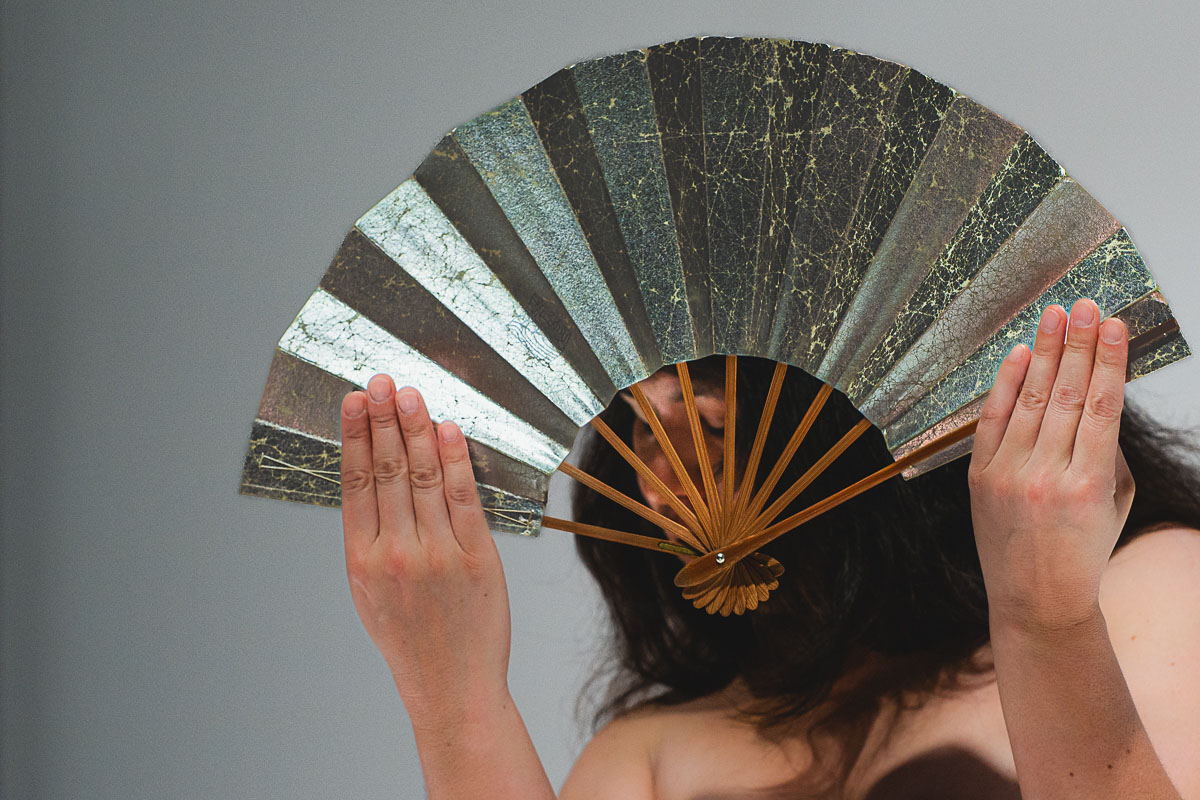
In jiutamai, we use a traditional dancing fan, which is, in a way, a dance partner.
The fan can represent everything you want it to. So, this point of view of the fan was a way to give the object its agency and try to find a way to not even animate it, but to really give it its perspective. And by extension, I get my own point of view back; I get my agency.
By emerging from an object, I become a subject.
What was the biggest challenge in the making of Rapeflower?
The psychological state that I put myself into. When I started making it, I didn’t realise it was going to be about rape; I thought it would be a different performance. I was not prepared to care for myself throughout the process and pushed it to the limit.
I think if I had to do it a second time, or if somebody else takes up this kind of topic, it’s important to plan how to support yourself. There was a period of time when I was just re-traumatising myself. But at some point, I began trauma therapy, offered for free by this Polish organisation, Feminoteka. They also opened ‘Femka’ – a centre for women who experienced rape. Such organisations operate in other countries, too; they offer free psychological, medical and legal help for women in need.
When I started the therapy, I realised that I had already done a lot of work myself, through the artistic process. Now, I feel more and more empowered each time I repeat this performance. So, I feel that it was worth the cost.
You mentioned you are interested in coping mechanisms inscribed into the form of jiutamai itself. The dance seems to be very rigid. Do you find it liberating?
Oh, I always found liberation in rigidity. The more my movement is constrained, the clearer the spaces of freedom become. My brain just works like this – if I can do anything at all, anything in the world, it’s hard to decide what to do. And if I have really limited space of freedom, then I can use it to its limit. ●
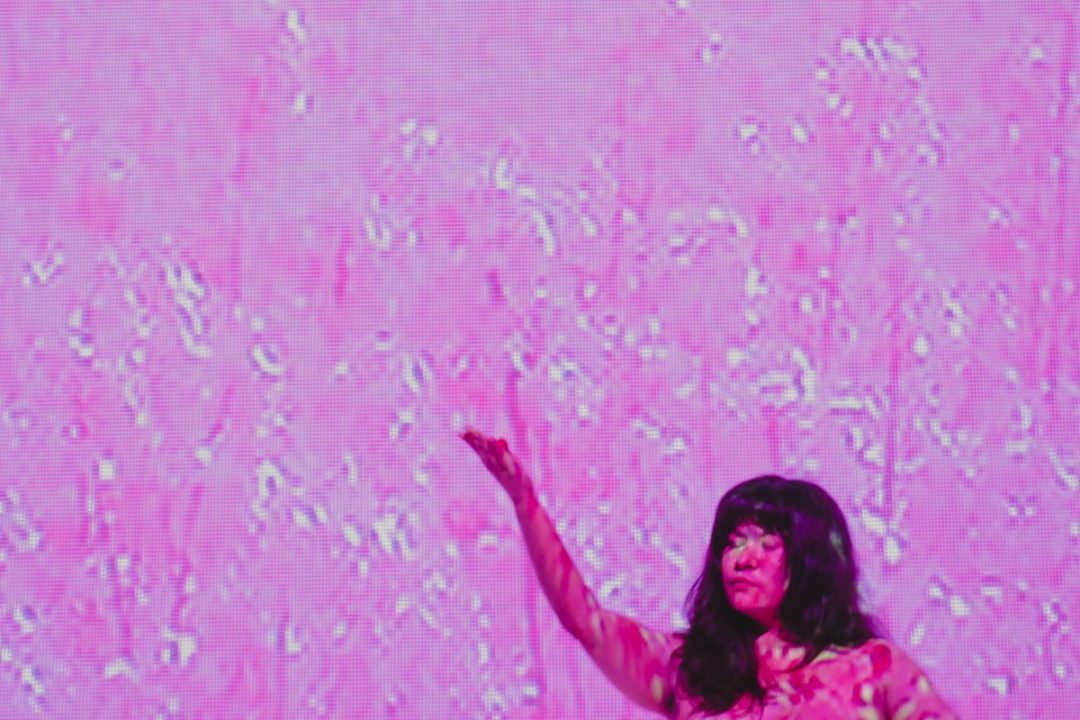
Rapeflower premiered in 2024, and was performed on 18.09.26 in Wrocław at the 2026 Polish Dance Platform, organised by the National Institute of Music and Dance.