

For 28 years, festival Faits d’hiver has set out to welcome the winter season with miscellaneous works of contemporary dance. Running from mid-January to mid-February, the festival spreads its 26 pieces – including 12 premieres – in 18 venues in and out of Paris. In the course of events organised by director Christopher Martin, I had the opportunity to discover a variety of styles and works designed by both newcomers and well-known artists. What better way to start the year than by being thrown in at the deep end of this 2026 edition?
Opening night: Gaslight by Hélène Rocheteau
With her solo-choral performance Gaslight, Hélène Rocheteau kicked off Faits d’hiver both literally and metaphorically. Standing in a dim-lit atmosphere beside a large table with a microphone on each end, she lights an old gas lamp. But Rocheteau plays with the term’s contemporary double meaning. All around the lamp, she displays a myriad of glasses and vases of various forms and tints – the kind you might find in a flea market – that distort both sounds and reflections. The image reminds that, after George Cukor’s eponymous movie from 1944, ‘gaslight’ also refers to an insidious form of psychological abuse that involves twisting reality to confuse the victim.
Like a witch in her occult den, she embodies the voices of dozens of fictional and real-life women that have been stifled. Thus, Ariel and the Sea Witch from Anderson’s tale The Little Mermaid meet French politician Ségolène Royal, opera singer Maria Callas and actress Jane Fonda. As Rocheteau quotes women in extremely diverse contexts, she shines a light on a brutal and highly gendered experience of losing freedom of speech. While clearly taking up feminist symbols, the artist’s universe astutely mixes ludicrous and dark humour through body metamorphosis. One second, she’s crying out in a transparent jar, and the next, she speaks in a honeyed voice with a kitchen knife in her hand and a devious smile on her face. The transformation process grows in nuances as painting her face, wrapping herself in a sparkling cloak or putting on a horned hat that gives her an orientalist look, like the narrator from the One Thousand and One Nights, Sheherazade. Shapeshifting and captivating, Rocheteau manages to be fully heard and seen.
Mirror dancing: La Visite by Sofian Jouini, Quartet by Alban Richard
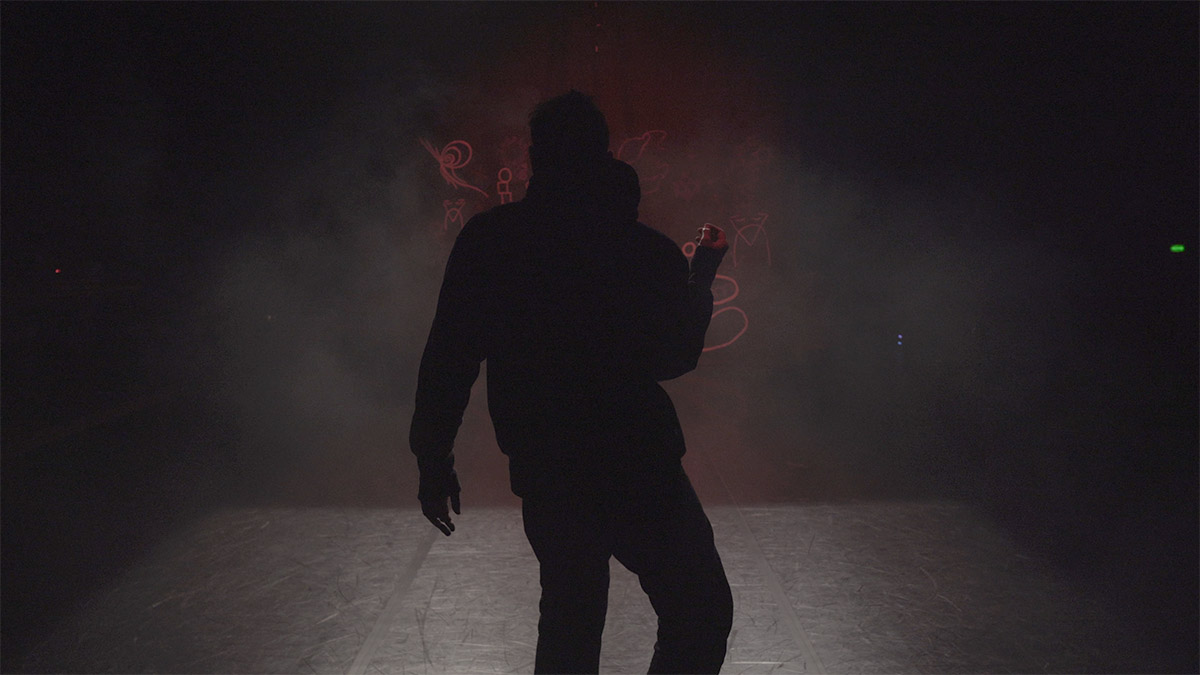
It takes a small step out of Paris to pay Sofian Jouini a visit. Once in Vanves, the breakdancer and choreographer will be waiting in the small, intimate Salle Canopée. The lights are still on when he unexpectedly stands up from one side of the audience and crashes face down onstage. His body, wrapped in a black hoodie and tracksuit, bounces and rebounds, following a long curvy line that runs across the room and goes up on fabric curtains with symbolic paintings. Diving in a dim-lit atmosphere filled with distorted sounds, his bumps and quivers already feel strange.
But Jouini reached new heights by literally listening to his gut. Lying down on his back, he moves his belly as if it were coming alive. Rolling up and down, his innards look like a hidden creature wanting to break free from his body. The womb-like choreography may make you sick to your stomach at first, but it somehow becomes weirdly mesmerising. Too bad that first impression faded throughout the performance. Progressively, Jouini starts walking on his knees like a child learning to stand, sometimes striking a yoga child’s pose, a ballet port de bras, or robotic arm lifts and turns. By the time he rises up and let his body undulate from wrists to hips to a mix of oriental music, the solo has lost its park.
A few minutes’ walk away, Alban Richard is tuning up his Quartet at the Théâtre de Vanves. The choreographer and ex-director of Choreographic National Centre of Caen describes his piece as a techno rhapsody for four individual and autonomous yet intertwined scores. At first, it is like strange music to our eyes. The four performers who walk onstage in light freestyle sportswear sound like they have been struck down by a syndrome of robotic psittacism. Standing behind music stands in a semi-circle like in a rehearsal, they randomly repeat single words and half sentences, ranging from short answers like ‘I don’t know’ to proverbs like ‘you can’t judge a book by its cover’. The more their distorted speech goes on repeat, the more it spirals into an existential crisis. Both accelerating and syncopating, they walk their own line across the room but seem stuck between fast-forward and rewind.
Yet as the soundscape evolves from synthesiser chords to electro beats, techno and trance music, they find a way to harmonise their obscure hubbub. From lonely bodies wandering around like lost souls to a squad of rebels, the four singer-dancers strike with synchronicity and energy as their bodies move to the sound of their voices. The looping and remixes of beeps and echoes resonate with their mechanical glitch-like gestures, creating funny sequences. Chihiro Araki stands out from the quartet as an impressive performer and singer. Even though she embraces contemporary dance onstage, you can tell she was trained in ballet – not only from her en dehors, but also from the way she moves with both high control and meticulous articulation. In the end, she’s the one who brings most vivid sequences to the Quartet.
Wrapping up with a double bill: …est au-delà, une raison d’être… by Jean-Christophe Boclé, Les Transparents by Anne-Sophie Lancelin
Back in Paris, my last stop in Faits d’hiver led to an intriguing programme entitled Mystère d’hiver at the Théâtre de la Cité internationale. For both Jean-Christophe Boclé and Anne-Sophie Lancelin’s works, it was a premiere. For me, it was the first time I was seeing their works.
Boclé set the tone of the night and couldn’t have had a more suitable name for his piece. Discovering …est au-delà, une raison d’être… felt like catching a dense story right in the middle of a sentence. As suggested by the two ellipses, it’s hard to guess where it comes from, and sadly, it’s even harder to tell where it’s going. The light rises on a trio of musicians followed by a quartet of dancers. They may be sharing the stage, but each group plays its own parts. At the back, pianist Orlando Bass, along with two saxophonists, perform intermittent melodies as if following fill-in-the-gaps music sheets. Meanwhile, the four performers, dressed in large white-and-nude clothes on the all-white floor, repeat methodical sequences of strokes, twists and turns. Sometimes in synchronised duets, sometimes in asymmetrical unison, they seem to be guided by their breathing more than the clashing soundscape that runs alongside them in fits and starts. Like free spirits slowly roaming and whirling across the stage, the dancers explore movement through multiple contrasts of weight and speed. Too bad the choreography doesn’t find a way to form a deeper bond with the music, and both end up going round and round in circles.
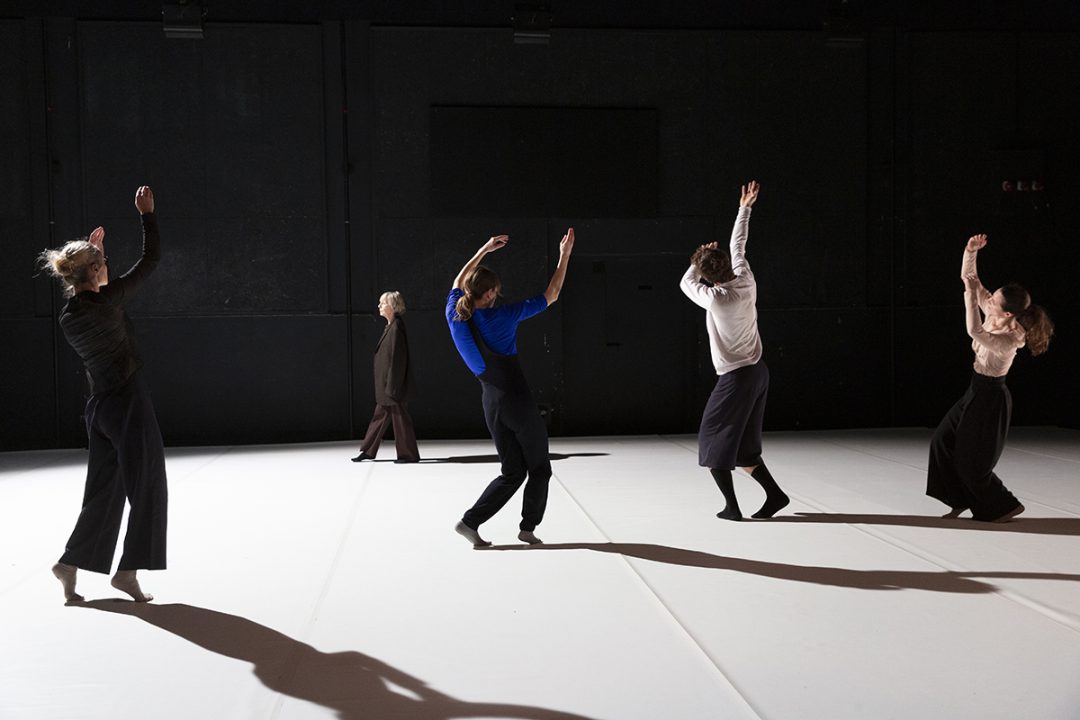
Contemporary dancer and choreographer Anne-Sophie Lancelin adds a fitting contrast to this double-bill with Les Transparents. Starting with a duet of dancers slowly rising up to discordant sounds, the piece seems to be inspired by the same kind of enigmatic atmosphere as Boclé’s. But when the other three performers join in, a clearer structure emerges. Through a succession of choreographic scenes, the five bodies alternately progress with and digress from the music.
Soft, undulating gestures in slow motion hinge on an extended suite of musical pieces. Likewise, unexpected variations come both from the soundscape – like Erik Satie’s Gymnopédies, a harpsicord and electrical guitar duet or a jazz melody – and the choreography – as when the only male dancer is held upside-down by the female dancers, or when one of them lies against another in a precarious position. Delineating space with light and shades and geometrical patterns, the flow of moving images conveys sensitive impressions with touches of humor. The piece might be obscure but it holds on to an enlightening common thread. With this January wrap-up, Les Transparents echoes like a subtle demonstration of how Faits d’hiver holds eclecticism as its core artistic policy. ●
19.01–20.02.26, Paris, France
www.faitsdhiver.com
See also Callysta Croizer’s review from Faits d’hiver 2025