

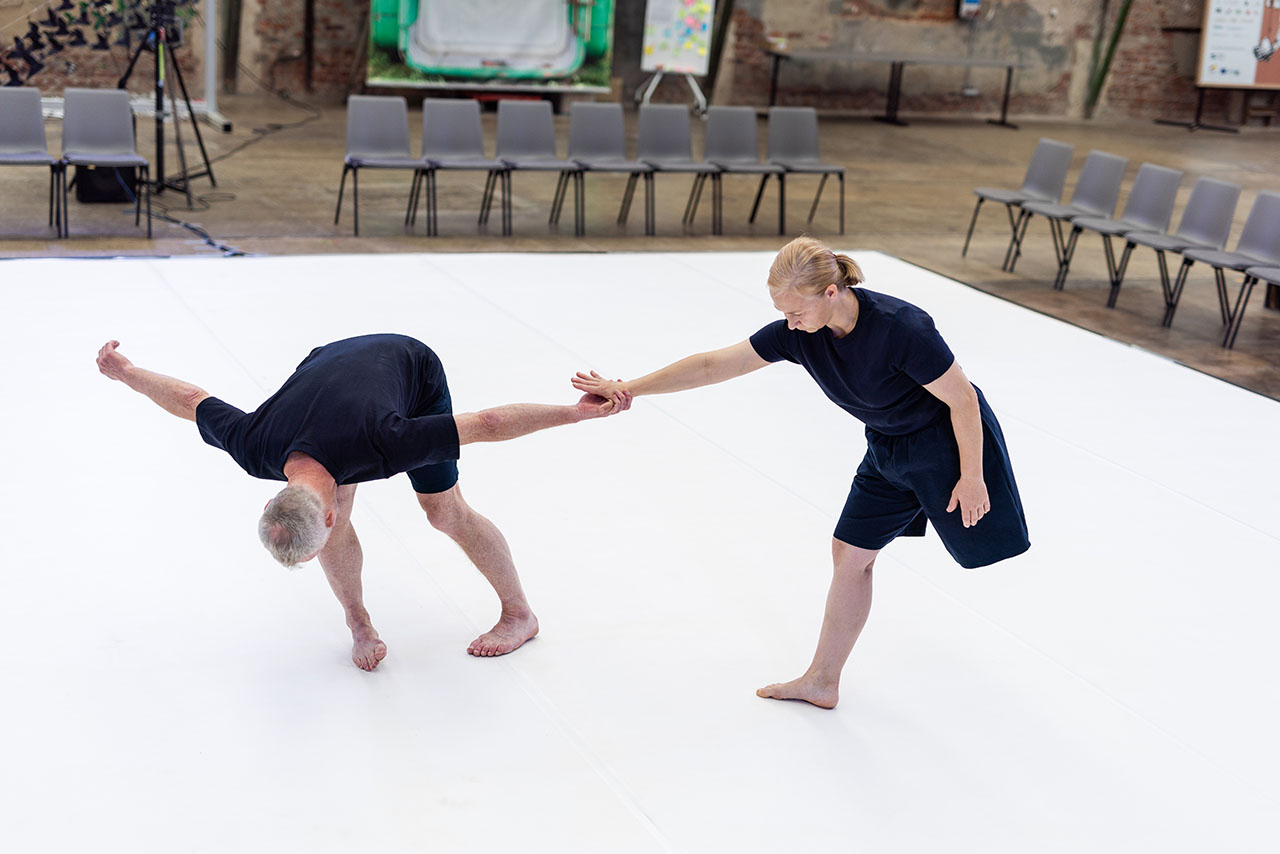
Markéta Stránská – a dancer with one leg – sets her crutches aside and hops forward to meet her duet partner Charlie Morrissey. They face each other. They look. They breathe. Time stretches and the subtle shifts of their bodies become amplified.
Accompanied by a crackling soundscape, the work unfolds through sustained, attentive touch. Negotiating weight and balance with care, they fall, rise, and fold into and around one another, at times appearing inseparable. Morrissey’s background in contact improvisation is evident in the quiet precision and ease of their partnering.
The book Politics of Touch by Erin Manning – which explores how meaning and politics can emerge through small, relational gestures – comes to mind. It’s difficult not to read the bodies through societal frameworks – gender, age, ability – which the work’s minimal approach draws attention to. Ultimately, Scáling highlights the narratives we tend to impose on others. This said, the constant agreement between the performers creates a lack of friction. I can’t help but crave more risk and dynamic shifts. Perhaps this reveals more about my own expectations rather than the performance itself.
Knee to foot. Palm round wrist. Chest on back. Charlie Morrissey and Markéta Stránská (both mature performers, the latter a dancer with one leg) navigate the architecture of each other’s bodies in the physical conversation that is Scáling. It’s like a more sophisticated version of Twister: Things start simply, fingertips extending towards one other, before more intricate combinations of contact emerge. Head under armpit. Shin to lower back. Thumb to little toe.
Caring, but not careful, Morrissey’s eyes are fixed attentively on Stránská’s body, while hers glaze over meditatively. This shared awareness allows them to become swifter and more playful with gravity over time, shifting together across the space in a rolling wave. Spines coil around one another like cobras; bodies whip into the air before melting lusciously back into the floor.
Scáling may be one of Spring Forward’s most stripped-back propositions, but it is one of its most captivating as a result. In a world of individualism and discordance, it offers a quiet proposition: regardless of our differences, physically attuning to one another can allow us to surf together in embodied harmony.
Scáling has nothing to hide. Markéta Stránská and Charlie Morrissey, both seasoned artists in their own right, meet face-to-face on stage, eyes softly flickering over each other’s body. Inspired by a chance encounter in 2019, Scáling is their first collaboration and devised in real time through touch and shared weight – dance made to measure.
Stránská and Morrissey come together and apart like slow-orbiting magnets, rising, tumbling and winding across the other. This partnership is less a negotiation than a shared brain. Scáling’s magic is in small gestures, which are made legible against stripped-back staging. Here, improvisation enables precision – the pressure between two fingers maintains the tension of a balance, limbs thread through the eye of a bent arm or wide stance. Refreshingly self-assured, Scáling resists embellishment as an aesthetic.
Scáling is slow work in the best sense: it feels like a lesson in the dying art of making a practice, not a product.
The encounter begins not with a movement, but with a gaze. Setting aside her crutches, Markéta Stránská navigates the stage on a single leg, meeting Charlie Morrissey at the centre – who doesn’t merely support her, but expertly fills the negative space, merging two distinct bodies into one emotionally fluid organism. Through shared contact, perception and sensation, the duet becomes a poem in constant flow.
The focus shifts from limbs to fingers; skin contact opens a new sensory connection. Even as the improvisation demands they collapse or lose balance, their gaze never breaks. The magnetic concentration pins the audience’s breath to the living sculpture they create.
Ultimately, Scáling reflects the social threads that bind us together. While society constructs rules to compensate for physical ‘limitations’, Morrissey and Stránská demonstrate the simple, often forgotten art of sensing one another. They rewrite the traces of human interaction, one balanced move at a time.