

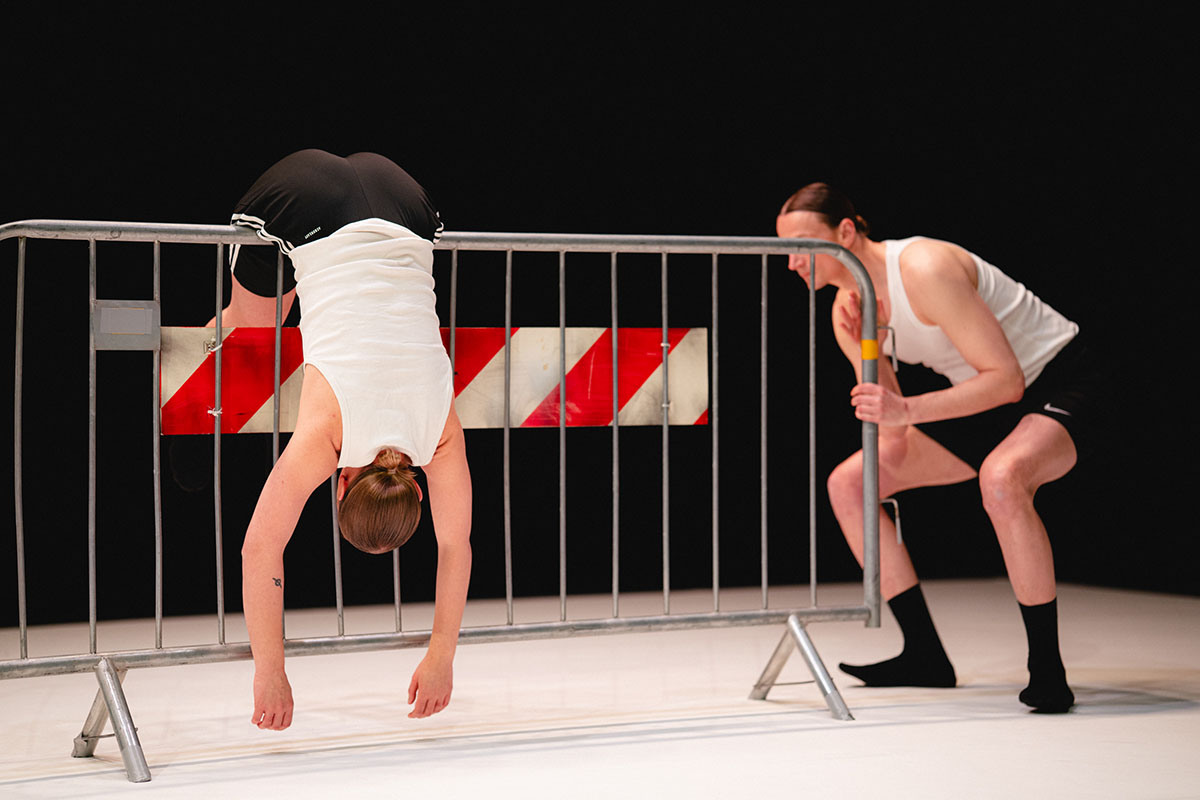
Beyond geographical proximity, what binds Lithuania, Estonia and Latvia into a distinctly Baltic identity? This question framed the opening panel of the Baltic Dance Congress, a new programme of talks and workshops presented alongside the fourth edition of the Baltic Dance Platform, held in Vilnius in April 2026.
While no clear definition was reached, many references to shared values emerged. There seemed to be a consensus that, while western Europeans take their rights somewhat for granted, residents of the Baltic countries – due to their shared history of being occupied by the Soviet Union – are well aware of freedom as something that’s hard-earned, and that can all too easily be taken away.
The Baltic dance scene is similarly hard-won and facing precarity. While the next edition of the Baltic Dance Platform is planned to take place in Tallinn, Estonia, in 2028, ‘when sending invitations to BDP, I wrote that this edition might be the last platform of its kind – and that may be true,’ said Gintarė Masteikaitė, director of the Lithuanian Dance Information Centre, in an interview with Springback’s Dmitrijus Andrušanecas.
Even this edition was marked by financial uncertainty, with participating artists needing to secure additional funding themselves to ensure their shows could go ahead despite unexpected reductions in funding. ‘With rising populism, cultural budget cuts, and geopolitical instability, it’s hard to predict where the [Baltic] dance community will be in a year or what its priorities will be,’ Masteikaitė adds.
Utopian gestures
The idea of the fragility of freedom permeated nearly all eight works presented at this year’s Baltic Dance Platform. Nowhere was the privilege of liberty more celebrated than in the programme’s first performance. ‘There’s no right or wrong, this is a safe space,’ one performer states over a microphone as the audience funnels into a smoky, dimly lit space for Latvian choreographers Laura Gorodko and Rūta Ronja Pakalne’s Freedom to Lose Control Together Within the Many. Cleared of seating, the room leaves the audience clinging to the perimeter while a large cast encourages us not to be shy – ‘or be shy… everything you hear from us is an invitation not a must.’
Intended as a guided meditation, the work sees dancers meander through the space as vague instructions relating to deep breathing and following the body’s instincts drift over a sound system. It isn’t until the prompts dwindle, and more driving electronic tracks from a live DJ kick in, that most onlookers stand up, give in, and start boogieing to the beat.
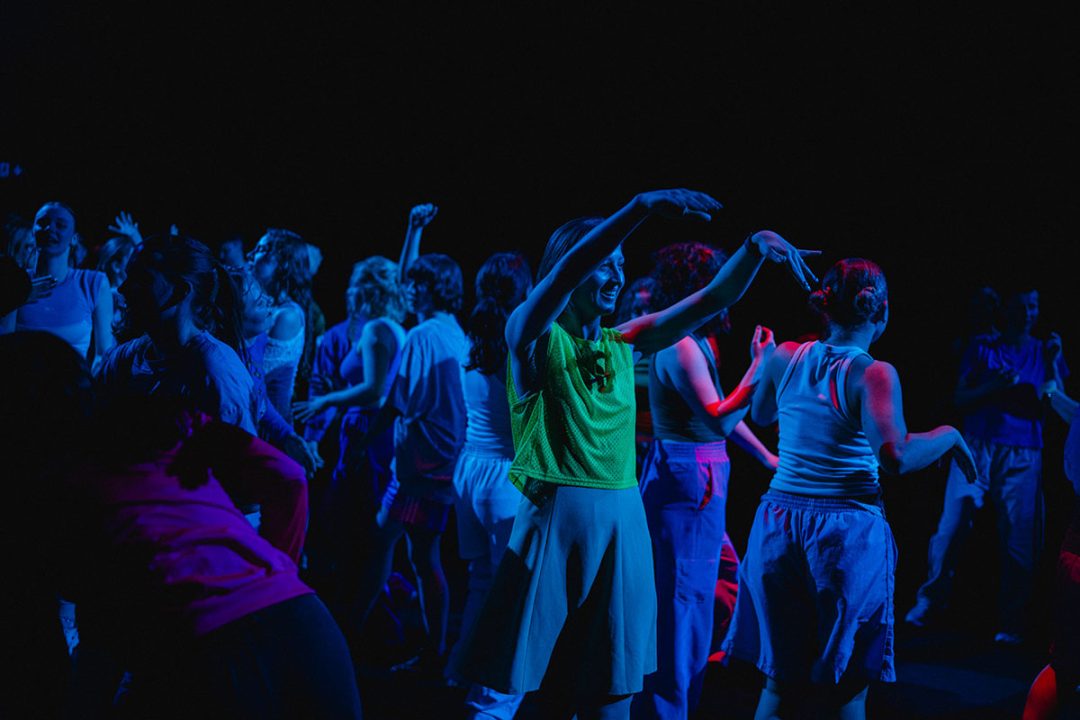
The ensuing party is enjoyable, yet is more akin to a curated club night than a contemporary dance work. Dancers occasionally emerge from the crowd to execute quirky unison sequences – running with grabbing hands, sliding on their stomachs like playful penguins, or jumping stiffly upwards like startled sardines – but for the most part they get lost among the bopping audience. It becomes clear that, even in the pursuit of freedom, a degree of structure is necessary to stop things dissolving into a formless haze.
A stronger structure emerges in Estonian artist and performer Nele Tiidelepp’s solo Ten Ways to Dance. The premise is simple: having accidentally enrolled in a choreographic MA in Gießen, Germany, a few years ago, visual art-trained Tiidelepp has set out to understand what dance and choreography actually are. To do so, she has invited ten people – everyone from a German architect ex-boyfriend to Czech choreographer Tereza Ondrová – to create sections of the work, which she replicates sequentially in an informal, studio setting. Skippy, postmodern dance-inspired phrases are followed by nonchalant side-stepping to club tracks, as well as comic outbursts that see Tiidelepp mime fart noises with her armpits, fling an audience member’s shoes across the floor, and vibrate her chest until fake blood spurts from her nose.
There can be a frostiness from some quarters when visual artists attempt to segue into dance, yet the calculated sincerity with which Tiidelepp performs endears her to her audience of dance-world professionals. Surely her navigation of the absurd extremes of what can be categorised as choreography is reminiscent of their own initial (and ongoing?) attempts to grasp the vastness of the field.
At the end, Tiidelepp candidly reveals that one of her main ambitions when she started her dance-focused MA was to learn how to do the popular dance move ‘the worm,’ before attempting to ripple her body against the floor from where she is standing to the edge of the studio. She’s surprisingly good, but tires halfway through, and it’s the audience’s clapping, cheering and shouts of encouragement that spur her on to the finish line. In a sector often defined by scarcity-induced competition, the moment offers a utopian vision of generosity and collective support. It’s a glimpse of what the dance community could, or perhaps needs to be, as it continues to face challenges.
Dystopian realities
Said challenges – funding cuts, the rise of right-wing governments, international conflicts – were ever present at this year’s Baltic Dance Platform, both in terms of the surrounding context (with attendees being invited to join a demonstration on the final day against the curtailing of free speech for Lithuania’s national broadcaster) and the works themselves.
Protest energy, for example, pulses through Lithuanian choreographer Vilma Pitrinaitė’s When you’re alone in your forest always remember you’re not alone. Solo performer Marija Ivaškevičiūtė’s punching fists, chest-puffing and rapid circular floorwork culminate in a vocal outburst of resistance: she screams the work’s title and confronts the audience. ‘What are you doing?’ she shouts accusingly, processing her cries as well as live guitar strumming through a loop pedal to build a layered soundscape of defiance against an unspecified issue.
In contrast, the issue at hand couldn’t be clearer in Agnietė Lisičkinaitė and Igor Shugaleev’s CLAP & SLAP, a meditation on the tension between their respective countries of Lithuania and Belarus. Projected text and calm yet firm voice recordings from the performers inform the audience of Shugaleev’s resistance to his nation’s complicity in Russia’s invasion of Ukraine, as well as Lisičkinaitė’s belief that, despite having ‘proven himself’ through protest and fleeing Belarus – where he would face imprisonment for his anti-government activism – Shugaleev should recognise his collective responsibility for his country’s actions.
While language provides CLAP & SLAP’s context, it’s the work’s movement that elicits emotion. Tears well as the performers repeatedly slap their exposed skin, sore red marks blooming across their backs, each strike a representation of guilt for their inability to reconcile each other’s positions. Yet the fact that they do not reach any form of resolution is where CLAP & SLAP finds its power, the performance becoming a blueprint for how dialogue and disagreement can exist without closure.
It’s a possibility that feels increasingly difficult in a culture of online cancellation and denunciation – a dynamic that CLAP & SLAP also addresses. Lisičkinaitė and Shugaleev compel the audience to clap along as they self-flagellate, their movements turning towards the erotic as Daddy Yankee’s Gasolina fades into the soundtrack. This increasing theatricality seemingly exposes the uncomfortable reality of how contemporary media thrives on the circulation of performative shame and virtue signalling. It’s a lot to put upon people who would probably rather be at home eating their grandmother’s beetroot soup or dumplings – dishes Lisičkinaitė and Shugaleev argue over the provenance of in films shown at the beginning of the show.
Ultimately, Lisičkinaitė and Shugaleev have more in common than they initially realise. So do audiences who may have never encountered the tensions between Lithuania and Belarus. As the violences of many countries are shifting from historical episodes into daily realities, the work acts as a regionally-grounded, but universally relevant comment on how we can navigate our personal connections to the crises unfolding around us.
When speaking of crises, the environmental emergency cannot be ignored. And it was evident at Baltic Dance Platform: Estonian performance artist Netti Nüganen and her collaborators Pire Sova and KISLING’s work Ash, Horizon, Riding a House centred around the gradual melting of three suspended panels of ice, as well as several frozen objects from spectacles and a cowboy hat to bones and a baby doll’s head. While the panels are painted on – the images disappearing, colours blurring and dripping onto the stage floor almost immediately after being marked – the props are passed among the audience, icy water dripping into their hands and laps, a tangible metaphor for the gradual yet inevitable disintegration of the world around them.
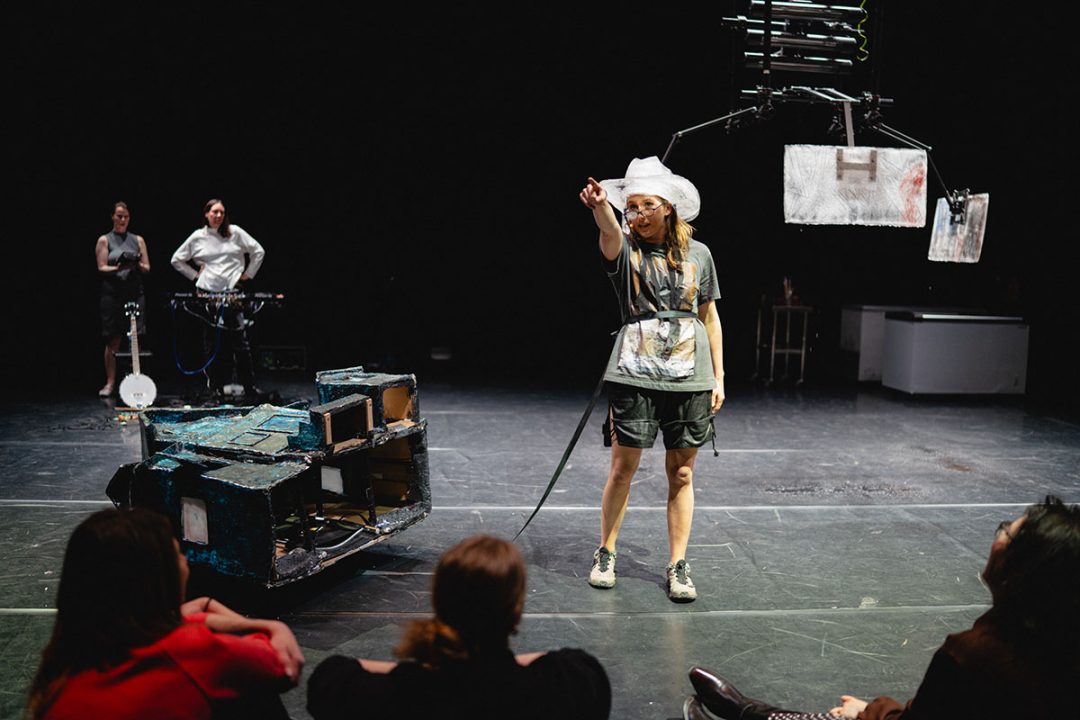
Nüganen has performed extensively with the Austrian director and choreographer Florentina Holzinger, who is known for divisive works that push performers’ bodies to physical extremes. Some of the hallmarks of her aesthetic are present here: onstage fire, nudity, curse-word-peppered text, and murky fluids into which the performers repeatedly press their intimate areas. They prompt several walkouts, yet there’s more to Nüganen’s shock tactics than first meets the eye.
In a standout scene, Nüganen, wearing the aforementioned hat and glasses, embodies the character of an estate agent, delivering an impressive imitation of an auctioneer’s rapid, near-unintelligible garble as she attempts to sell off her dripping wares. Occasionally, clear sentences cut through the torrent of speech: ‘Six years for this?’ By valuing her offerings in time rather than money, Nüganen cleverly reframes consumption not as a financial transaction, but as a question of how much of our futures we are willing to sacrifice for material desire.
Just (?) dance
Other performances at Baltic Dance Platform prioritised the exploration of movement languages and intricate composition over sociopolitical commentary. While Lukas Karvelis’ She Dreamt of Being Washed Away to the Coast claims to be inspired by Lithuanian folklore, few specificities of the love story between sea goddess Jūratė and fisherman Kastytis emerge. What stands out instead is solo performer Dominyka Markevičiūtė’s luscious undulations in and out of the floor, made all the more impressive by the fact that her arms, bound in fabric, are unavailable to aid her ascents and descents.
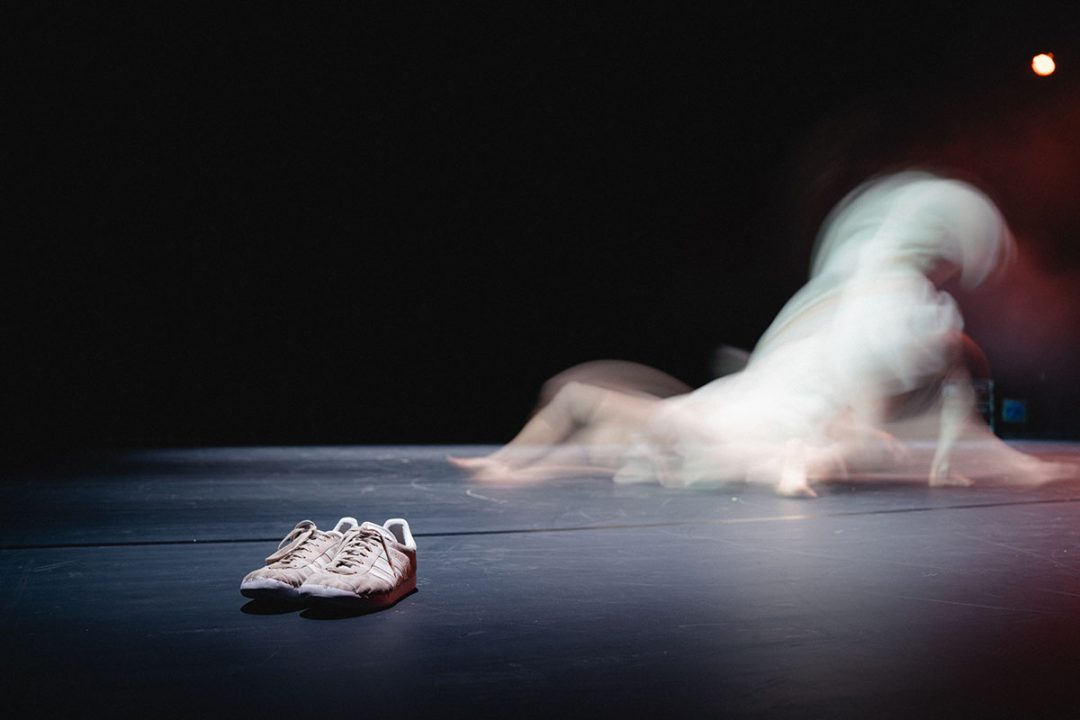
Spiralling in never-ending circles around the stage, the dancer’s limbs tumble like a bundle of drifting seaweed, extended electronic notes breaking like waves over her body. Though it lacks dynamic variation, the one noteness of She Dreamt lends it a calming, mesmeric quality – a breath of fresh air after watching several works grappling with heavy, urgent themes.
Latvia-based artistic duo IevaKrish’s Oblicus {also covered here]generates a similarly captivating movement language. While described in the programme text as a love story, it approaches the theme of romance in a decidedly abstract fashion. Following an opening in which real life couple Ieva Gaurilčikaitė-Sants and Krišjānis Sants read letters they wrote to each other on their wedding night, the bulk of the work sees the pair perform repeating minimal gestures – hands on hips, wrists flexing, heads tilting, calves lifting – that appear like mathematical, fragmented tai chi poses.
They begin cycling through these poses slowly: Each performer takes their turn to move, every action resembling a question or response, a trepidatious, considered move in the chess game of their relationship. That is until the pace accelerates – a reflection of their growing understanding of and confidence, perhaps? Orbiting one another while maintaining their own complex internal rhythms – at the beginning of the show they describe being inspired by the Lithuanian polyrhythmic tradition of sutartinės – and aided by a metronomic score, their perpetual in-and-out-of-syncness is not only visually hypnotic, but becomes a powerful metaphor for how one can maintain individuality while attuning with another person.
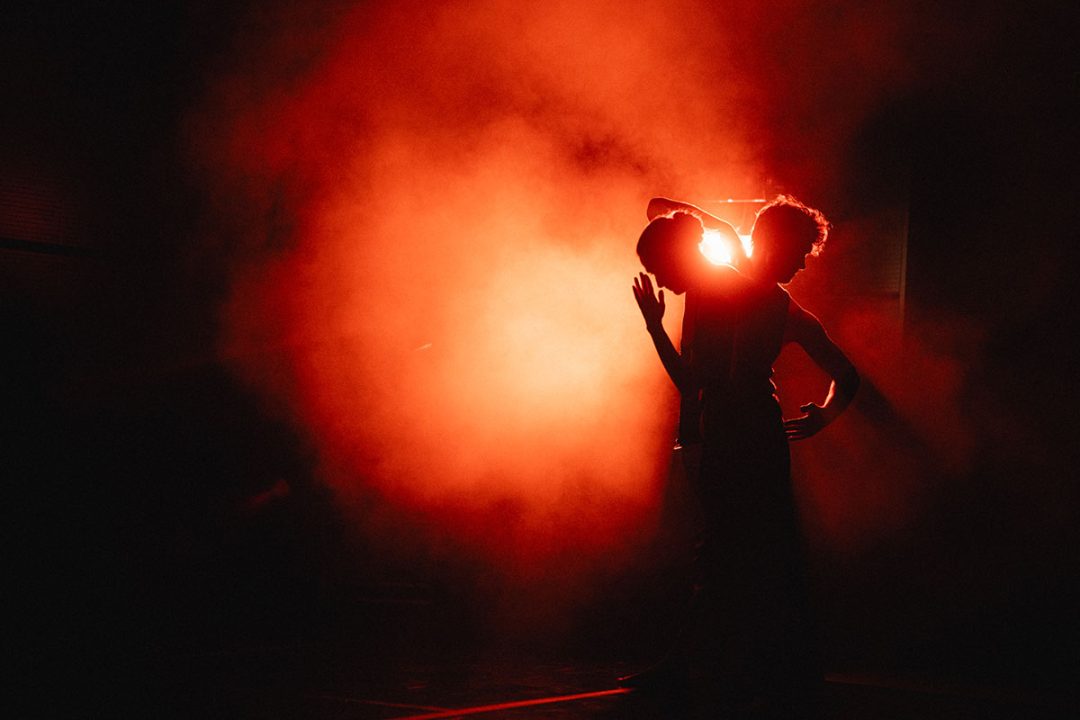
The intimacy Oblicus generates through abstraction – their cheeks coming within a hair’s width of each other before coyly recoiling – feels more powerful than more overtly theatrical depictions of romance. Even when the work moves toward erotic expressions of closeness, with the performers removing their clothes for an intertwined duet, it is staged in darkness. Orange, firefly-like lights attached to their palms barely illuminate their exposed limbs as they share a semi-private moment of affection.
Though works like Oblicus put the poetry of the body front and centre, they can be read on multiple levels, demonstrating how multitudinous meanings can emerge from movement. Sometimes, however, such ambiguity can feel disorienting. That’s the case in Latvia-based choreographer Vladimirs Goršantovs’ trio Voluntary Servitude, in which dancers battle against the elements – aka a wind machine – while wearing oversized white coats of shredded plastic in an opening scene reminiscent of East 17’s Stay Another Day music video.
Later, they strip them off. Clutching the remains like pom-poms, the cast descends into jerky, glitchy routines punctuated by feline claw gestures and conjuring images of cyborg cheerleaders or AI-generated K-pop stars. I struggle to make sense of it all – especially considering the programme note talks of the performance beginning ‘in the realm of the simplest components of the microworld’.
Conversations with friends after the performance reveal wildly different readings. But isn’t that the beauty of dance: the freedom to interpret and disagree? Considering the Baltic countries’ shared understanding of the fragility of freedom, it’s no surprise that so many works across the platform embraced openness, and the coexistence of multiple perspectives. ●
22–25.04.2026, Vilnius, Lithuania