

A web of stories and histories
I would like to begin the conversation about the STHLM DANS festival not with its performances, but with a 3-hour public discussion that took place on May 8th. Entitled ‘Moving with Time: Stories of Dance Makers’, it featured the personal trajectories of three established dance artists from different generations across the Nordic region: Sweden’s Charlotta Öfverholm, Norway’s Mia Habib, and Finland’s Samuli Emery. Facilitated by Virve Sutinen and organised by Ars Navitas, the event invited the audience to listen to stories of how these creators navigated their paths in dance, and how they perceived the landscape they found themselves in.
The questions posed were both factual and deeply intimate: place of origin, childhood dance classes, the first local teachers whose names never appear in history books, family class status, the school environment, early encounters with theatre, parental reactions to an unconventional career choice, the acquisition of connections, the navigation of dance styles – from small-town studios to the central stages of New York. It was three hours of deep listening, with minimal interruptions, an immersion into how individuals traverse this demanding career in radically different ways.
‘
Remarkably, this detailed factual inquiry and journey into individual circumstances also touched upon profoundly complex issues of cultural politics
This format stands out as an interesting alternative to the typical festival events dedicated to dance history. It shifts the focus from grand names and linear progressions not just to the personal (and not to the myth of the ’exceptional personality’) but to the complex web of social ties, infrastructures and circumstances in which artists exist and dance histories are forged. School classes, fleeting inspirations from chance encounters, lucky connections, doubts and persistence, opportunities, privileges and their lack, genre accessibility in one’s immediate environment – a love for rhythm and a childhood desire to belong. The audience included guests from Barcelona, Greece, Ukraine, Belgium, Albania, Estonia, and Norway, participants of the Visiting Artists Programme: diverse regions of Europe that evoke certain cultural associations in us, yet whose essence remains impenetrable without personal experience or narratives like these.
Remarkably, this detailed factual inquiry and journey into individual circumstances also touched upon profoundly complex issues of cultural politics: the visibility of different communities, cancel culture, and the possibility (or impossibility) of engaging with aggressive regimes, especially when one finds oneself within complicated geopolitical constellations.
At the same time, this catalogue of subjective dance histories destabilises our habitual ways of navigating the ‘general context’. What does it consist of, and what do we expect from a contemporary dance festival today? In a landscape where grand narratives seem to have lost their authority, perhaps we might instead find common ground in the plurality of our journeys – in the personal, messy, and contingent stories that individual artists bring to the stage. The dance we see is not a final statement, but a trace of these journeys, a negotiation between the self and the pressure of representation. Which formats and genres? Types of movement and narratives? They seem to be becoming increasingly fragmented, or perhaps more composite.
This composite nature is characteristic of STHLM DANS as a whole: it features very different types of contemporary dance, carrying within them different approaches to movement, its conceptualisation, framing, and ways of generating meaning. Perhaps it is this genre diversity, rather than than thematic curation, that deserves special attention – for in many festivals the themes are typical, endlessly repeated, at once reflecting a crisis of comprehending reality through the lens of contemporary dance and, conversely, a need to insist on the same narratives.
Performances tracing journeys
The popular contemporary dance festival theme of gender and queer identity was presented by two of the most striking works in the main program: Haunted Desires by Swedish choreographer Björn Säfsten and TESTO by British drag and performance artist Wet Mess.
Haunted Desires features a male trio in acid-pink string briefs, balancing between stereotypes of gayness and a decidedly non-stereotypical essence, which – surprisingly – feels fresh (no easy feat!). Stylistically, the work begins with grotesque, reserved, and strictly limited movement, which self-ironically frames queerness as both a costume and a constraint – within which, however, genuine sensuality and self-expression unfold. Choreographically based on internet content that dictates to gay men how and what they should desire from themselves and each other, the piece, while often humorous, is suffused with a striking sadness about the attempts and failures of communication, the longing to be what others desire, and the impossibility of matching the imposed ideal – even when one outwardly and behaviourally matches it perfectly.
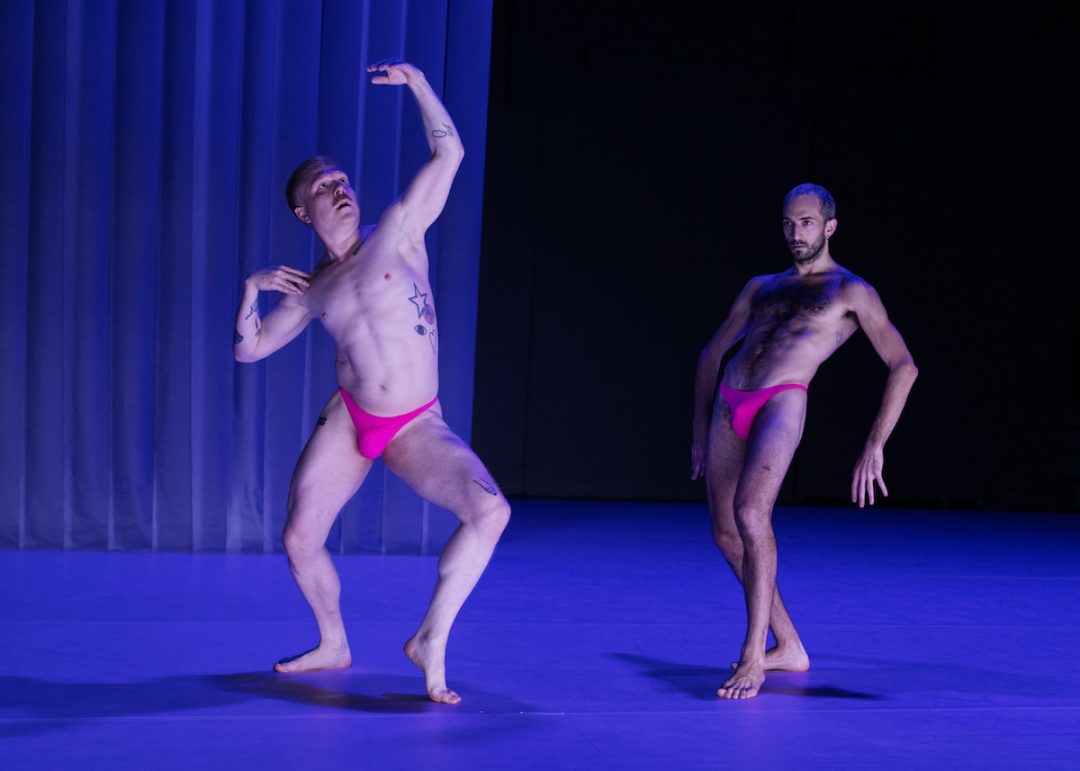
One of the work’s most compelling qualities is its fusion of deep semiotic research with penetrating emotionality. On one hand, it is a kind of readymade choreography, assembled from images of gay men from social media, complete with the irony and defamiliarisation inherent in such an approach. This is reflected in the movement quality: disjointed, robotic, yet fluid (like our contemporary existence). On the other hand, through this calculated representation, a sense of perplexity seeps through – the perplexity of coinciding with the desired image. Periodically, these images seem to dismantle, and in their place emerges a confused self, a person finding themselves but losing their place within the system of representation. The use of voice is particularly telling. In one scene, the dancers communicate through lip-sync, embodying characters from a cheap gay melodrama or erotic film; in another, a performer seems to ’speak for himself’, but it sounds like a reproduction of a broken stream of consciousness – akin to scrolling through a social media feed.
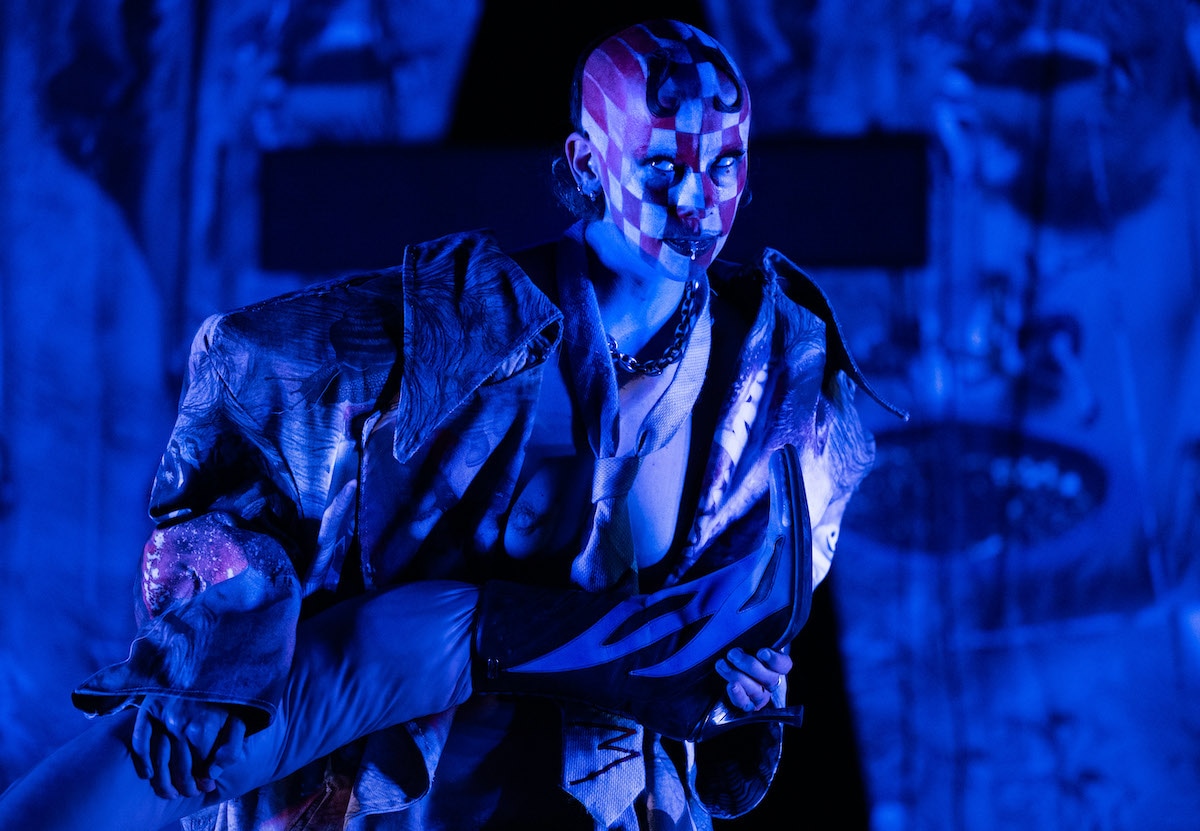
Let lip-sync serve as a bridge to the other queer work of the festival: TESTO (from the word testosterone) by Wet Mess. Made in an entertaining, theatrical vein, it is equally infused with the sincerity of a personal queer journey. Ostensibly a solo about tracing the journey of one’s identity, it operates at the intersection of the personal, the theatrical, and the documentary. It actively employs lip-sync – the performer ’moves through’ the speech of others reflecting on their queerness, sexuality, and trans transition – one of the key performance genres of the drag scene. Beneath the mantle of a gender-fluid persona, we discover a male torso with muscles; later, mammary glands appear underneath. The work is constructed less as a dance performance and more as a corporeal monologue, leaving room for the performer’s own fluid identity, the voices of others, and prosthetics – costumes, shoes, giant sausage-like props.
What makes TESTO genuinely moving is not only its formal experimentation, but the tension between the grotesque and the deeply personal. Wet Mess navigates the space between revelation and performance with remarkable vulnerability. The work suggests that identity is a continuous, messy, and often playful process of construction and deconstruction. Yet beneath the layers of irony, and theatrical excess, there is a quiet, persistent act of resistance. The performer refuses to offer a coherent, digestible narrative of queer becoming. Instead, through the deliberate fragmentation of voice, body, and persona, TESTO insists on the right to exist in the contradictory, and the unfinished.
Courtney May Robertson, a British performer based in Rotterdam, presented HUNTER, a work that explores bodily autonomy through the lens of horror and BDSM aesthetics. The performance features Robertson alongside a life-sized doll, her near-identical double, as they enact scenes of torment, ecstasy, and grotesque transformation. The staging is gothic and cinematic, evoking the visual language of horror cinema, while the industrial soundscape amplifies the sense of danger and transgression.
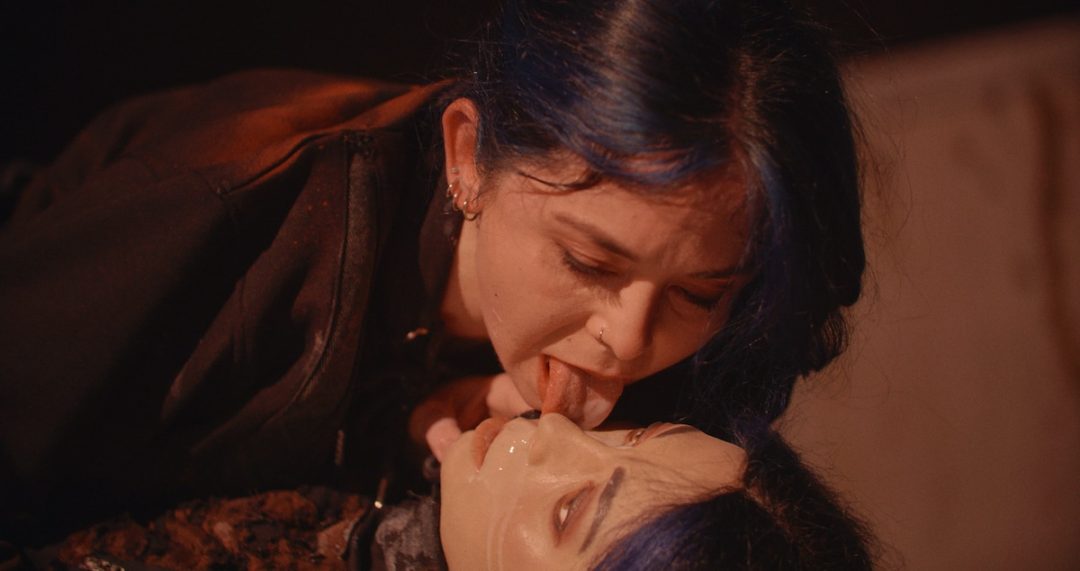
Robertson is a captivating performer, commanding the space with a powerful presence and impressive physicality. The work explicitly engages with the dissolution of shame, proposing that what repels us can also fascinate and empower. However, dramaturgically, the piece remains somewhat obscure. The transition from obsessive love-hate interaction with the doll to a state of liberation is difficult to follow and its internal logic is elusive. While visually stunning and intense, HUNTER ultimately resists emotional engagement, leaving the spectator impressed by its aesthetic force but uncertain of its emotional or political stakes.
A different kind of encounter was offered by Freddy Houndekindo’s Becoming Tree, which, alongside Lilian Steiner’s lecture-performance Dance Becomes Her, belonged to the festival’s ‘dance in the museum’ section. While Steiner’s performance placed the audience in a circular configuration, Houndekindo’s work unfolded as a shared journey through the exhibition When We See Us: A Century of Black Figuration in Painting at Liljevalchs art gallery.
In Becoming Tree the audience follows Houndekindo through different parts of the exhibition, stopping in various spots and looking at the paintings through his movement, speech and little rituals. The exhibition itself is impressive, boasting a remarkable diversity of genres and regions. Houndekindo’s performance, however, lends it an intimacy and a personal perspective, revitalising grand narratives through his family stories, memories, brief commentaries and bodily expression.
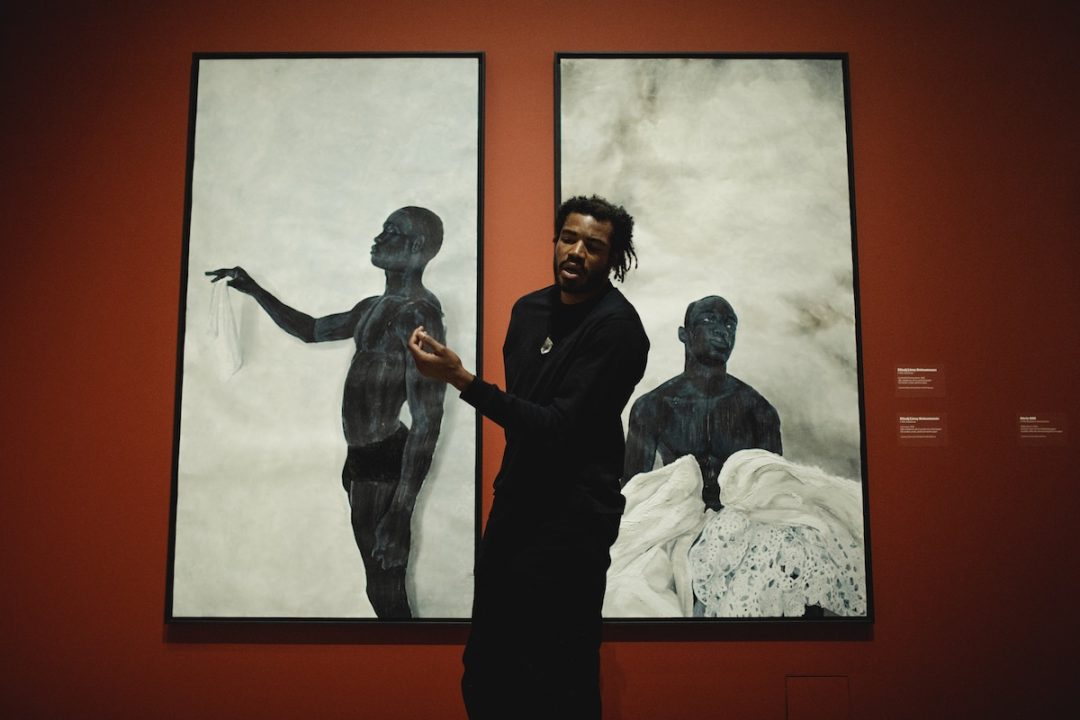
There is something touchingly cosy about this piece: the vast museum space transforms into a living room, with the audience invited into an intimate conversation. It was particularly noteworthy how the presence of children was welcomed; Houndekindo incorporated their playful interruptions into his narrative and movement with remarkable ease, allowing them to scurry around him and even sit on his lap, blurring the boundaries between performance and communal gathering. In this gesture, the work achieved something rare: a genuine sense of shared space and shared time, where the museum ceased to be a temple of art and became a site of collective imagination.
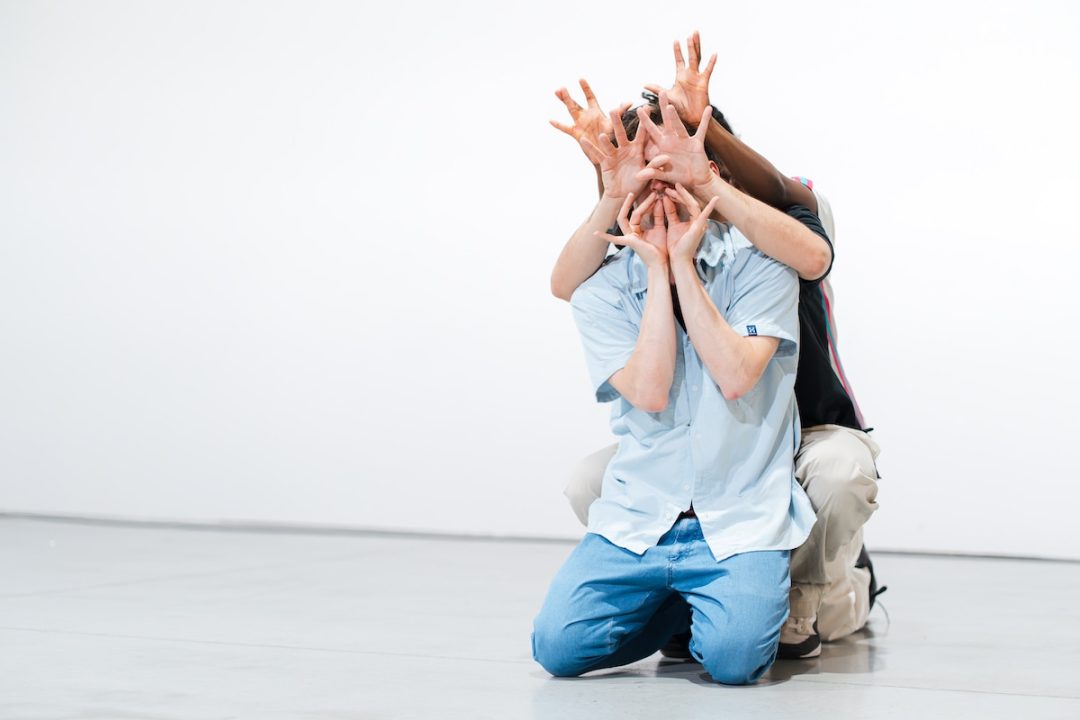
The festival opened with Manifestus by Jacopo Jenna, inviting audiences to an unusual venue for dance: the Italian Cultural Institute in Stockholm – a space with stunning architecture and 1950s designer furniture by architect Gio Ponti. Ostensibly an abstract work for three dancers, it merged various street dance styles with minimalist contemporary dance, built around movement of the hands and choreographed largely from gestures.
Unlike the semantically dense Haunted Desires, Manifestus does not engage with gesture as a cultural symbol or a specific language of communication. For the most part, the choreography comprises abstract movement patterns with a distinct emphasis on the hands. The performers, however, navigate a charming blend of different dance languages: from the precision, coolness, and restraint of minimalist abstraction to a freer, more personal mode of expression where the dancers’ native street dance styles come to the fore. The piece serves as a fitting opening act, not by declaring a grand manifesto, but by demonstrating the sheer plasticity of dance itself when stripped of overt narrative, allowing the body – and the hands in particular – to speak in its own idiom within a space of architectural grandeur.
Fragments and connections
As usual, the festival unfolded across various venues throughout Stockholm, inviting its core audience to rediscover the city and experience dance in different contexts, while also reaching out to residents in more peripheral districts. This year, the festival also hosted two other significant events: the mini-festival Baltic Takeover (see Springback review here) and the Visiting Artist Program, further extending its geographic and professional reach.
‘
The festival’s true core lies not in any single performance, but in the dialogue these disparate works create with each other and with the context of the city itself
What emerges from STHLM DANS 2026 is a portrait of contemporary dance at a crossroads. It refuses to offer a unified thematic vision or a singular aesthetic. Instead, it presents a fractured mirror: here, queer desire is deconstructed through ready-made choreography and theatrical monologue; there, horror is used to explore bodily autonomy; elsewhere, dance becomes a tool for intimate storytelling within a museum. The festival’s true core, I believe, lies not in any single performance, but in the dialogue these disparate works create with each other and with the context of the city itself.
If we can no longer agree on a shared ‘general context’, STHLM DANS 2026 suggests that we might instead find common ground in the plurality of our journeys – in the personal, messy and contingent stories that individual artists bring to the stage. Whether this fragmentation is a symptom of a crisis or a condition of survival remains an open question. In any case, this festival is about forging connections – between people, genres, between the past and the future, and between the stage and the streets of Stockholm. ●
5–13.05.2026, Stockholm, Sweden