

Festivals sometimes resemble airports – people are constantly rushing, searching for gates, after a few days they no longer remember which country they are in. The Moving Balkans Contemporary Dance Platform in Novi Sad (Serbia) feels quite the opposite [1]. Even before arriving, practical matters that suddenly become important outside the European Union – currency, routes, internet access – are easy to navigate, while the organisers’ willingness to help is evident from the outset [2]. Although only in its second edition, Moving Balkans possesses the confidence of a long-established festival. Performances and meetings are spread across Novi Sad, yet the SKCNS Fabrika complex becomes its beating heart, a harbour to which we constantly return. The whole experience feels like an endless Balkan gathering, where art genuinely builds bridges between people [3].
It quickly becomes clear that performances are not the only thing that matters here. The programme breathes calmly, leaving room for coffee with artists, presentations, VR experiences and unexpected encounters [4]. Listening to discussions on collaboration and moving from one venue to another, one gradually senses that the people gathered here are speaking not about competition, but about a shared home [5]. Perhaps that’s why the ten showcase performances begin to merge into a larger narrative about people exhausted by entertainment, noise and excess, yet still searching for ways to endure [6]. Only in retrospect does Chara Kotsali’s IT’S THE END OF THE AMUSEMENT PHASE emerge as the festival’s unexpected leitmotif [7].
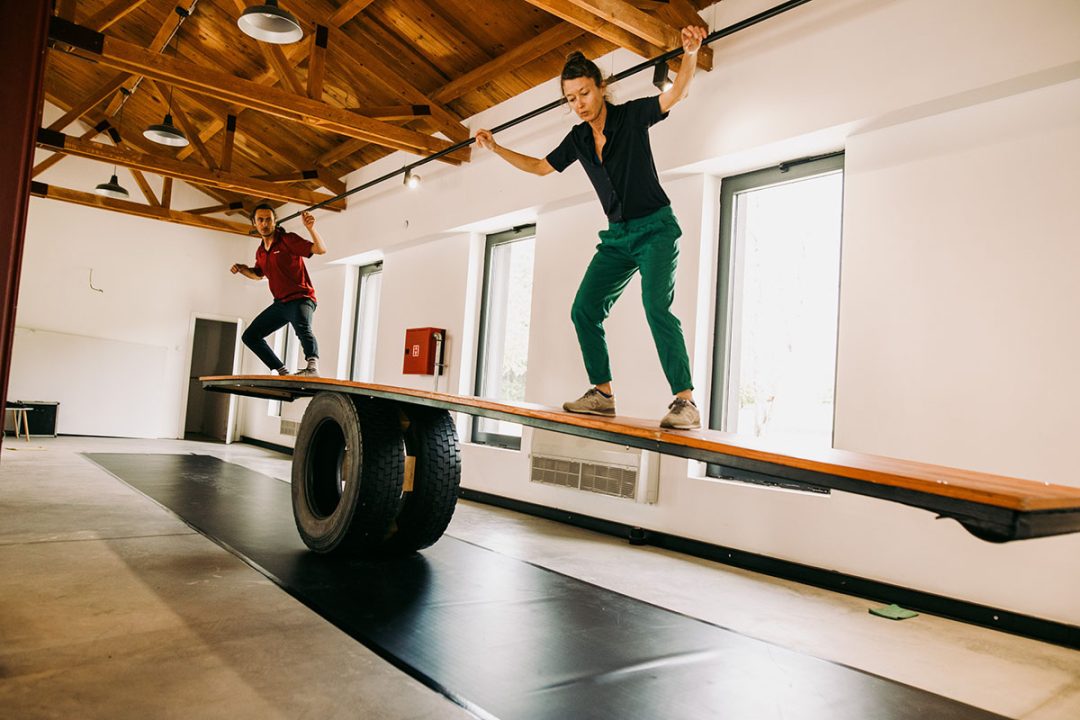
Vlad Benescu & Alexandra Mihaela Dancs (RO), Somatic Freaks – The Proprioceptors Revolution, serve as a kind of prologue to the festival. At first glance, the three-hour work appears almost ascetic: two large tyres, a wooden board and two bodies suspended in perpetual oscillation. Yet this simple arrangement soon begins to resemble life itself. They fall, climb back up, search for balance and begin again. Silent agreements exist between them, requiring no words. At one point, I catch myself tilting my phone with their bodies, as though I might somehow help them stay upright. Despite its simplicity, the work never loses its grip on the audience. In its quiet persistence, it becomes a metaphor for people who, exhausted by distraction and spectacle, simply learn how to stand again.
Kosta Karakashyan (BG), INSERT COIN / PLAYER ONE, takes a radically different path. Four musketeers (Aleksandar Gochev, Bilyana Tsolova, Emiliya Toncheva, Nelly Georgieva) operate like algorithms pretending to be human, their purpose to make themselves indispensable. The coins handed to the audience before the performance evoke the economy of social media, where attention has become currency. Once the game begins, the more one interacts with them, the more human they appear. They ask for names, secrets and offer comfort. Between these encounters, strange knockout battles erupt like scenes from a video game. While visually effective at first, these sequences gradually become predictable, making the intimate encounters with the audience as the work’s strongest element. As phrases such as ‘produce’ and ‘generate views’ echo through the space, it becomes painfully clear that even loneliness has become monetised. Perhaps the amusement phase truly ends when an algorithm becomes one’s closest companion.
Ginevra Panzetti and Enrico Ticconi (HR), in ALL’ARME, create a world in which a state of readiness never ends. Their choreographic language feels fully formed and immediately recognisable. Six women (Martina Tomić, Ida Jolić, Viktoria Bubalo, Marta Krešić, Filipa Bavčević, Nastasja Štefanić-Kralj) move like a single organism, where individuality constantly yields to the force of collective rhythm. Precise gestures, a tension-building soundscape and movements inspired by military drills gradually draw the audience into a state of perpetual mobilisation. One falls, the other lifts her up, the formation regroups and the movement continues. The work oscillates between female rage and vulnerability, while the power of synchronised movement appears both hypnotic and unsettling. The vivid red backdrop (screen), perhaps an allusion to the matador’s cape, intensifies the atmosphere of tension and suggests how fragile the boundary between defence and attack can be. The choreography remains strikingly cohesive throughout, its precision sustaining the work even when its emotional impact feels more restrained than its imagery suggests. The performance leaves us with a simple yet unsettling question: where does protection end and aggression begin?
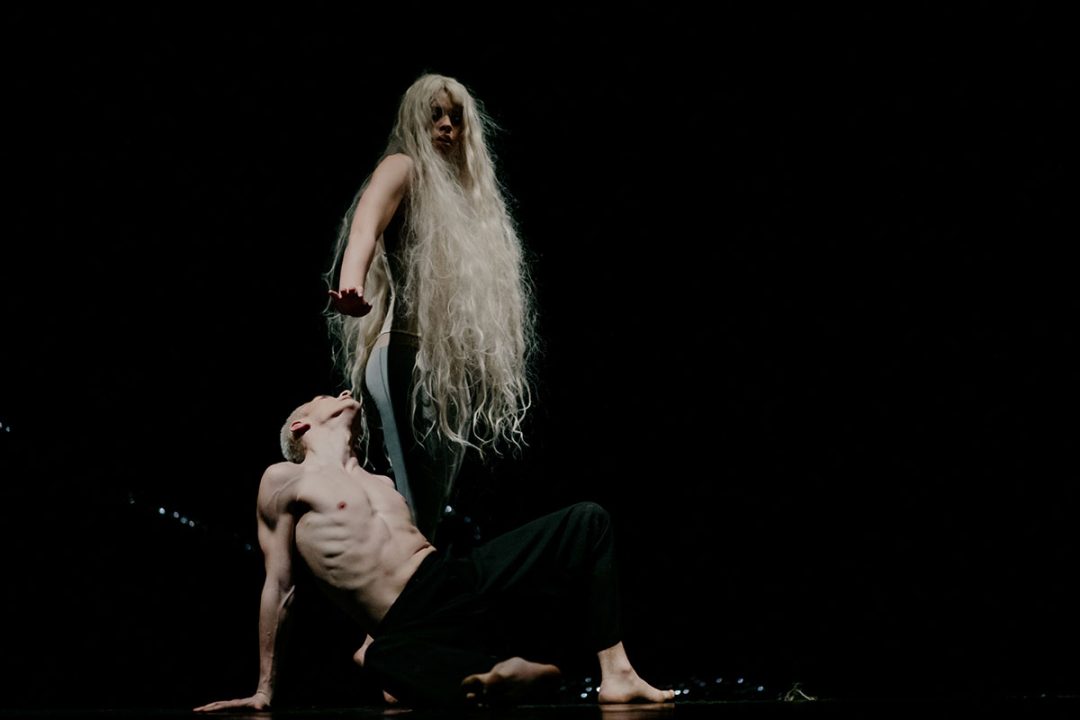
After such discipline and precision, Adrijana Danchevska Rovchanin’s (MK) Mockumentary feels like a sketch from another world. Elements of drag culture, the myth of the siren and youthful experimentation collide in a haze of industrial sounds and shimmering objects. Distorted bodies (by Nina Petrushevska, Luka Gjorgjievski) seem suspended between the human and the animal. Deliberately fragmented and seemingly unfinished, Mockumentary embraces ambiguity and leaves behind a lingering sense of unease. Its openness is intriguing, yet within such a consistently strong festival programme the work struggles to leave as lasting an impression.
One of the festival’s most subtle discoveries is Unfolded Moments by Enya Belak & Kristýna Peldová (SI). Here, the screen, the camera and the living body converse like reflections no longer certain of their source. Peldová dressed in white encounters her red-clad counterpart on the screen, while projections become a second skin. One of the most striking moments arrives when the image alters the colour of her skin and she appears to wipe away this unfamiliar identity with her own hands. The woman (Belak) seated beside the technical equipment proves to be not an assistant but another extension of the choreography itself. The dialogue between body, movement and technology feels remarkably seamless, opening new ways of seeing the relationship between them. Suspended between darkness and light, reality and reflection, Unfolded Moments quietly asks where the body ends and identity begins.
Ilias Chatzigeorgiou’s (GR) SCARED resembles a cabaret staged somewhere between Dante’s Inferno, The Addams Family and street dance culture. Balloons held in the performers’ (Kostas Phoenix, Sofia Pouchtou, Mairi Giannoula, Haris Chatziandreou, Periklis Petrakis) mouths appear like artificial lungs keeping them alive. When one bursts, bodies collapse alongside it. Childbirth becomes grotesque comedy, death a birthday party, while a disco ball spins overhead like the sun of an afterlife. Changing colours transform the stage into a haunted amusement park. Amid all this spectacle, Chatzigeorgiou demonstrates an impressive ability to weave elements of street dance into the work’s theatrical language, making movement feel inseparable from the ideas it carries. There is so much happening that the performance itself seems on the verge of exploding. Yet beneath the excess lies something darker: a celebration of life that constantly threatens to collapse under the weight of fear.
A similar sensation accompanies Last Orbit by Deyan Georgiev (BG). Four bodies (the choreographer’s and Bianca’s Braunesberger, Marina’s Haralambova, Alexander’s Gochev), cosmic sounds, elongated ties and carefully sculpted shadows create a world in which gravity seems to have lost its authority. A platform shoe on each dancer’s foot allows the performers to become taller for a fleeting moment, only to return to their ordinary height seconds later. Light conceals them and then pulls them back out of the darkness like extraterrestrials briefly visiting Earth. Yet the work often feels as though several performances inhabit the same orbit. Time and again, the music signals an ending that never arrives, while the performers drift towards one another in search of a fragile intimacy. Like a satellite unable to land, Last Orbit remains condemned to circle endlessly through space, longing for a centre that no longer exists.
Marta Rak’s (HR) Appropriations: territory unfolds like a map constantly rewriting itself. At times, its layered visual language leaves the audience uncertain where their attention should settle, though this uncertainty seems to echo the work’s broader exploration of shifting boundaries. A car, screens, projectors and a living body coexist within the same ecosystem, where territory becomes less a matter of geography than of memory and belonging. By allowing live images and memories to reshape the performance in real time, Marta in Appropriations: territory extends one of the festival’s recurring concerns: the uncertainty surrounding where our territory ends and where the world begins.
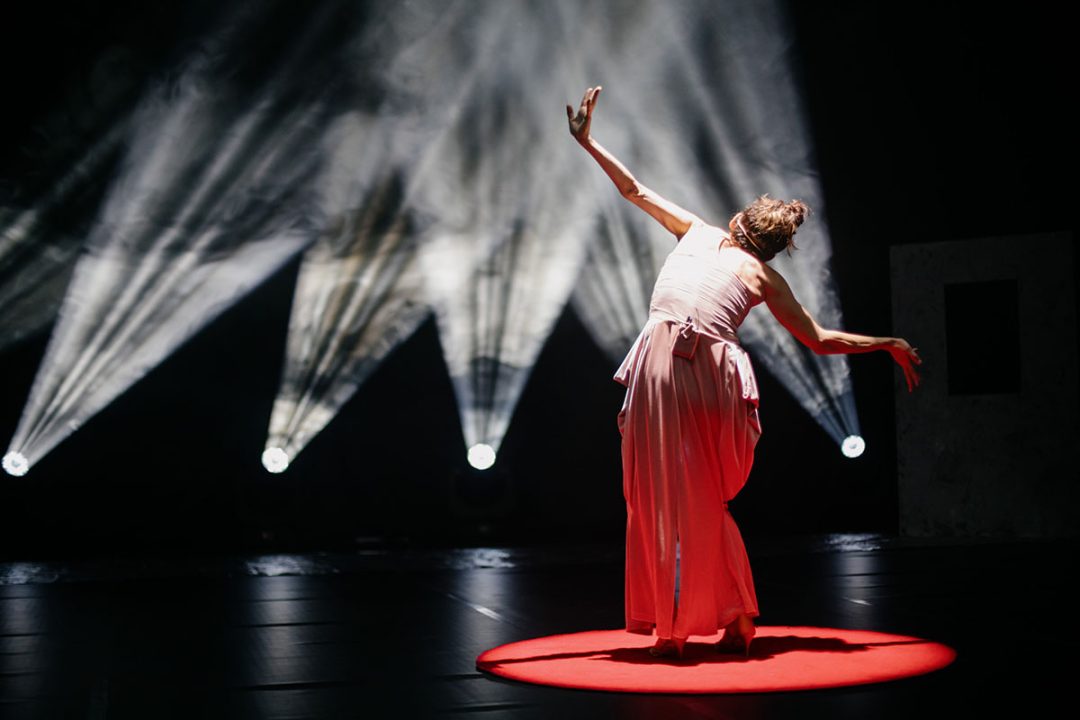
Created and performed by Ermira Goro (GR), TELOS unfolds like a long farewell letter. At first, the audience gathers around a bench as though it were a sculpture, while Goro, in almost suspended time, wraps herself around it, lies on it and crawls beneath it, as if carefully navigating her own memories. Later, the action shifts to another space, where the audience settles in more comfortably and encounters a scenography overflowing with objects, sounds and images. From water, microphones, foil and disembodied voices, an entire world gradually emerges. The richness of Goro’s movement becomes quietly hypnotic, while the sensitive interplay between choreography (created by Maria Hassabi, Hannes Langolf, Ioanna Paraskevopoulou and Ermira Goro herself), scenography, sound and light makes TELOS remarkably compelling and immersive. ‘I wanna be loved’, ‘Well, I am not me any more’ and other fragments sound like the confessions of an ageing diva reluctant to leave the stage. Beneath all its theatrical layers lies something profoundly human: the desire to be loved and the fear of becoming invisible.
Finally comes Chara Kotsali’s (GR) IT’S THE END OF THE AMUSEMENT PHASE [also covered in Springback Academy]. Perhaps it is no coincidence that its title ultimately becomes the leitmotif of the entire festival. Kotsali, together with performance and material co-creators Sofia Pouchtou and Christina Skoutela, stages nothing less than the collapse of entertainment itself. Elvis Presley, the Spice Girls, confetti, pom-poms, a pistol, a piñata, flags, screens, countless objects, memories and relentless running evoke someone desperately afraid of silence. There is an exhausting abundance to everything, a dance marathon caught somewhere between continuity and collapse. For all its chaos, the performance never loses its direction. Amid this whirlwind, a voice asks, ‘Does the future make you horny? Is it killing your sleep? So go on, fuck it hard and let’s move to the beat.’ The line lands somewhere between provocation and despair, capturing a generation unable to stop dancing even as it grows weary of its own rhythms. Yet when it ends, what lingers is not exhaustion but an altered sense of stillness. Perhaps the amusement phase really has come to an end.
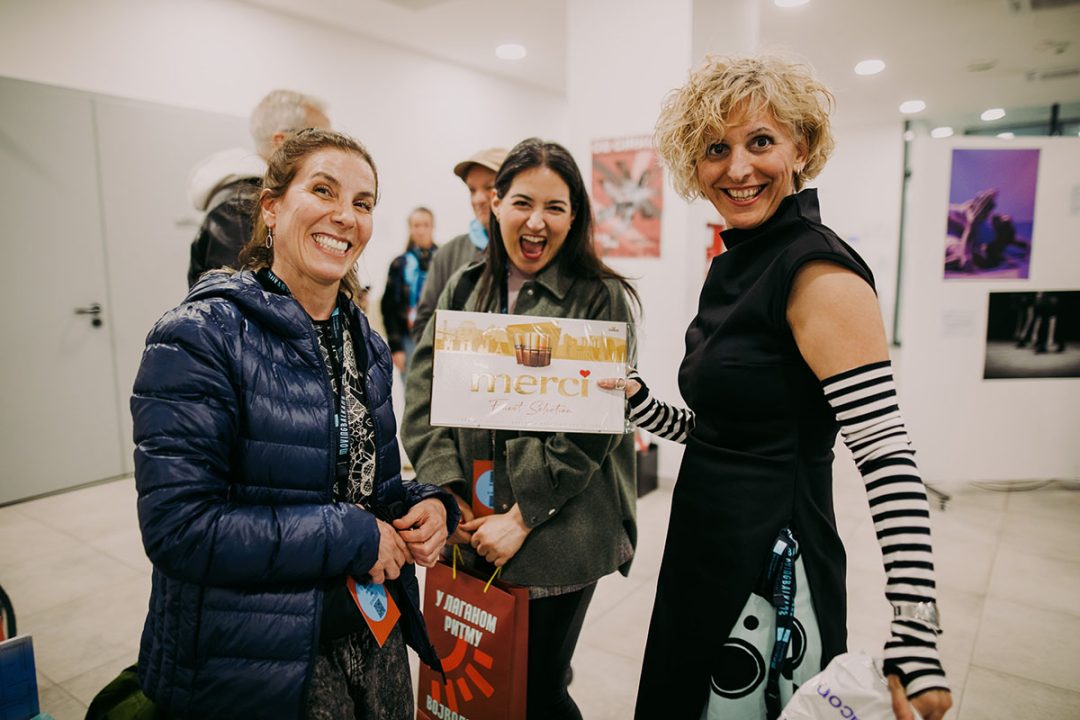
After four days in Novi Sad, one feeling remains: Moving Balkans is more than a festival [8]. It feels like one long Balkan table where each song gives way to another, and stepping outside only makes one realise it’s still too early to go home [9]. The ten performances speak different languages, yet they’re united by recurring themes of exhaustion, fear, endings and survival [10]. Some balance precariously on wooden boards, others lose themselves in screens, while others construct cabarets for the end of the world. Yet all return to the same subject: the body that, against all odds, continues to move [11]. Leaving Novi Sad, I find myself thinking less about what I have already seen and more about what remains unseen. Somewhere in that thought lies the certainty that I will gladly return to the same Balkan table in Skopje in 2028 [12]. ●
This text was also published in Lithuanian for Nemunas magazine.
For a documentary on the platform, take a look at our On Record album from Moving Balkans 2026, with audio by Dany Mitzman and text by Daria Ancuța
13–16.05.2026, Novi Sad, Serbia