

It could be the vodka shot talking, but now that the sun has set I am struggling to orient myself back towards the hotel amidst the looming skyscrapers, their reflective surfaces producing dizzying duplicates of buildings across the skyline. We’ve passed the decadent Palace of Culture and Science several times in the last few days, but its geometric prowess doesn’t help me locate myself right now.
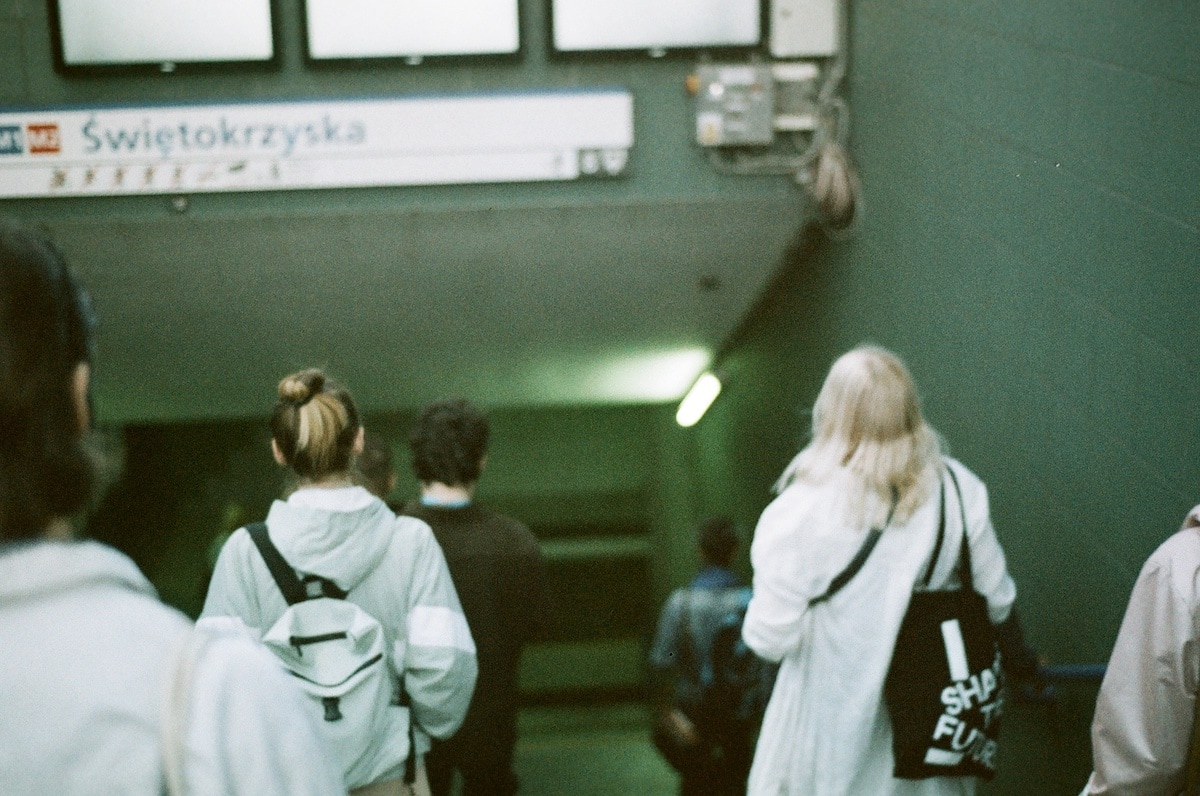
‘Three of these skyscrapers were built just this year,’ says our Springback Assembly co-ordinator Franek Dziduch as he guides me into the subway, avoiding the stretch of busy road ahead. We trot back up the stairs and pop out seemingly in the exact same spot, still coddled by glass-fronted monoliths. He continues talking endearingly about how it feels to bike home from nights out, the sunrise thrown back from each tower, none of which were there during his childhood – ‘the New York of Europe, so they’re saying.’
We take a right, and my internal sat-nav reactivates. The hotel is just ahead.
Safely on track, I consider how, during each Springback Assembly, I find myself occupied with how cultural events and performances act within the context of the location, rather than the quality of the performances themselves. What can festivals and performances reveal about the infrastructure of a city? Warsaw has emerged as one of the fastest growing cities in Europe, evidenced by the surrounding financial centre through which we amble and wind. In this period of rapid change, politically and materially, there seems an urgency to remain connected to memories, histories, and more-than-human relations before they are consumed by concrete waves. Anchors are needed to stay oriented amongst a dizzying skyline in flux.
Performance, I conclude as I skip past the construction work spilling across the footpath, can be this anchor.
During this Assembly there were three moments curated with site-specificity in mind, offering novel ways to interact with the cityscape. These moments spilled out from the theatre to think-with the city, encouraging contact with Warsaw as something beyond its expanding architectural blueprint.
The last-of-the-summer sun reaches its apex, battling with rainclouds as I climb the street away from the Poniatowski Bridge, under which HEAVY WEIGHT HOLDING BODY, a site-specific performance from Karol Tymiński has lapsed.
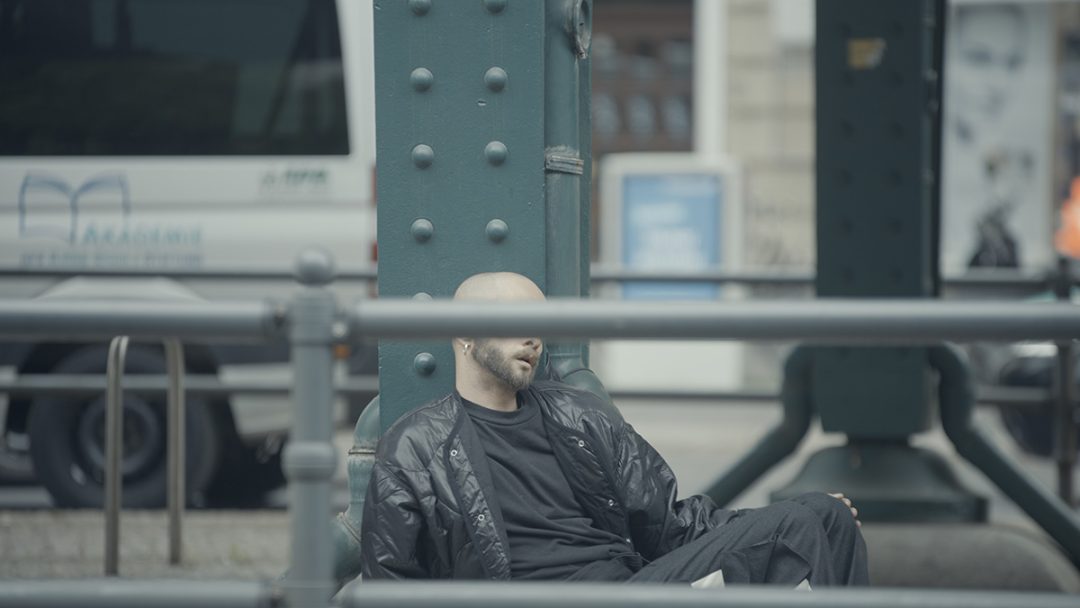
Beneath the archways, Tymiński’s stunning tableau reminded me that a city is never static. It is pulsating with eroticism; tangible and intimate memories can erupt into the open when tickled out. Physically, he needn’t do much. Rather, his evocative memoirs of sex in, on, and with the city were passed onto the audience via headphones through visceral storytelling. I let his words wash over me, granted the opportunity to observe Warsaw in its mass concrete glory, and let the surrounding architecture do the talking.
There’s pleasure in imagining the body interacting with architecture in unthinkably titillating ways: a city morphing into body and then back again; as alive, drooling, desiring. After all, the city should be made for the body, not the other way around, I think, jostling between the shoulders of two of my writing companions, whispering our own stories of cityscape liaisons into the bricks of the passing streets.
Slipping away to walk alone once more, I take an unexpected meandering bend until I can’t quite place myself. ‘Orient yourself towards the river,’ I recall.
I wriggle my toes, hips, head, and carve a rippling intuitive pathway. I find myself back at the patch of public grass outside the Pavilion of Dance, the site of Weronika Pelczynska’s participatory performance Vistula, named after the river splicing through the heart of Warsaw. Whilst the river acts as the scenic neighbour to waterside boulevards, beaches and fountain parks, Pelczynska asks us to consider it as a living inhabitant of the city – a life force threatened by the hydrological droughts of the preceding summer.
The action of turning towards the river is powerful in this collective choreography; a demand to remember the ancient wisdom of the water bodies that provide us with so much nature and life. It is a reminder that even as the city grows ever upwards, one mustn’t forget to look down, towards forces that flow beneath our feet.
Just as fluidly the matter underneath my feet turns from liquid to spongy grass, crossing the boundary from stone street to park. My penchant for city exploration is soon to be further satiated by the participatory happening FIGURE UNKNOWN / KNOWN NAME facilitated by the performance collective Sisterhood Practice at the Królikarnia Sculpture Park. Strapped into headphones and led out into the greenery, we are ushered into a physical relationship with the history of the sculptures by our energetic guides.
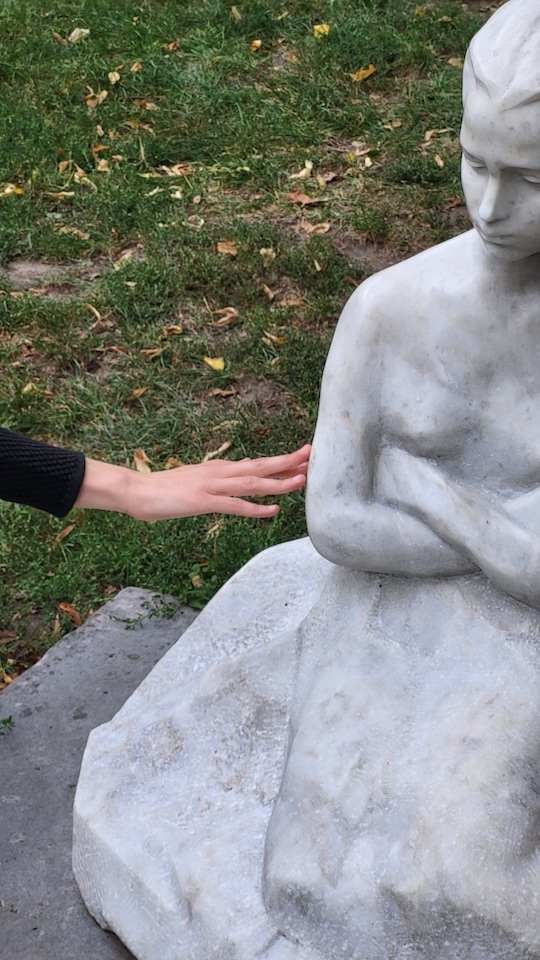
‘You cannot usually touch them,’ we are told after this session. The revelation that the public are usually discouraged from tactile interaction with sculptures comes as a surprise, especially after the preceding hour in which we all had our hands, faces, fingertips pressed onto stone. Likely, this rule does not need enforcing; it has been so normalised to think of the monuments and structures that adorn public space as untouchable. There’s something implicitly naughty about such an action. Yet if so many vital stories about the city, artists and history can be communicated through the power of touch, shouldn’t this opportunity be extended to all those that pass through the park?
I allow my feet to swing freely forward, dwelling on this strange contradiction. With each step I become more and more perturbed by the difference in rules for those who frequent the park, and us –- the visiting international audience. I falter in front of a large white wall, behind which a new performance space is in construction. Exciting, I think, as I trace the outline of the barrier. Yet still, I hope that performances continue to seep out of these four-walled spaces and into the streets, proposing more wide-reaching opportunities for the passing public to consider concrete structures as intimate partners, rivers as wise mentors, and statues as keepers of history.