

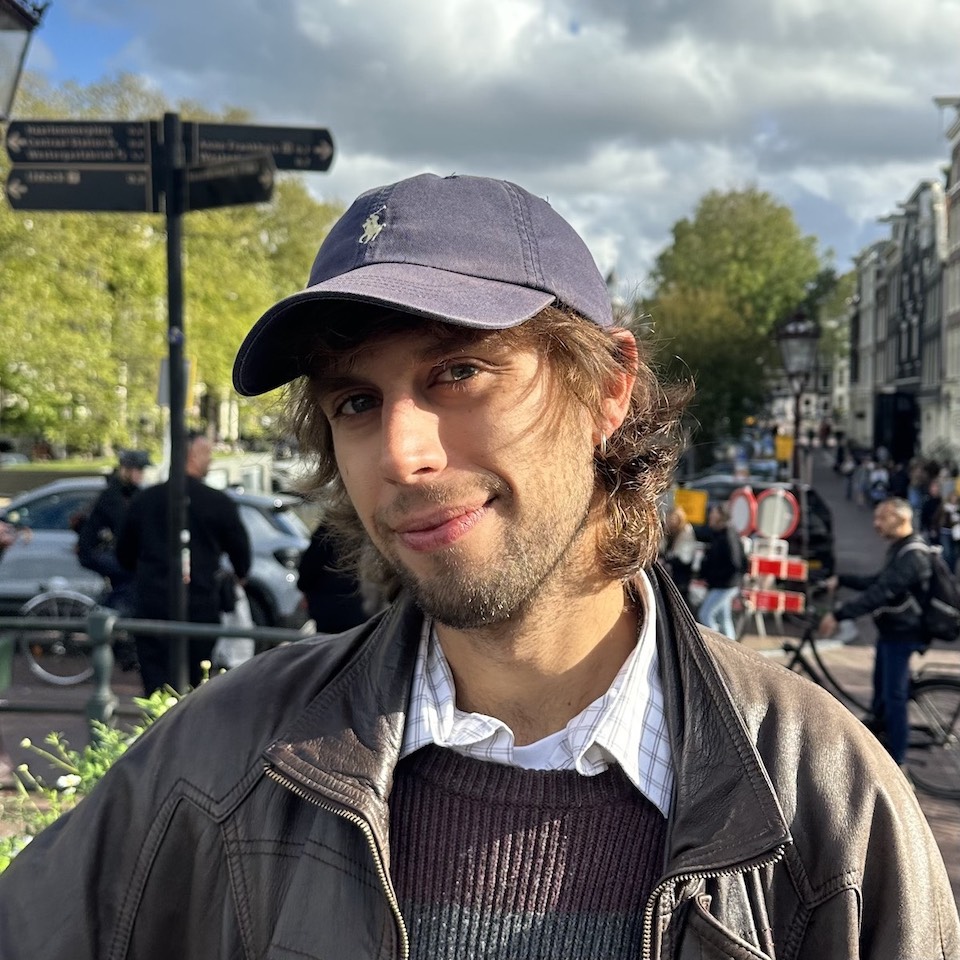
Franek Dziduch, newly relocated to his hometown of Warsaw, steered us nimbly through the cultural cutting-edge of the city during our 2026 Assembly. I asked him to guide me through his own, atypical pathway that pointed him to dance and then to join Springback Academy in 2026.
Both my parents are actors, so going to the theatre was a big part of my childhood and teenage years. I also played children’s roles in professional theatre productions at Warsaw’s Roma Musical Theatre – Gavroche in Les Misérables for example, or The Little Prince – as well as appeared in TV shows and films, and did a lot of voiceover work. Acting was an enormously fun adventure.
Academically gifted too, at the age of 16, Franek earned a scholarship to study at one of the most prestigious high schools in the US, Shady Side Academy in Pittsburgh. It was there that he experienced something of an epiphany.
It was a really formative year, for which I’m extremely thankful; I got to try so many new things, made a lot of friends, and had an opportunity to travel a lot. At the same time, I found myself completely outside my comfort zone – and that challenge made me realise a lot of things about myself. Gen Z, my generation, grew up watching American kids’ TV shows on Disney Channel. We’re the first fully online generation, completely immersed in American social media. We were constantly fed a particular aesthetic associated with the US: even silly things like going to Walmart or Target and buying Arizona drinks or Reese’s cups… As teenagers, myself and my friends’ goal, was to emulate this aesthetic.
Yet living in the US, I was also confronted with a lot of stereotypes about eastern Europe. This prompted me to question these global perspectives. My vision of the American dream began to shatter as I realised that perhaps some things actually work better in Europe than in the US, such as public transport or access to healthcare.
All this inner upheaval expanded my intellectual horizons enormously. I discovered a passion for studying and learning, and realised that I wanted, somehow, to explore academia and critical writing.
So you continued your studies back in Poland?
Yes, I did a year of philosophy at the University of Warsaw, online, as we were still in COVID lockdown. However, politically, things were getting worse and worse. The party in power was Jarosław Kaczyński’s Law and Justice party, a conservative right-wing party. They championed anti-LGBT rhetoric, and several regions began to call themselves LGBT-free zones. This was also the time when access to legal abortion had been restricted to the extreme.
Because of all that, I started considering moving abroad. I was very lucky that my family could financially support me in this decision; I enrolled in the Bachelor of Liberal Arts at Amsterdam University College. I ended up living in Amsterdam for five years, where I also completed a Research Master’s in Cultural Analysis.
But your journey into dance had already begun?
Whenever I went back to Warsaw, I always made sure to go to the theatre. At one point, my friend took me to Komuna/Warszawa, which in 2020 relocated from Otwock to the capital. It’s an independent theatre and cultural organisation, dedicated to experimental work, which we also visited during our Assembly. There, I’d seen two performances: Bang Bang Bodies by Greek choreographer Xenia Koghilaki, and Imperial by Polish choreographer Paweł Sakowicz.
I was really struck by how movement could be used to tell stories, not on a rational level but, perhaps more effectively, on an emotional one. I began to appreciate how, compared with conventional theatre, I suddenly had to pay attention to completely different things, which resonated with me in an entirely different way.
Another show that ignited my interest was one I saw in Amsterdam: The Polish Project by artist Maria Magdalena Kozłowska, about the experiences of Polish labour migrants in the Netherlands. It was a mixture of genres – dance, opera, performance – and felt like such a powerful yet poetic way to address a complex and charged subject, one that I was very concerned with at the time.
But you’ve recently relocated back to Warsaw?
Living in Amsterdam, I began to miss writing in my own language. I realised that I could combine all my interests – politics, culture, writing – through journalism. In The Netherlands, without knowing Dutch, that path wasn’t really open to me.
Plus, as a friend and fellow Springbacker put it, in western Europe, for our generation, there’s a sense that the best things happened 20 years ago, and everyone is walking on the embers of a fire that was burning before we were born. Here in Warsaw, it feels as though the flames are only just starting to blaze: things are buzzing, and there’s a lot of excitement.
In Poland, as in other post-socialist countries, we live with so many contradictions. In the west, I noticed how a lot of art that is produced just affirms shared values and beliefs; sometimes, it feels like mutual back-patting. But I think art is way more interesting if it challenges what you think and emphasises ambiguity. An unexpected, a non-consensual approach can throw new light on things, rather than simply represent or reiterate what we’re already talking about all the time.
You’re now an assistant editor at the widely read weekly Kultura Liberalna, which brings together liberal politics and culture. It sounds as though you’ve found your sweet spot.
It’s impossible to look at culture without its political context. The two are always intertwined. That said, I think I’ll always lean more towards culture, and I find that dance especially has a capacity to reflect the world’s complexity on levels that go deeper than words or intellect.
One of the best decisions I made this year was to apply to Springback Academy. It’s a network of wonderful people who geek out about something quite specific, but also expand it into all sorts of different spheres. When I joined, I felt a bit like an outsider because I come from an academic background rather than being a dance specialist. But I can feel that, just by talking, doing and watching, I’m already learning so much more about it.
Franek may have come to dance from the outside, but his curiosity, critical perspective and appetite for challenging assumptions are precisely what make his voice so valuable. He’s hoping Springback has plenty to offer him – but it’s clear that Springback has lots to learn from him too.
Follow Franek’s writing for Springback at springback.org/who/franekdziduch