

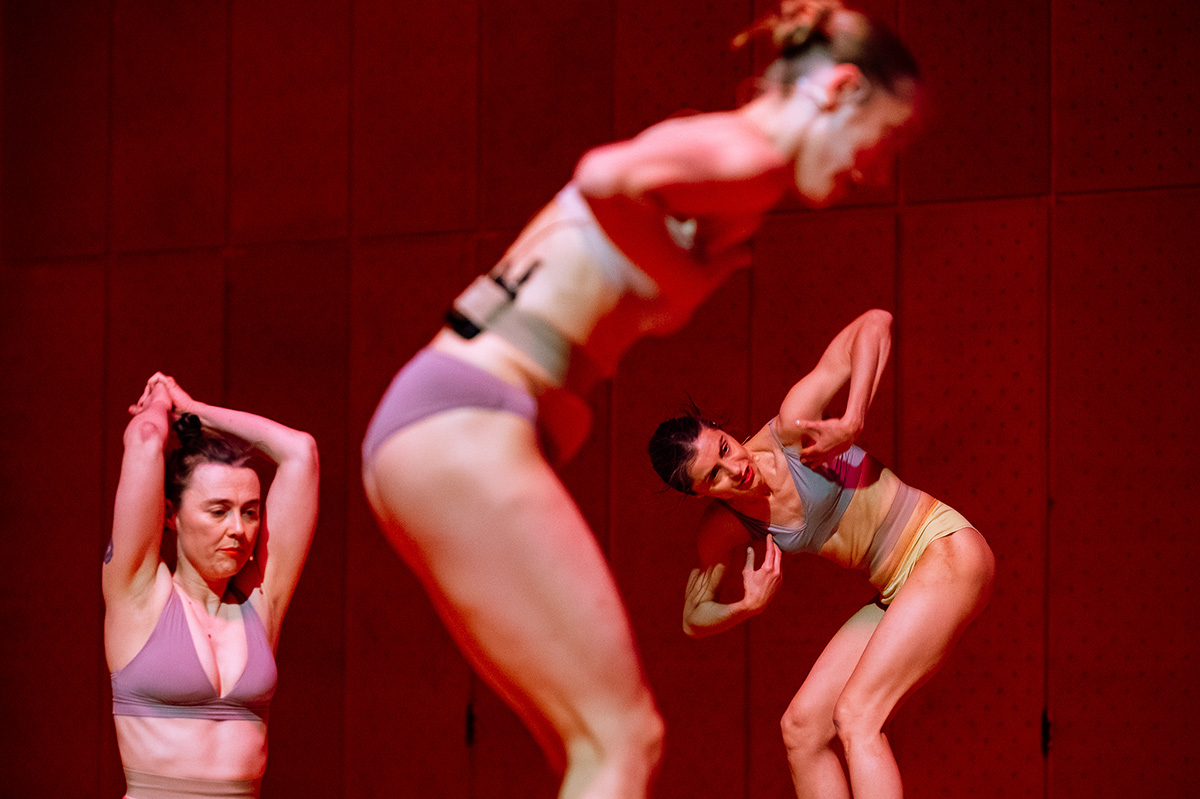
It started with three women on stage in CLEAN. A repeated gesture. Fingers digging into the flesh of their own bodies as if trying to separate something unwanted from themselves: skin, fat, perhaps the body itself. The gesture was ongoing, changing register, flowing through other associations: body dysmorphia and disordered eating, bodies of gymnastics and exercise, partying and consumption. Underpinning it all, was the seductive allure of food itself, ingrained in our visual culture. The body is helpless against it. To resist, it must be punished, corrected, trained, consumed, displayed. Yet these lonely gestures of discomfort and obsession quickly stop being private: the performers repeat the same action on each other’s bodies.
My hand on my flesh becomes my hand on yours.
What teaches a body to look at itself like this? Who imposes the rules for it to move like this, to think like this, to keep ‘attacking’ itself – and then to recognise its own faults as correctable in someone else? The hand belongs to the performer, but the command seems to come from somewhere else. Or perhaps ‘somewhere else’ is already misleading: the imperative has settled into the gesture itself.
This is where Michel Foucault’s ‘disciplined body’ almost inevitably enters the picture. Power does not need to keep striking from outside once the body has learned how to reproduce its demands. It monitors itself. Disciplines itself. And most of all, punishes itself. But CLEAN complicates even this familiar image of self-discipline, because discipline does not remain contained within the self: it passes between bodies. The performers are simultaneously the object of correction and the agent administering it. The distinction between acting and being acted upon becomes unstable: I am doing something to my own body, yet the desires, prohibitions and standards directing my hand are not entirely my own.
Already in CLEAN, then, something that I would later begin to think of as masochistic was taking shape – not necessarily pain, and certainly not pleasure in pain, but a body willingly, almost faithfully, continuing a rule that acts through it.
The following evening, this thought acquired colour. Red, more precisely. Sitting in my seat, I could not stop tearing up (yes, real tears!) while the two performers – a Lithuanian woman and a Belarusian man – repeated one ‘simple’ gesture. With one hand they slapped their own backs; the other hung loosely beside the body. Slowly, the choreography of CLAP & SLAP left its trace on the flesh. Red marks across their naked backs, each body reacting differently, voicing its unique experience of pain. I stared hypnotised as the force became visible on the skin. Then the tables turned: the performers began striking one another. Slap after slap. Again and again.
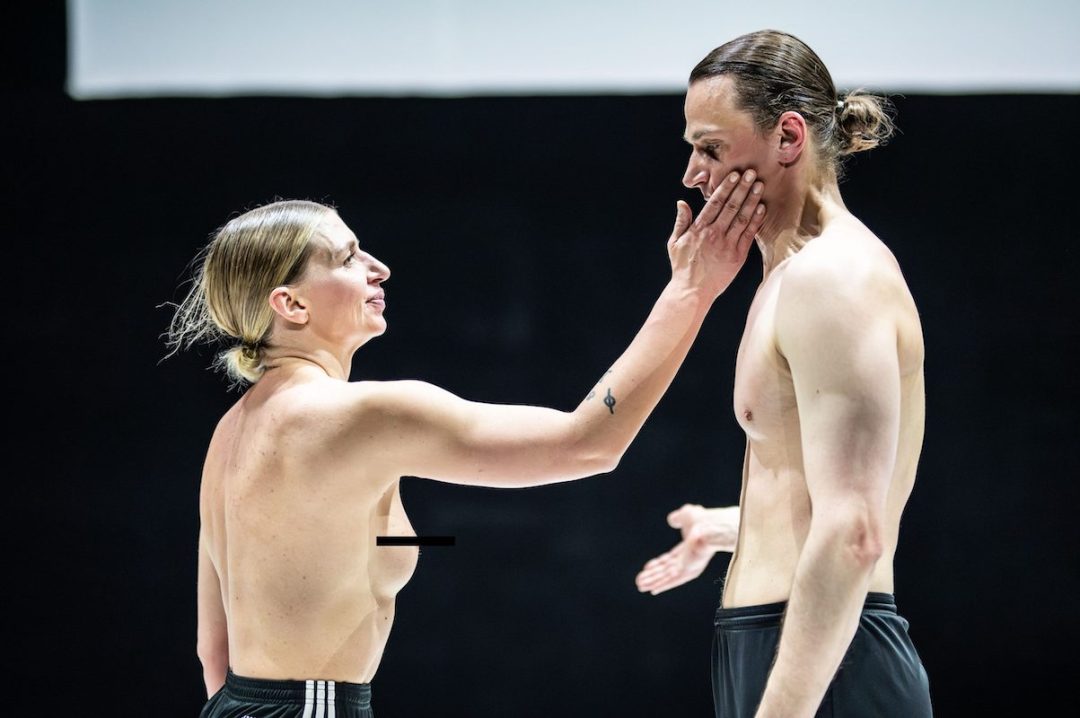
Once again, this transition felt familiar. An action transposed from my body to yours. Yet here the pain had real consequences, while at the same time carrying more than physical implications. A fine web of guilt, accumulated: the political guilt that is explicitly presented in the work and in the performers biographies is submitted to a religious vocabulary. The familiar grammar of guilt, confession, penance and self-punishment. Above all, it worked. It worked on me intellectually, emotionally and physically, all at once. I understood the gesture while simultaneously watching its meaning materialise as redness on another person’s skin. Yet this effectiveness also produced an uncomfortable question. To make the gesture of punishment work, the performers had to submit to it. Unlike CLEAN, here mimesis was no longer enough. Here, punishment became choreography.
What precisely was I recognising across these works? Surely, it was not simply pain? If CLEAN made the origin of the command difficult to locate, CLAP & SLAP made its physical consequences impossible to ignore. So, when does deliberately putting one’s own body through harm become masochistic in the context of the theatre? And, more importantly,
who is actually doing what to whom?
I still wanted to name it. ‘Masochism’ came to mind almost immediately, but it is surely not masochism per se, at least not in its conventional sense. Yet, as a dramaturgical logic it is borrowing some of its mechanisms. The wilful infliction of pain on one for the pleasure of another is only one aspect of it. Crucially, these performances organise bodies through repetition, endurance, submission, compulsion: the persistence of an action beyond the moment when its representative and performative purpose should arguably have been exhausted. Yet, it is precisely this persistence past the conventional frames of performativity that is most striking.
A third work is worth mentioning. In Agata Siniarska’s Museum of the Anthropocene, harm was less immediate than in the first two performances, yet the choreographic logic of persistence became perhaps even more central. Here, my question shifted. Not simply: does this hurt? But: to what end does the performer continue to embody this radical, almost cruel pain?
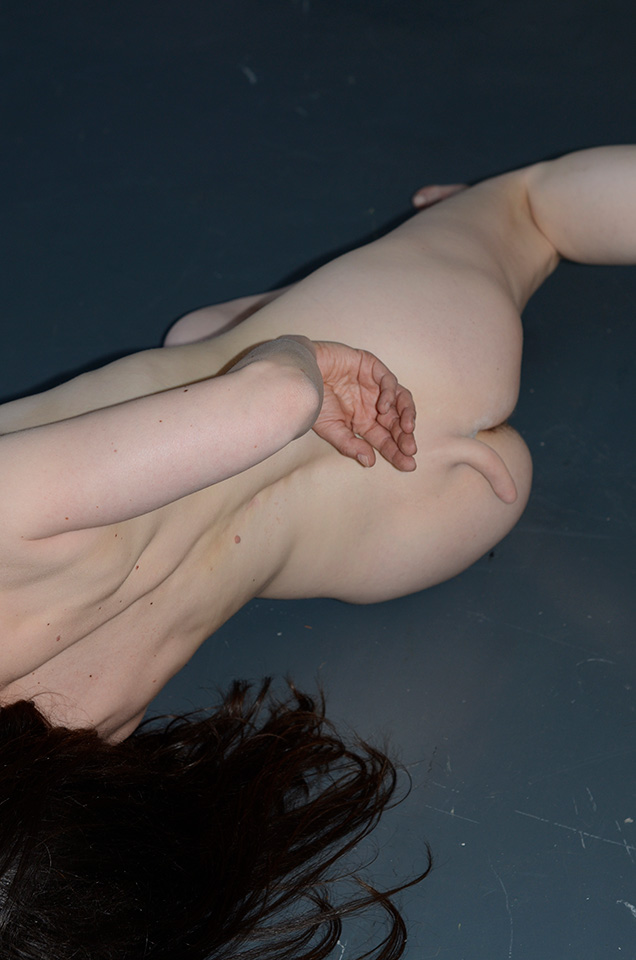
Here a naked woman performs a sort of metamorphosis, transforming into a range of different creatures and animals. Throughout the whole performance she is making screeching, guttural sounds. The screams become a form of grieving for dead and dying ecosystems. The face twists into grimaces; the vulnerable, raw body crawls, contracts, cramps. Pain and grief becomes a medium through which ecological loss is deeply felt and embodied. Yet, what is it that makes the body persist in an action that appears impossible, insufficient, or already doomed to fail? I had been asking what a performer was doing to herself. But who exactly was this ‘self’ I kept assuming to be there – choosing, submitting, enduring, continuing?
Across the three works, the more insistently I looked for an autonomous body acting upon itself, the harder that body became to locate. But ‘dissolution’ would be the wrong image. The individual does not disappear into a faceless collective here. Each performer remains irreducibly singular: this hand, this skin, this particular history and context, this particular capacity to endure. What begins to dissolve instead is the idea that this singularity was ever self-contained. Social norms inhabit the gesture in CLEAN; histories of political guilt enter the bodies of CLAP & SLAP; and in Museum of the Anthropocene, the body’s persistence channels environmental loss. The relations exceed the individual, and what looks like a private act becomes increasingly crowded.
The individual, the milieu and the collective continuously create each other. The gesture in CLEAN is not purely ‘self’-discipline. The punishment in CLAP & SLAP cannot remain individual once guilt is political, another person administers it, and an audience watches. Yet masochism complicates this possibility. If political guilt becomes my pain, my punishment, my suffering, a collective problem might just as easily be folded back into the individual body. The masochistic act may expose the fiction of autonomy without necessarily producing solidarity in its place.
I spent the festival with these thoughts circling through my head. Yet when I asked my Springback colleague Dan Mussett, a performer in Jan Martens’ relentlessly exhausting The Dog Days Are Over 2.0 if he entered a masochistic state of mind while performing it, his answer came promptly, almost impulsively: ‘No’. According to him, to perform this piece is similar to running a marathon: it requires exercise and building a pain threshold that may seem incredible for an onlooker, but is built through care and with a regard for the performers.
From the point of view of the performers then, it is not about punishment. Yet seen from the audience, Dog Days appears to a clear example of the logic I had been tracing. Seventy minutes of jumping. Constant, jumping. Repetition, endurance, exhaustion, submission to a score that asks the body to continue long after continuation begins to seem unreasonable. From the outside, it looks punitive. The choreographer himself recalls in an interview that, at one performance, an audience member shouted: ‘This is torture!’ – directing the accusation not at the dancers, but at the choreographer. The work therefore already contains this split perception: spectators may read cruelty and punishment into what they see, while the performer, inhabiting the same action, can reject the word masochism altogether.
And Dan’s experience comes from inside the action, from within the performing body itself. His refusal immediately destabilised my reading. Where, then, is masochism situated?
I saw the punishment.
And I began looking for the crime.
By Dog Days, neither category seemed sufficient any more.
What remained was the body enduring – and the question of who, or what, was acting through it.