

What does a national dance platform reveal about the artistic landscape it represents? The ninth Polish Dance Platform, held in Wrocław in September 2026, brought together nine performances offering markedly different approaches to movement, theatrical expression and the relationship between performers and audiences. From intimate encounters to elaborate stage productions, the programme offered a broad view of a contemporary dance scene unwilling to settle into a single aesthetic.
Over several days, these contrasting artistic voices created an experience that was often surprising, sometimes demanding and rarely predictable. Taken together, they offered an opportunity to consider not only the individuality of the artists, but also the wider questions emerging from their work.
When less is more
At twelve minutes, Agnieszka Brzezińska’s who cares offered something unexpectedly refreshing: economy. In a programme where several performances seemed unwilling to end, its short duration became one of its greatest strengths.
Performed by Katarzyna Leszek, the work unfolds through transformations involving clothing, identity and external expectations. The dancer struggles with garments, attempts to appear seductive and repeatedly submits to images seemingly imposed upon her. Brzezińska’s interventions, including the introduction of a horse-head costume, reinforce the tension between the dancer’s search for identity and the expectations imposed upon her by society.
Leszek’s physicality is particularly convincing. Resembling a rag doll or a puppet manipulated by invisible forces, she maintains remarkable seriousness even when the audience laughs. The absurdity never entirely undermines the psychological tension. The work’s strength lies in its refusal to overexplain. It suggests the exhausting labour of becoming acceptable to others without turning that proposition into an extended lecture.
Ramona Nagabczyńska’s I Love Ballet, by contrast, approaches its subject through excess. Four performers (Nagabczyńska, Aleksandra Borys, Karolina Kraczkowska and Iza Szostak) revisit classical ballet conventions through repetition, exaggerated gestures, vocalisations and the manipulation of pointe shoes.
The opening establishes a promising tension between technical discipline and parody. The dancers repeat ballet combinations while producing sounds resembling seagulls rather than elegant swans. Russian expressions invoke the authoritarian pedagogical traditions associated with classical ballet.
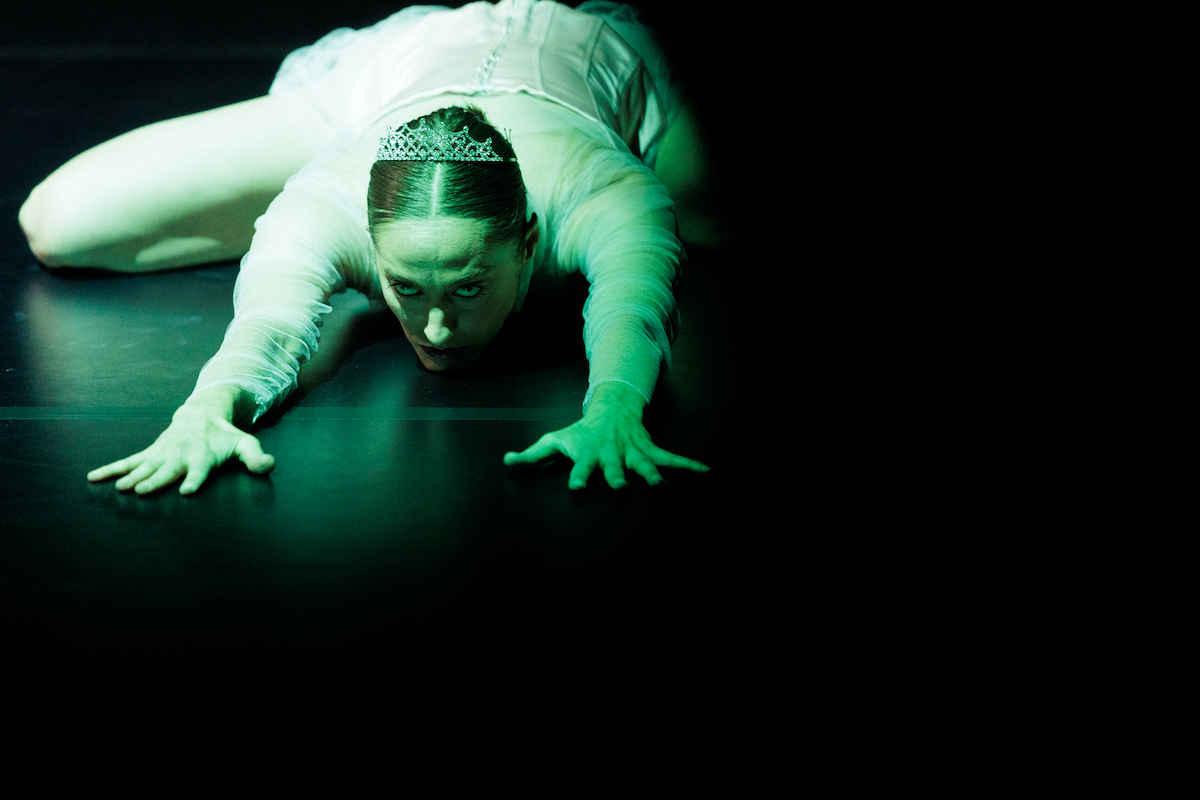
Yet the production becomes increasingly exhausting. Dense theatrical smoke, in a venue already offering limited visibility, obscures rather than enriches the choreography. The overwhelming sound and increasing use of theatrical effects gradually undermine the work’s initial idea. The performers resemble restless ghosts haunting the institution of ballet, an image reinforced by the lighting. However, the work struggles to develop beyond its theatrical insistence. When the system finally collapses amid flashing lights and relentless movement, the conclusion feels less like liberation than exhaustion.
Competition, display and theatricality
Dominik Więcek’s Glory Game examines competition through six performers moving within an environment dominated by sand, athletic references and slowed-down action.
The opening establishes a shared rhythm of running, with performers reaching the edge of the space before reversing direction, recalling swimmers touching a pool wall. Gradually, collective synchronisation gives way to individual behaviour. Glances turn into silent competitions, bodies compete for attention. Clothes concealed beneath the sand emerge as objects of desire, perhaps even a new currency. The performers celebrate their discoveries, display their acquisitions and measure themselves against one another. The choreography intelligently exposes relationships between sporting achievement, possession and social recognition.
There is considerable pleasure in observing these interactions. A fall into the sand, a sideways glance or an exaggerated gesture of triumph can communicate more than an elaborate theatrical statement. Nevertheless, persistent slow motion eventually becomes restrictive. The multiplication of sporting references and props, alongside projected messages such as ‘Book this show’, risks turning a perceptive examination of spectacle into spectacle for its own sake.
A different relationship between bodies and representation emerges in Hertz Haus’s To Bitch or Not to Bitch. Created and performed by Magdalena Kowala, Natalia Murawska, Joanna Woźna and Anna Zglenicka, the production resembles experimental theatre more than a choreographic work.
The audience encounters women performing cleaning tasks, surrounded by domestic objects. Gradually, the work develops through spoken language, projected texts, classical references and ritualised actions. A sign-language interpreter adds another expressive dimension.
One particularly striking sequence involves a woman lying on a table while the others wash her body. The image is simultaneously tender, clinical and unsettling. Under the projected title ‘Lady Mac Bath’, the gesture establishes an effective dialogue with Shakespearean associations of guilt and cleansing. Yet the quantity of text, not always readable within the time provided, raises questions about choreography’s role. Movement often seems to serve the concept rather than develop it.
The strong presence of theatrical elements across the programme raises a broader question about the relationship between theatre and contemporary dance. Nothing wrong with theatricality itself, but sometimes the movement becomes very much secondary to text, visual effects and other means of expression.
The body between exposure and expression
In Wojciech Grudziński’s Threesome/Trzy, theatrical excess becomes almost confrontational. Extremely loud music, projections, repetitive movements and bodily exposure form an aesthetic familiar from his previous works.
The recurring phrase ‘The power of three will set us free’ points towards the three legendary dancers invoked in the work: Stanisław Szymański, Wojciech Wiesiołowski and Gerard Wilk. Yet the choreographic vocabulary remains surprisingly limited. Grudziński commands attention through his physical presence, but the narrative relies more heavily on projections, text, lighting and music than on movement itself.
The prolonged exposure of the performers’ buttocks and anus raises another question. Nudity can be provocative, but its mere presence does not make it artistically radical; and when repeatedly confronted by it, the audience may encounter predictability rather than transgression. The problem is not nudity itself, but what it actually reveals. When does a radical gesture become a predictable artistic signature, and when does that signature begin to replace choreographic development?
Joanna Leśnierowska’s Rooms by the Sea: Exercises in Listening adopts a contrasting aesthetic, replacing confrontation with collective attention, slowness and physical interaction.
Five performers inhabit a space shaped by modular objects, recorded voices, audible breathing and shifting light. Individual solos develop into encounters, explorations of touch and collective movement. The work approaches listening as both a physical and a relational practice. Yet a considerable distance remains between its conceptual premise and the spectator’s experience. Prolonged sequences of slow movement and loosely defined transitions give the impression of an open-ended rehearsal rather than a fully developed performance.
The performers’ sensitivity to one another is evident. Less evident is how that sensitivity becomes meaningful for the audience. Improvisational practices can generate extraordinary complexity, but their presence onstage does not automatically produce dramaturgy.
When every gesture matters
Hana Umeda’s Rapeflower stands apart, not because it avoids theatricality, but because its formal choices carry extraordinary emotional and political weight.
Humeda initially lies naked before projections of flowers. References to Japanese dance, delicate hand movements and traditional fans create an impression of beauty. Gradually, her words reveal an experience of sexual violence, changing how we see everything onstage. Umeda contrasts controlled, almost ceremonial movements with disturbing accounts of violence and separation from her own body. Object extracted from her vagina, changing Baroque images and repeated phrases turn the body into a place where trauma is both remembered and resisted.
What makes Rapeflower exceptional is how carefully it holds the audience’s attention. Nothing feels unnecessary, despite the explicit material. Nudity is neither decoration nor an easy way to provoke; it is central to questions of who controls the body and how vulnerability can become strength. The most moving moment comes near the end, when Umeda cleans herself, gets dressed and smiles. Only then does the absence of that expression throughout the performance become fully apparent.
During the applause, Umeda returns several times to acknowledge the audience. On her final return, she kneels. The gesture is deeply moving, not because it asks for sympathy, but because it creates a moment of connection beyond the violence described earlier. Rapeflower shows that a powerful performance does not need louder sound, greater length or more theatrical effects. Its strength comes from the close connection between movement, the performer’s presence and emotional truth.
Dancing through exhaustion
Marta Wołowiec’s WoW, performed by Karolina Pewińska and Tomasz Pomersbach, approaches exhaustion through popular culture, humour and physical excess.
Driven by familiar pop music, the performers launch into exaggerated gestures, running, vocalisations and theatrical displays. The stage becomes a space of relentless entertainment, filled with recognisable clichés, including those of contemporary dance itself. Yet the work’s self-awareness distinguishes it from performances that seem overwhelmed by their own excess.
The performers move between exaggerated theatricality and moments of apparent sincerity. What begins as an expression of joy gradually becomes a test of endurance, raising the question of how much pleasure remains when the demand to entertain never stops. Dancing becomes both a celebration and an obligation from which there seems to be no escape.
If some sequences feel longer than necessary, the final image of two performers leaning into one another brings unexpected tenderness. After so much deliberate chaos, this simple moment of mutual support feels deeply human.
Finally, Marta Kosieradzka and Marta-Luiza Jankowska’s The Spell places the dancers’ technical skill and the choreography itself at the centre of attention.
The dancers demonstrate an impressive movement vocabulary, shifting between fluidity, mechanical precision and demanding sequences, drawing inspiration from the sculptural work of Louise Bourgeois. Gieorgij Puchalski’s lighting operates almost as independent choreography, shaping space through changing colours and geometries. Industrial sounds and rhythmic pulses reinforce the sensory intensity. The performers move beautifully, sometimes with apparent effortlessness, even if the work does not quite develop into a coherent artistic statement.
Still, The Spell has a strong sense of timing: its conclusion arrives almost unexpectedly, leaving space for interpretation rather than saturating its own possibilities.
What does a national platform represent?
No platform can fully represent the national scene in all its variety; and every platform, as here, is necessarily variable in quality. In Wrocław – which incidentally provided excellent conditions for performances and professional exchange – one salient feature was the use of theatrical effects, loud sound, projected text and lengthy scenes. These elements can enrich a performance, but they can also distract from the choreography. Poland has a strong theatre tradition, and its influence on contemporary dance is worth considering. The programme showed a scene full of different ideas and approaches, with moments of real artistic strength alongside works that struggled to bring their ideas fully to life.
The less convincing performances often seemed to assume that a longer work is a deeper one, or that greater intensity makes it more meaningful. Yet strong ideas alone are not enough. The most memorable moments came when movement, theatrical elements and emotion worked together, with nothing added simply for effect. Perhaps this is one of the central challenges of contemporary performance in general: not only to have something important to say, but to find the right artistic form to communicate it. ●
17–20.09.2026, Wrocław, Poland