

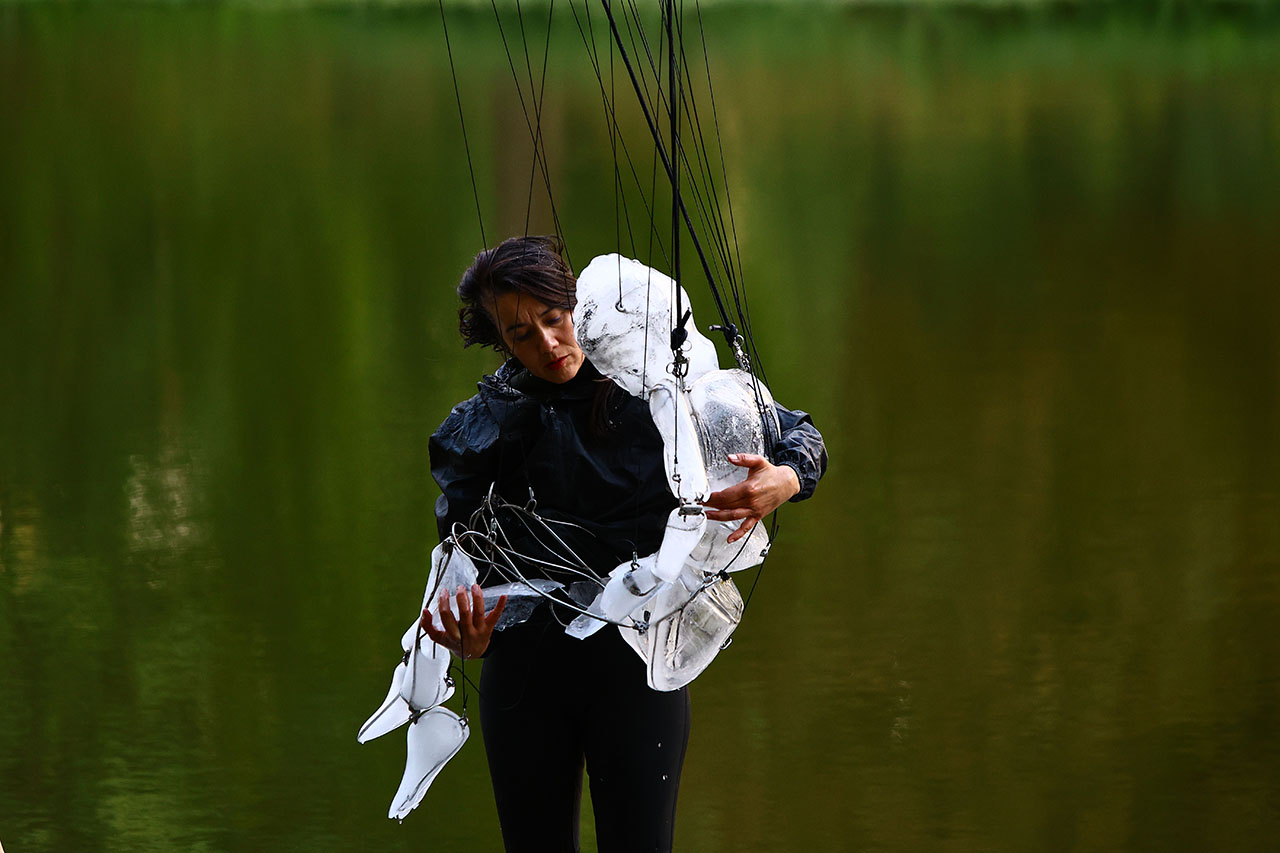
A platform hosting a tall wooden structure floats in the middle of a pond. Two performers slowly unwrap what looks like a fireproof blanket. Suddenly, an ice puppet is revealed.
While it begins its life executing simple gestures – hands raising to the chest and arms reaching out to embrace its duet partner Satchie Noro – the puppet’s motions gradually intensify towards the acrobatic. Manipulated delicately by puppeteer Sarah Lascar, the puppet flips and flails in the air, tangling its limbs around Noro’s, until eventually it carries her on its back.
Water drips from the puppet’s form, pieces break off. In the end, only its head and metal skeleton remain as it spins with Noro in a last soaring embrace. Whether read as a disintegrating relationship or an illusion to the natural world slowly melting into oblivion, Mizu expresses grief and loss in a tender way. Its images are striking, yet somewhat literal, meaning that unfortunately, little room is left to the imagination.
There’s a sense of promise as dancer Satchie Noro and puppeteer Élise Vigneron set sail across a pond on a floating metal structure. It quells as they faff around with sheets of foil, attaching ropes to an unknown entity within. The reveal is worth the wait: An anthropomorphic ice sculpture emerges from the packaging, limbs quivering as if nervous of its surroundings.
It has a right to be. In Mizu, the puppet melts before our very eyes, chunks cracking off its wire frame during a kind of good cop, bad cop interrogation. While Noro embraces the puppet tenderly, Vigneron manipulates it with strings, lifting it high into the air before crashing its form down to fatal effect.
The empathy Mizu conjures for frozen water is impressive, yet its choreography – namely slow, simplistic counterbalances and exchanges between the puppet and Noro – is less so. The movement becomes more compelling when the puppet soars in weightless arcs through the air and skates across the base of the sinking vessel, yet its flailing limbs, reminiscent of videos showing robots attempting choreography, offer reassurance: dancers shouldn’t be worried about non-human performers taking their jobs any time soon.
Floating over a pond, two performers unwrap an unexpected third. A life-sized ice puppet, its face marked with an enigmatic grimace, is the central figure of choreographer Satchie Noro and puppeteer Élise Vigneron’s Mizu. Prefaced by a detached audio narration on glacier melt and breakage, the puppet sweats and fractures, its disintegration a metaphor for climate change.
Noro negotiates poses alongside and atop the puppet – bracing, lifting and perching. But they’re not actually sharing weight. Vigneron manipulates the puppet at the platform’s edge, meaning the sense of care falls flat. The puppet bares its skeletal wires after being twirled and dashed against the platform, which partially sinks into the pond. Noro picks up the wasted frame. She reprises the duet. It is changed: hinges fold slackly and pondwater sloshes with each move.
Mizu’s gradual melting and submersion suggests that life continues with climate change, and our efforts to hold onto a dying planet are performative. The statement is perhaps unintended, yet revealing.