

Can you feel the weight of a revolution if you can’t understand any of its slogans? In the chatty Musseque, his choreographic debut, Fábio (Krayze) Januário dives into Angola’s struggle for independence from Portuguese colonial rule, ultimately achieved in 1975. If you don’t speak Portuguese, unfortunately, it takes a kindly translator to explain this after Musseque ends.
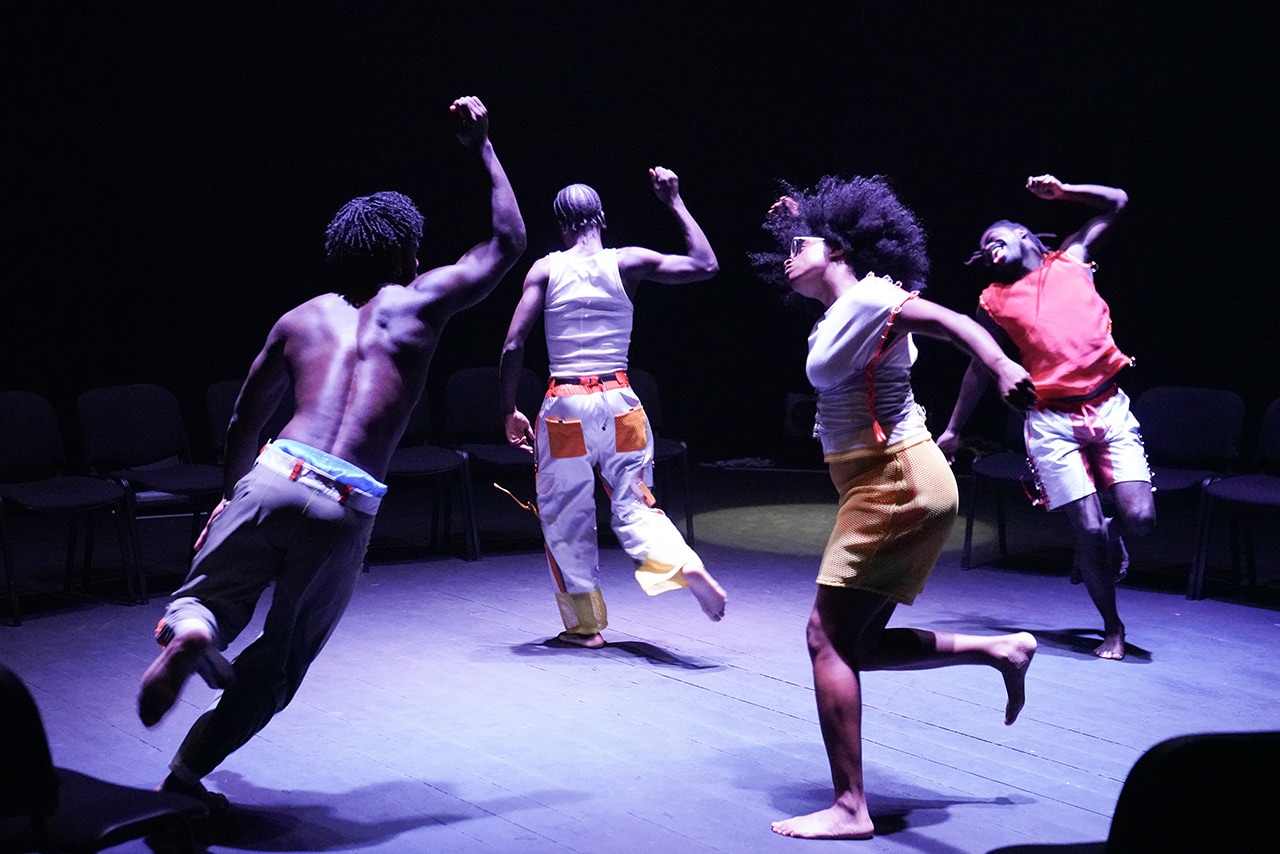
It’s a shame, because the quartet of performers can dance up a storm. When they step in front of us, after shooting the breeze in a corner of the stage, their nimble, high-speed interpretation of kuduro – an Angolan dance style born in the 1980s – is infectious. Throughout, Januário weaves the performers in and out of the audience on all four sides, building intriguing geometry out of their interactions with each other.
Yet kuduro was also a response to hardship and social instability, and the dance party is interspersed with scenes of struggle. Gunshots are heard; a dancer keeps being pulled backwards, his arms reaching blindly behind him. One aches for him – and for subtitles, too.
Musseque doesn’t wait for better times; the quartet of dancers inhabit the present on their own terms. Their world pulsates with the bass drum of Kuduro beats, energetic stomps and feverish clapping. Reflecting on the colonial past and migration from Angola to Portugal, the performers search for belonging through bodily interactions.
But amidst spontaneous dance battles and playful back-to-backs, the trauma of war tears through – strobe lights, shooting sounds and disembodied voices of politicians pierce with violence.
The dancers emphasise collectivity: solos only confine, cuff, and wrestle. Embodying ‘musseque,’ the Angolan word for slum-dwellings, the performers take over the space by making themselves ubiquitous as they dance among the audience. Turning peripheries into the stage’s centre transforms dance into resistance.
The world of Musseque may at first seem impenetrable, but this opacity is soon dismantled, as the dancers teach us choreography and insist that we join. The spectacle bursts into a carnival – an inviting gesture to continue decolonising the present.
Drawing on kuduro, an upbeat, energetic music and dance style from Angola, Fábio (Krayze) Januário’s Musseque is a performance that highlights the joy and strength there is in moving together. Four dancers travel around the stage and converse in Portuguese, often disappearing into the audience and making it frustratingly difficult to follow along.
It is a pity losing them in the crowd, but when you do witness the tense, rhythmic movement, it fills the space and captures the attention. Unfortunately, it is not enough to mask the choppiness of the lighting and sound design, and the lack of dramaturgical clarity.
Whilst the piece’s chaotic development is in some way emblematic of Angola’s anticolonial struggle and stories of migration to Portugal, it leaves the average audience member isolated, grappling only with fragments of fleeting movement. Still, the night ended with both the dancers and audience members filling the stage for a dance party – a heartfelt reminder of the ways in which dance can bring us together.
As Musseque opens, four dancers – three men and a woman – are seated in a small metal shed. Above them are the symbols of the Angolan flag: a cog wheel, a machete, and a star symbolizing labour, agrarian struggle, and solidarity. Choreographer Fábio ‘Krayze’ Januário, born in Luanda and now based in Portugal, takes Angola’s civil war not as history to be recounted, but as a painful memory still vibrating in the body.
The audience sits on all four sides of a space that forms the stage. One by one, the dancers step into the aisles, each caught in a beam of light. What follows is a dance of resistance: kuduro – an Angolan street dance from the 1980s – with stomping movements and afrobeat music that evoke simultaneously a historical panorama and a ritual. Fragmented movements, gunshot sounds, and strobe lighting disrupt the gathering before it returns as liberation and defiance. The message lands clearly even without understanding the Portuguese dialogue: the artists are taking a stand through propulsive, electrically charged dance, and a celebration of autonomy.
Musseque, the title of Fábio (Krayze) Januário’s piece, refers to the informal neighbourhoods on the periphery of Luanda. While spectators sit in a circle, the performers take their dance outward – into the corners and behind the audience – making you feel peripheral, too, like you are left behind by the action.
Yet at times, between the red light, smoke, and the dancers’ verve, it feels like we are sitting by a cosy fire with them. Their legs hammer the ground with rage, creating sparks of resistance, while their arms whip around the clear yet flexible axis of the spine. Their dance – kuduro – contains at its core endurance, and life.
The energy of their furious steps and playful duets builds up tension. Many Aerowaves spectators could barely remain seated. The dancers generously invited the audience to step onto the dance floor and shared with them the pleasure of movement and resistance. At least that day, dance won.