

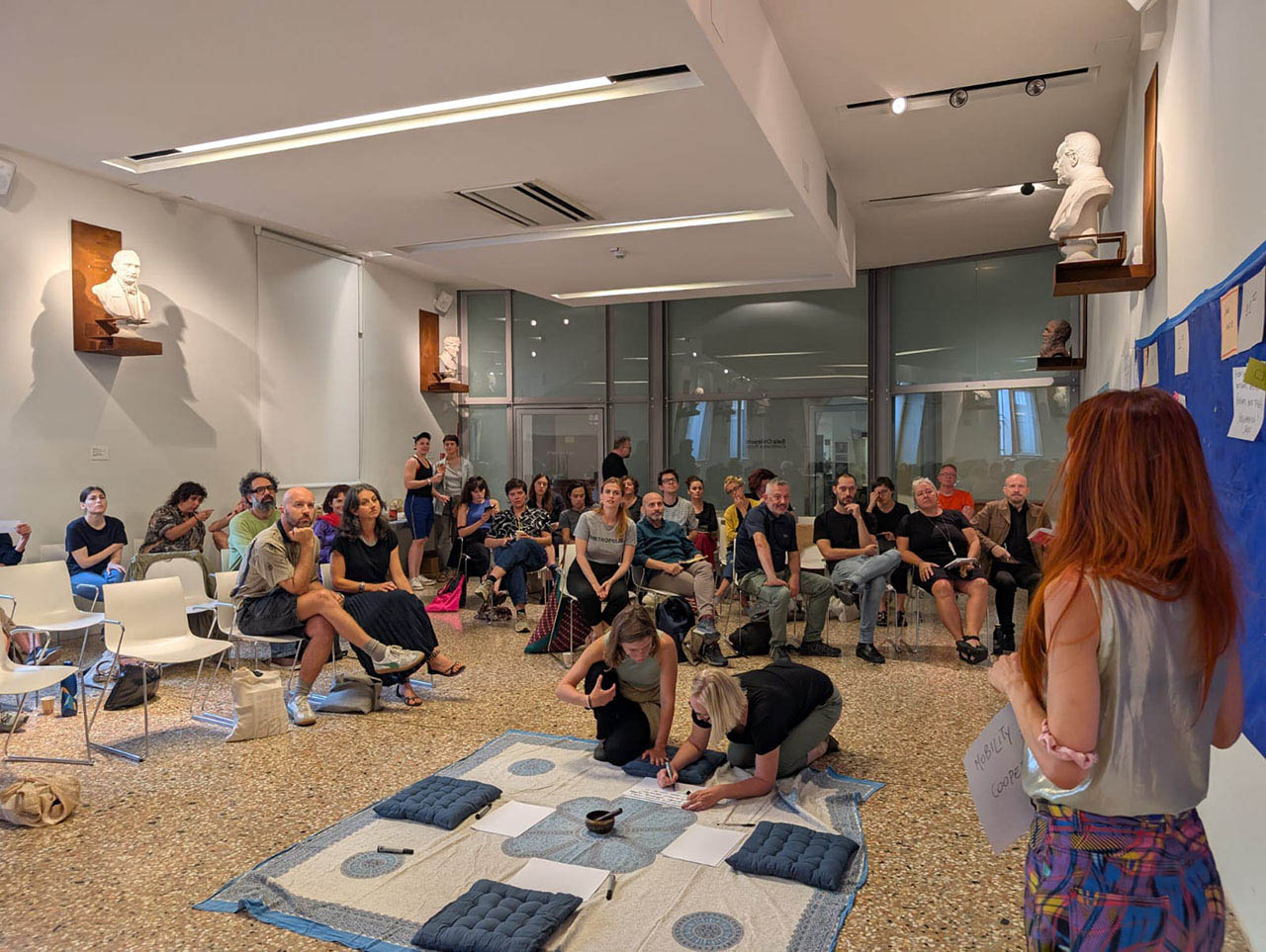
Performing arts networks were once again at the centre of the B.Network event, held as part of Operaestate festival that took place during late summer in Bassano del Grappa, Italy. Following last year’s focus on building a shared understanding of performing arts networks as systems of ‘interconnected people, organisations and institutions at work for making “things”, such as art policies, work for the benefit of arts, artists and their audience’, this year’s meeting explored networks as systems of cooperation. The event, facilitated by Silvia Ferrari (Ca’ Foscari University of Venice – Aiku Research Center) under the initiative of artistic co-director of Operaestate festival Michele Mele, revolved around the key question of how can we organise and imagine collectively international cooperation?. Using Open Space Technology – a participatory methodology that enhances co-thinking and co-imagination within groups of various sizes – curators, programmers, artists and cultural professionals divided into multiple self-organised groups to propose and discuss their own questions and issues related to the organisation, creation and sustainability of international cooperations. Here are some of the outcomes from those groups.
Co-operation as face-to-face encounters and slow-cooked relations
This group engaged in collective brainstormingto identify potential tools for facilitating long-term international cooperation in artistic development and production. The principal hypothesis, prompted by Séverine Latour, coordinator of performing arts agency Wallonie-Bruxelles Théâtre Danse, and Lauréline Bombaert, producer of MoDul ASBL, was to examine whether collectively visiting international performing arts festivals could improve international cooperation and partnerships. Participants noted that existing cohorts of delegates are often composed solely of programmers, and emphasised the need to form mixed-composition delegations to include especially artists and other professionals in the field, such as dramaturgs, for moving the focus from presenting or selling an artistic work – something that programmers and producers would normally do – to building deep-rooted human connections.
Another issue highlighted was the lack of financial support for such initiatives, along with the economic disparity between different countries and regions. For countries that have the means to fund travel abroad for performing arts cohorts, such as Belgium, it is helpful to be able to communicate their needs and expectations in advance as well as to have information beforehand regarding the cultural economy and ecosystem of the visiting country or region through preparatory and introductory sessions.
The group also stressed the importance of providing shared time and space during the actual meeting for connecting visiting artists and cultural professionals with the local territory through informal social activities, targeted conversations and visits to venues and diverse communities. Once the first contact has been established, it is crucial to maintain continuity and keep on nurturing the exchanges that took place – a shared responsibility between hosts and visitors. Sharing the knowledge gained from these experiences with the wider artistic field is also key for keeping the cooperation open to future additions and collaborations.
The ‘co-’: co-operation as co-creation and co-authorship
Can cooperation in the field of performing arts be the outcome of co-creation and co-authorship between artists and curators? This group explored such ways of working, despite limitations of distance and other differences. The discussion, co-led by performing arts curator Lorenzo Pappagallo (Escena Patrimonio) and choreographer Elisa Sbaragli, embodied the very question it posed, applying dramaturgical tools for activating collective imagination on the co-definition of the public square
– an element that could potentially lead to performances in public space or participatory designed performance experiences and festivals. Through an exchange of leadership, altogether, they explored a horizontal process of transmission, co-creation and co-thinking that as a collectively produced knowledge inevitably belongs not only to the facilitators but also to those who were present in the discussion.
Redefining conflict and introducing agonism
Responding to a question posed by performing arts curator Massimo Mancini (Teatro di Sardegna), this group discussed ways of dealing with conflict in small and large scale cooperations, and on the wider political scale. Rightly acknowledging that ‘conflict’ is a very charged word covering tensions from the geopolitical to the personal, they observed the need to constructively redefine and revalue it. Rather than viewing conflict as inherently negative or threatening, the group proposed the counterintuitive but highly resonant idea of rethinking conflict as an opportunity to enrich confrontation and to learn through difference. They did not argue for the resolution of conflict but for its preservation as a catalyst for social and political transformations as part of a healthy and pluralistic democratic society based on exchanges and interactions.
To support this rethinking, participants introduced the concept of ‘agonism’, a term from political theory that acknowledges conflict as an essential and generative part of democratic engagement, pushing back against consensus, which it considers an unrealistic ideal. In this light, cooperation was reimagined as a human constellation that values plurality and multiplicity through spaces where differences can coexist and interact. Negotiation was described as a dance of giving and losing, a process that includes stepping back to learn from the other and to make space for transformation.
Legacy, sustainability and the future of co-operation
Initiated by members of the Anticorpi XL network Selina Bassini (Cantieri Danza) and Valerio Verzin (IterCulture), this group considered the idea of legacy: the transmission of knowledge across generations and how cooperation can be both preserved and open to transformation. There is a friction between what to keep in long-established cooperations and what to allow to evolve, particularly in connection with the communities they aim to serve, such as festival audiences or emerging artists. Positioning these communities at the heart of a network’s mission, participants proposed a shift in focus from preserving legacy to prioritising what is relevant and effective for the community that the network serves. Legacy, they noted, can be a burden but also a gift, especially for younger generations looking for guidance or inspiration. In both cases, it needs to be understood as a process in movement rather than fixed, evolving alongside the communities it addresses, which are also in movement. Legacy comes with knowledge, experience and responsibility, all of which need to be transmitted to emerging professionals in the field, both formally and informally, to ensure the sustainability and relevance of cooperation into the future.
Understanding cooperations as constellations of ‘co-’ (co-creation, co-authorship co-production, co-thinking, co-imagination, co-leadership and more) where agonism is negotiated is key to building healthy and lasting human interconnections, open to transformation. Networks (net+works), as discussed during last year’s event, and cooperations (co+operations) can be seen as extensions of one another, interlaced through the act of collaboratively working and operating within diverse groups, brought together through shared missions. After two editions of the B.Network event on defining and imagining international networks and cooperations, it is time to see concrete steps towards organising meaningful networks and cooperations that will promote much-needed changes in the production, curation and distribution of the performing arts. ●
Bassano del Grappa, Italy
The B.Network event was promoted by Ca’ Foscari University within the framework of the lifelong learning initiatives of the PNRR project iNEST – Interconnected Nord-Est Innovation Ecosystem