


Among the several co-productions of ONE Dance Festival in Plovdiv, one of the most important contemporary dance festivals in Bulgaria, is Fantastic Futures (FF), by Aleksandar Georgiev. Born in North Macedonia, professionally linked to Stockholm, and based between Skopje, Sofia and Tenerife, he considers national representations in the arts as an obstacle rather than a benefit, and seeks ways to move beyond them. Pursuing such endeavour, in 2020 he started, together with Darío Barreto Damas and Zhana Pencheva, the international artistic project ICC (Imaginative Choreographic Center), which ‘doesn’t have a physical space, but actualises itself in different existing physical spaces’, through a variety of programmes, from mentoring young choreographers to triggering new dialogue formats with the audience.
I first saw Georgiev, also known as Ace, during Sofia’s Antistatic Festival in 2018, and later collaborated with him on an ICC project related to dance writing. I caught FF in Sofia a few days after its Plovdiv premiere, and having followed Georgiev’s artistic path over the past seven years I could recognise several elements distinctive to his work: a simple yet impactful scenography, captivating music, clear dramaturgy (in contrast to verbose programme notes), and the poetic presence of something queer.
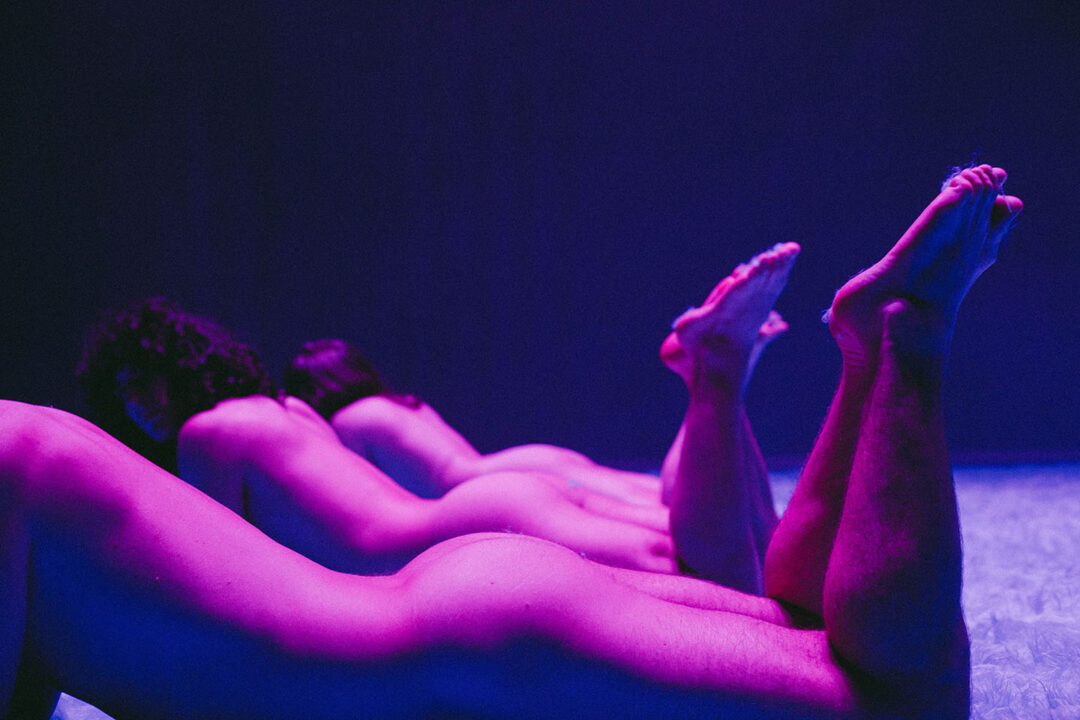
The audience is placed at the four sides of a fluffy light blue carpet, which serves as a stage. Four naked dancers – Darío Barreto Damas, Caterina Varela, Martín Los Arcos and Georgiev himself – slowly roll on it, swing their legs, or shake their arms in a constant flow. Each of them moves individually, as if following a specific itinerary, on vocal notes and electronic music by Tsvetan Momchilov, whose variations add sparkle to the performance. Their sinuous movements often put the most intimate parts of their bodies in the spotlight, but instead of hinting at sexual acts, they evoke gentle cuddles. Smoke, slowness and the surreal floor create a suspended atmosphere, in which spectators make their own associations.
But what were Georgiev’s own associations when creating the work? I met him after the performance to ask him about the ideas that guided him, and he told me that in FF he was continuing a line of research on co-existing practices through the key concepts of queer nostalgia, anal politics, and radical tenderness.
Queer nostalgia – the longing for moments in the past that we haven’t actually experienced, particularly those tied to LGBTQ+ experiences of the 1960s to 1980s – is a concept Georgiev began exploring in his performance Screensaver (2020). He told me: ’I am intrigued by the disrupted sense of temporality that queer nostalgia carries. I think that giving relevance in the present to the queer past – and the desires it inspires – is crucial for building a better future.’
Also related to the queer sphere is the notion of ‘anal politics’, further elaborated by philosopher Slavcho Dimitrov, which proposes a shift towards a view ‘from behind’ and reaffirms the value of the back of the body and its most despised organ. Georgiev’s recent works show an evolution of this perspective: in The power of S (winner of the Bulgarian IKAR award in 2022) the three performers dance the full piece offering spectators their backside; in the solo Atràs (2024) the entire dorsal part of the body is highlighted, with the front also being shown; and in Fantastic Futures, turning movements and the audience’s spatial arrangement offer a 360-degree view of the body. The choreographer stated: ‘I wanted not only to normalise the exposition of the anus, but also to emancipate the whole body and challenge standardised frontal performativity.’
‘But the main thing is radical tenderness!’ he acknowledged. ‘I am interested in disrupting the notion that tenderness is weak, pathetic, unnecessary – opposed to power and necessity. On the contrary, tenderness is powerful and complex and can be used as a tool: spending time with it allows us to project alternative narratives, beyond those shaped by the phallic power of aggression. Tenderness enables soft, slow shifts in perception and the re-radicalisation of affect and emotion as vital collective values – not as something shameful, suppressed, or neglected.’
At the end of our conversation, I asked Georgiev how we can think of fantastic futures in a period marked by human rights violations, the climate crisis, and cultural budget cuts. ‘Personally, I have to imagine, because I don’t want to live in the future resulting from the current premises. For example, I cannot have a child in the country where I am from, because I am partnering with a person of the same sex – but to be alive, I need to imagine ways and possible narratives where I will be able to have one. Imagining for me is definitely an operative mode, but I try to think of it also outside of this “survival/emergency” scenario. While working at ICC with my collaborators, I really experienced that co-thinking, co-dreaming, and co-imagining are the key to creating a better future. Together we face challenges and find out the beauty of plurality: that’s what FF shows. Not one determined reality, but multiple futures, visions, and interpretations.” ●
04.06.25, Toplocentrala, Sofia, Bulgaria
Fantastic Futures (FF)
26.09.2025 Teatro Paraninfo, La Laguna, Tenerife, Spain.
A production by Aleksandar Georgiev
Choreography: Aleksandar Georgiev
Performers: Darío Barreto Damas, Caterina Varela, Martín Los Arcos and Aleksandar Georgiev
Music and sound: Tsvetan Momchilov
Vocals: Daniela Belcheva
Costume design: Hector León León
Light design: Grace Morales
Poster design: Gjorgji Despodov
Producers: Beatriz Bello, Darío Barreto Damas and Viktoria Kostova
Co-producers: One Dance Festival, Toplocentrala – Regional Center for Contemporary Art in Sofia, Bulgaria, LAV-C Laboratorio de Artes Vivas y Ciudadanía de Canarias (Canary Islands)
Funding: Cabildo de Tenerife, ICDC Instituto Canario de Desarrollo Cultural Gobierno de Canarias, National Cultural Fund of Bulgaria.
Support: Teatro El Sauzal (Tenerife), Teatro Paraninfo (Tenerife)
Collaboration: Garage Collective – NGO (Sofia), Teatro Victoria (Tenerife)