

To those who want to kick off spring on the Paris contemporary dance scene, Séquence Danse festival is the place to be. For three whole weeks, the CENTQUATRE-PARIS – an old crematorium turned into a 15,000 square metre cultural centre – welcomes nine eclectic pieces. With fourteen annual editions so far, the festival has made it a point to feature a wide range of artistic styles, from solo to group works, where dance meets theatre, archery, circus and painting. As I jumped in with both feet to discover five of them from the first two weeks of the programme, little did I know of the many shades and contrasts I would discover.
Round 1:
Tsirihaka Harrivel, Cruel Trop Tard
Simone Mousset / Ballet National Folklorique du Luxembourg, The Great Chevalier
After circus performer Tsirihaka Harrivel miraculously came through an accidental seven-metre fall unscathed during a show at the Centquatre in 2017, he did not wait to get back in the air. If as a gymnast he lives to defy gravity and physical laws, the fall came as a trigger to question his perception of the world. Nearly a decade later, he has turned this reflection into a performance at the Centquatre. At first, the intention sounds pretty cathartic. But this time, Harrivel calls the shots backstage, and leaves the live shooting to Kyudo archer Caroline Ducrest and performer Charlotte Le Hir. In Cruel Trop Tard, he has designed a pas de deux for a bowswoman and a dancer. Standing on one end of a long stage delimited by two security ribbons, Ducrest aims at the foam target that Le Hir places on the opposite end. The audience, behind both ribbons, has a ringside seat to see each arrow fly with a swoosh.
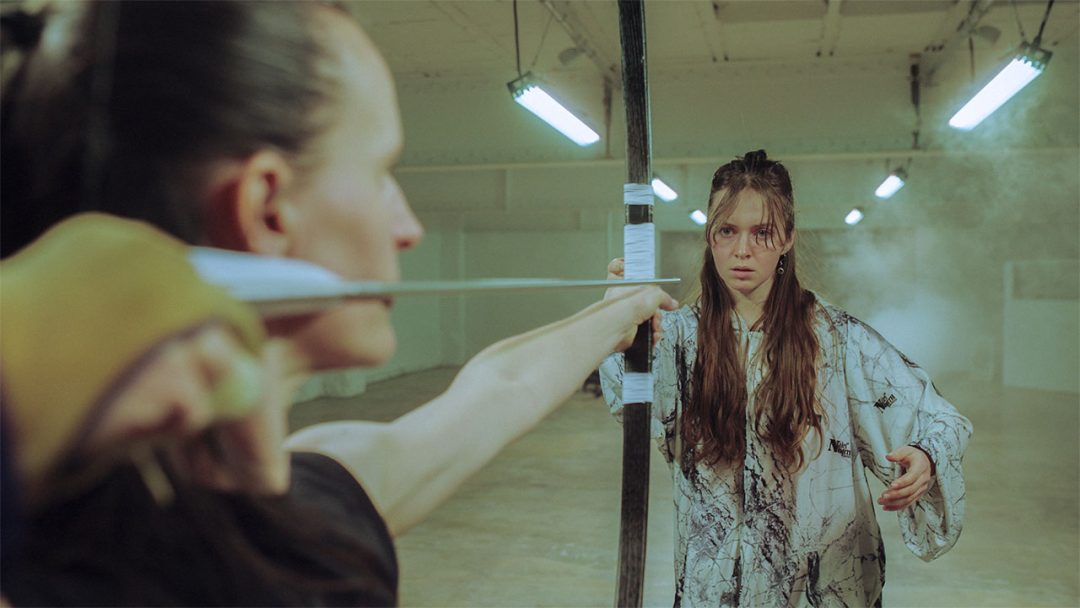
But the performance does not shoot straight to the point. In between the shots, a robotic monotone voiceover rises with loud music and light effects, talking about people coming in her room and telling her how messed up her life is. As if embodying this voice, Le Hir walks onstage in spirals, dropping wooden sticks, and hops while wearing an inflatable balloon on top of her head. Meanwhile, Ducrest prepares her next shot as if trying to shatter this uncanny vision. The performance thus unfolds like a strange series of scenes cut by shots, in an unsettling atmosphere. While tension holds the performance together, the plot is as foggy as the white cloud of smoke into which Le Hir disappears every time Ducrest prepares to shoot. As impressive as it is, Cruel Trop Tard seems to miss its mark.
As it happened, the festival started on April 1st – and as I moved to the second show of the night, I couldn’t help but think that choreographer Simone Mousset and performer Louis Chevalier had concocted the best April Fool’s prank. Their piece, ceremoniously entitled The Great Chevalier, is a solo embodied by the one and only M. Chevalier, Artistic Director of the fictive ‘Ballet National Folklorique du Luxembourg’. Based on an entirely fabricated and highly satirical national story, the piece tackles the issues of abuse of power by showing how truth can be attractive and manipulated. Introduced with postcards bearing his effigy and a speech by codirector Mousset herself, M. Chevalier appears as a charismatic, narcissistic drama king, in stylish burgundy suit and small round sunglasses.
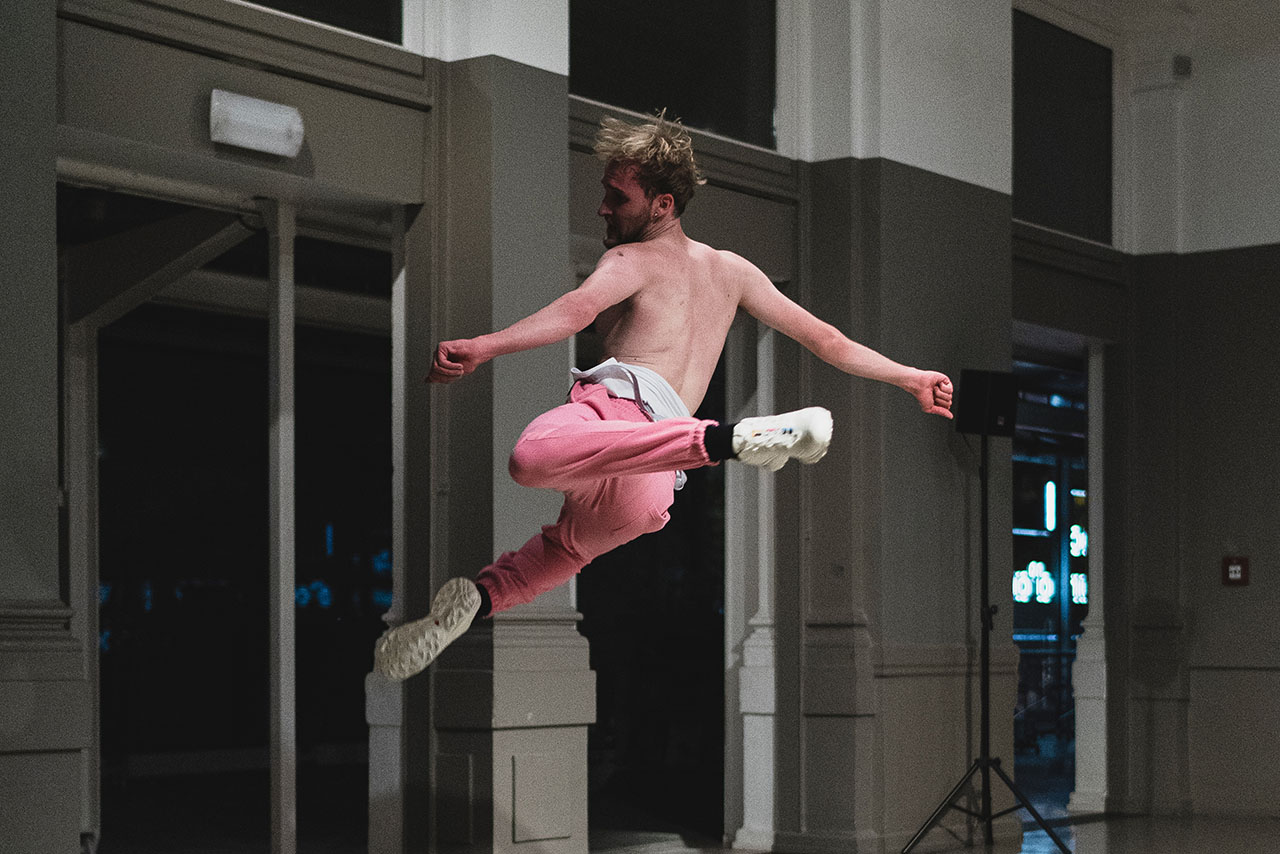
With nationalism rising in Europe, Mousset and Chevalier proudly answer with off-the-wall humour. Through these surprising plot twists, remarkably tied-together, Chevalier showcases his impressive ability to combine acting and dancing in various styles. Changing his outfit for a white shirt and pink sweatsuit, he keeps his over-dramatically sophisticated attitude but his moves are clearly influenced by pop culture – from Mario Bros jumps to Michael Jackson’s moonwalk. As any true fake folk dancer should, he pastiches flamenco zapateado. He even takes Odette’s flapping wings from Swan Lake to revive the Dance of the Pigeon, an emblematic opera piece from the Ballet’s fake repertory, allegedly composed fifty years ago by founder Josephine Bal. His energy is captivating. The Ballet National Folklorique du Luxembourg might be a myth, but Chevalier and Mousset’s performance was brilliantly picturesque.
Round 2:
Not Standing / Alexander Vantournhout, Frames
Compagnie Diptyk, Le Grand Bal
Back at the Centquatre a week later, the programme was taking dance to other dimensions. First Belgian choreographer and circus artist Alexander Vantournhout and three performers take a rigid structure and make it a playground for remodelling. For starters, they turn the stage upside-down by making the audience sit in a dark room under a big top and look up to the rectangular frame cut in it. There above, a knee (or maybe an elbow?) briefly appears in a corner. Then a leg and an arm (definitely) – until a whole body reveals itself from neck to toe, resting on both horizontal sides (from my perspective) of the frame, and rolls over to the other vertical side. The performer is therefore not onstage, but over and around it. From one to three, the acrobats dive into the frame. To go from one edge to the other, they twist around each other’s legs, or walk on each other’s feet hanging in the air. One might take a plunge using another’s body as a vine or a swing spiral, before going back to the top again. The figures may not be brand new but the acrobatic feat is always breathtaking.
Conjugating suspension with suspense, Vantournhout shows up in the second frame. Set in the great luminous hall of the Centquatre, the rectangle is now a metallic structure that faces the audience. Inside, the choreographer and three performers keep challenging gravity by creating geometrical and contorted human figures. Piled up, head-standing or even split-jumping, the sequences tend to highlight the edges of the frame and how to break free from them. Vantournhout is discreetly playing with the material and symbolic senses of the term: is the frame a limit for the performers, or a springboard to freedom? At times, the quartet stops and stares at the audience for a while. Could it be that they are framing us?
Back in a dark room, the four circus artists are left with a circular platform and no frame other than the tense atmosphere. The third frame is now a narrow pole. There is only room for two, so they take turns to climb up on each other’s back and slide back down between their legs. While they are masters in balancing their bodies, some of their moves remain unstable. As they perform single-handedly and without a safety net, the slightest shiver or shudder is met with gasps in the audience. But Vantournhout’s writing thrives because it highlights finesse over virtuosity. At the final bow, the room is filled with a mix of relief, amazement and a more-than-deserved round of applause.
While Vantournhout turns the frame inside-out, Compagnie Diptyk aims to dismantles it from the inside. Yet the structure here is more nebulous. Le Grand Bal gathers together eight dancers in a collective burst of rebellion against routine and apathy. The idea emerged from a parallel between the urge to dance that rose after lockdown in 2020 and the mysterious ‘dance fever’ that struck the city of Strasbourg in the 16th century. A mix of electro beats and flashes of lyrical singing, performers appearing in the middle of the audience. Either in the aisles or rising up from a random seat, they are spotted by a blinding light and seem to go into a trance. Slowly taking back control of their bodies, they make their ways through the seats down to the dim-lit stage. Under the nightclub-style lighting, the company mixes traditional folk dances, reminiscent of Renaissance branles or galliards, with urban and contemporary dances. You might expect a clash of dance cultures – but the choreography confuses deconstruction with messiness. Ironically, the dance rebellion lacks the structure and coherence to make it spark.
Round 3:
Sandrine Lescourant, Raw
My last stop at Séquence Danse was a single ride, and still turned into a dance battle. Surrounded by foil blankets shining with red and gold lights, Sandrine Lescourant (aka Mufasa), Ashley Beckett, Lauren Lecrique and Sonia Ivashchenko line up to dance hip hop in Raw. Yet their goal is not to showboat on their own. When she created the piece in 2021, choreographer Lescourant wanted to make the stage feel like home for everybody in the room. Thus, no sooner had the performers started their solos than they were slowing down the vibe to engage with the audience. One by one, they introduce themselves for the room to hype them up, share their stories of how dance came into their lives and helped them fight through hard times until they found their own place. The balance between performance and narrative nicely highlights the bilingual process that most dancers experience. First, the words make sense of the moves. Then when the words get too hard, the steps take over, forming a physical-verbal crossover. In the end, the moves have the last word and drive them back to krump or break styles.
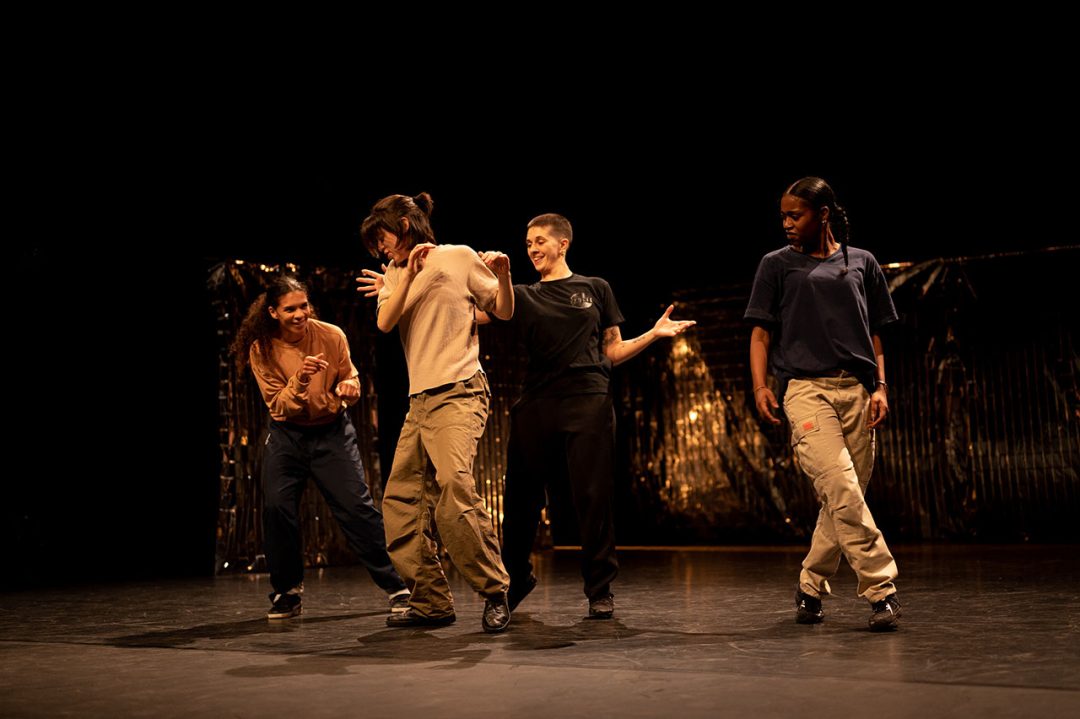
Sharing singular stories highlights the multiple branches of hip hop dances and the strong sense of community that bonds the dancers, and yet the format of successive self-portraits feels a little too orderly for these four women, who had to overcome such hardships to earn their place on stage. Though they proudly expose their energy and mastery, they seem to take have their heart set on revealing the pain and the failures behind the show. Yet standing out of breath after their demo still looks like another form of display. The same goes for when they implicitly criticise performing arts standards regarding the structure and intention of the works. By the end of the show, they come forward to say that they had exerted themselves to come up with an introduction-body-conclusion pattern, a statement of intent, and an artistic direction to make this work.
However, the quartet’s real strength is a spontaneity that makes their moves convey an irresistible urge to dance. Its effect is especially striking when the youngest spectators in the room rush to the stage when the performance eventually turns into a DJ set. As my last stop at Séquence Danse 2026, Raw put a warm final touch to an eclectic sequence of performances, leaving me curious to see what paths the festival will open next year. ●
01–24.04.2026, Centquatre-Paris, France