

Sunday 12 April: The Nelken Line by Pina Bausch
It is a Sunday in April in the Olympic Park, London. Dogs on leads, kids on scooters, teens on rollerblades running rings around pedestrians. A trumpet sounds from Sadler’s Wells East: a refrain from Louis Armstrong and His Hot Five’s ‘West End Blues’. Out of the theatre foyer emerges a single file of dancers, in no particular order of shape or size. Young and old. Men, women and non-binary people. Disabled and non-disabled. All putting one foot in front of the other as they triumphantly march through Pina Bauch’s four seasons of life in The Nelken Line: Spring, Summer, Autumn, Winter. A march so intoxicating in its cyclical nature that members of the public can’t help but fall in line, be it with toddlers on balance bikes or babies in buggies – myself, heavily pregnant, included.
The gestures are not hard to pick up. Spring: a lawn at waist-height, each finger a blade of grass measuring a millimetre at most – the space between my forefinger and thumb when I press them together. Summer: a meadow overhead, and a sun in the east – I cup my forefinger and thumb into a ‘C’. Autumn: a tree-trunk – left arm, bent at the elbow – and leaves falling, my right forearm winding its way down the tree, the space between forefinger and thumb now the width of a twig. Winter: an upper body brace, with shoulders shrugged, neck sunken, both fists clenched at the chest; shivering. Until we find ourselves back where we started.
Spring, Summer, Autumn, Winter. The sequence is hypnotic: the body opening, up and out; before closing, down and in. Movements simple but deeply symbolic. Movements deeply felt. I, them, we all, snake around the Olympic park in what must, from above perspective, amount to a figure of eight, ∞ an infinity symbol that not only mirrors the helix shape of the nearby ArcelorMittal Orbit sculpture by Anish Kapoor, but also seems as fitting an image as any for a dance about the cyclic nature of life.
We are each, every one of us, in a different season of life. Not only from decade to decade, but also from year to year, week to week, day to day, and even hour to hour. Earlier that morning my pregnancy yoga teacher had asked us what season we each felt we were in. I said ‘summer’ with one hand on my belly and one on my heart, heat rising in my chest. Others said ‘spring’, ‘autumn’ or ‘winter’, regardless of their apparent age or stage of life. A few hours later I was dancing The Nelken Line, feeling all four seasons within four simple gestures, within four mere counts of four… Time collapsing through dance.
And that is surely the true gift of the Sadler’s Wells Elixir Festival: to challenge not only our ‘perceptions around dance and age’, as the festival tagline goes, but also our very idea of time. For who, when they’re dancing, is really counting?
Tuesday 7 April: Pina Bausch/Meryl Tankard, Kontakthof – Echoes of ’78
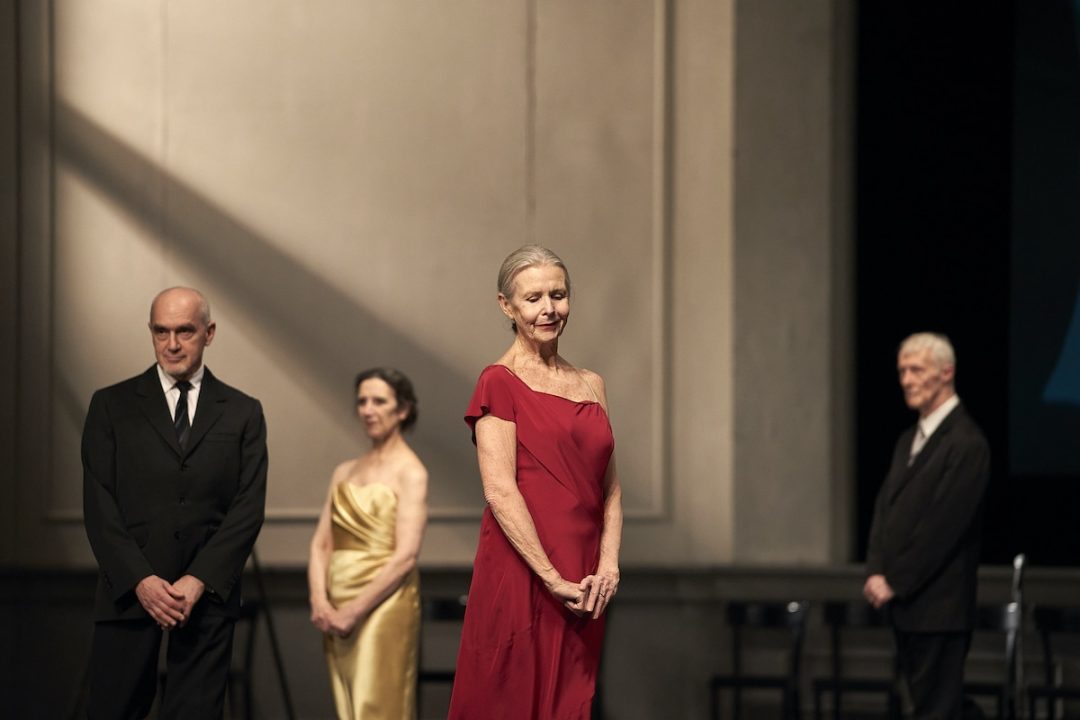
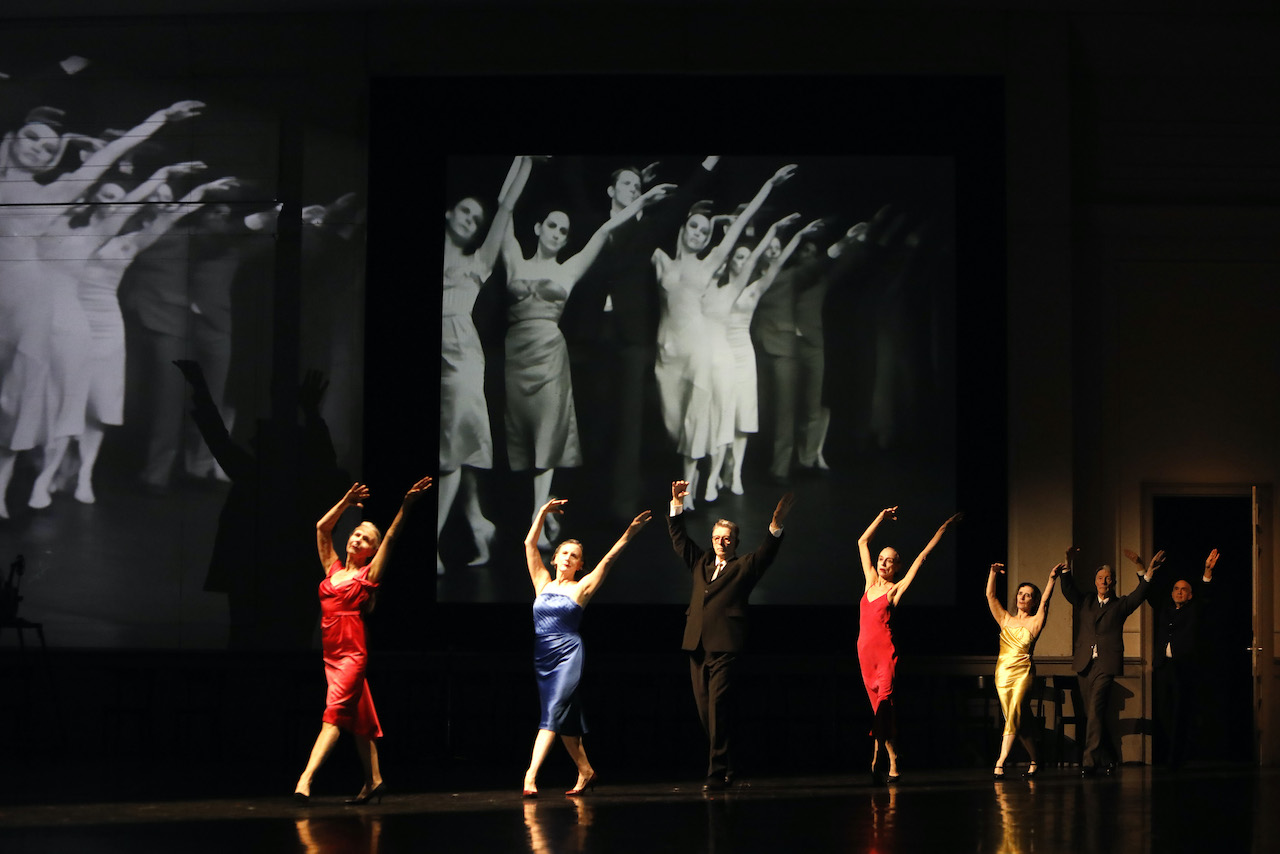
When Pina Bausch’s Kontakthof first premiered in 1978, the German choreographer always said how she imagined it being performed by the original cast members 30 years on. And while the idea never transpired within her lifetime, with Bausch’s unexpected death in 2009, one of its original cast members, dancer and choreographer Meryl Tankard, has since manifested this vision to haunting effect. Kontakthof – Echoes of ‘78 is no mere reenactment, but rather an uncanny encounter between ‘then’ and ‘now’. As a handful of the original cast members, now in their seventies and eighties, edge forward from the back of the stage, they are confronted with black and white archival footage of their former selves. The footage is larger-than-life, projected onto a gauze screen at the front of, and spanning the full breadth of the stage. Looking up and out at their younger selves, the dancers start to move in much the same way as they did back then, albeit less in perfect unison than in quiet communion with the past. Post-show, Tankard said:
At first, we tried to synchronise with the film, which is really hard. We had little tiny monitors right over there, but they were never in the right spot… You just have to go back to when you were 23 and feel it. AndI remembered how I looked at the audience… as if there was a little emotional file in me that opened up and I actually felt it. So when people say, “Oh, how does it feel?” Honestly, when I’m on stage, I feel like I’m 23. I know I don’t look it, but there’s something about… you just become that person again.
Certainly, there are moments where the real life dancers and their filmic projections merge in a palimpsest of movement. Take, for instance, the scene in which the men scrape their chairs across the stage, limbs flailing in the direction of the women, and the women bat away their advances with mounting aversion. Present and past blur as if time has imploded and the dancers are back there in the ‘desire, disappointment and desperation’ of the dance hall, as Bausch put it, in the so-called ‘Kontakthof’ – ‘a place where people meet who are searching for contact’. For the fact is, people never stop searching for contact, irrespective of age. And it is such facts, ‘so loaded with emotion and depth’, Tankard describes, that the dancers carry with them to this day. That is why it would be hard to recreate the work with younger dancers, Tankard observes in interview: ‘it was never on a count, it was something we felt.’
It comes down to a matter of process, she later explains, when a question crops up about a scene in which Tankard appears puppet-like, men manipulating her limbs: has it taken on new dimension in light of the #MeToo movement? ‘Each man had six different ways of being tender,’ she responds matter-of-factly, ‘be it to their pet or their father or their mother or their baby… but doing it for so long, it turned it into something else.’ Dancer John Giffin concurs: ‘Yes, it looks very different than it really is,’ and fellow performer Anne Martin continues, ‘Maybe quicker, or with certain music, what starts to be a gesture of tenderness becomes a gesture that is violent.’ Without going through Pina’s painstaking creative process, Tankard concludes, younger dancers could not convey the same complexity of emotion, the same crucible of meaning.
Nor could they convey the same gnawing sense of absence, as much as presence, that the original cast members carry as they dance with the ghosts of their former friends. Because, of course, not all of Bausch’s dancers are still with us. At least, not in the flesh. As Giffin says, ‘In dancing with these people who are no longer there, we’re very much honouring their presence… even as invisible beings, they’re somehow really there’.
For all the piece’s poignancy and profundity, there is a sense of levity too, like all good Bausch work. When Arthur Rosenfeld tries to move his hips in a figure of eight, for instance, and his dance partner Josephine Ann Endicott encourages him to look for inspiration in his younger projection, she soon concludes: ‘It was not good 47 years ago, and it’s not good now.’ Likewise, as a line of female dancers paces in bandeau dresses and high heels, they teeter on the brink of slapstick. Martin admits, ‘You won’t believe it, but for me, the hardest thing was to dance in high heels!’ I, for one, can believe it, and share an audience member’s sentiment when they ask, ‘What’s your secret for being so phenomenal at your age? Because I want to be you when I grow up.’
‘There is a sense of accepting your age,’ Martin responds, ‘to just be in your age and not try to be something that you are not.’ Giffin agrees: ‘I feel that I’m a much better Bausch dancer now than I was then, because there’s no trying now. It’s just me. You just come on stage, you sit down. That’s who you are. That’s where you are. And it’s really rather free.’
It’s a wonderful note to end the post-show panel on, but not wholly fitting for a piece that strikes the perfect balance between nostalgia and novelty, wisdom and wit – at which point Tankard delivers the perfect blow. ‘I do think that yoga and pilates help [laughter]… No, but seriously, exercise. I know it sounds boring, but it’s amazing. You just have to keep moving.’
Monday 27 April: Louise Lecavalier, danses vagabondes
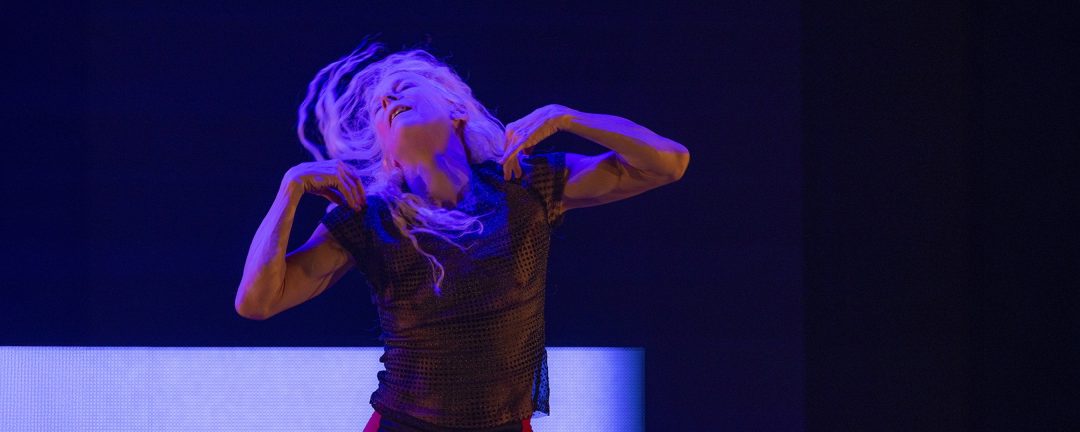
If there is one dancer in Elixir festival who embodies the ‘keep moving’ maxim, it is Louise Lecavalier. The 67-year-old Canadian dancer-cum-choreographer, perhaps best known for collaborating with David Bowie, takes to Sadler’s Wells East with a one-woman show of unremitting, mesmeric movement: danses vagabondes. Clad in a black hooded cloak and lit by a grid of LED tube lights – made bearable on the eyes by puffs of smoke swelling from the wings – Lecavalier bounces about the stage with the indomitable spirit of a Berlin clubgoer. Only, her movements, while iterative, are not monotonous. And her only drug seems to be, well, dance.
How does she sustain herself for over an hour on stage, asks Sadler’s Wells director Alistair Spalding in a post-show talk. Does she map out her stamina and take little breaks? ‘I force myself to take them because they are needed choreographically,’ Lecavalier corrects him, ‘because, naturally, I wouldn’t take breaks’. So, they’re not just to take a breath, Spalding presses? Shaking her head, Lecavalier retorts, ‘It’s not five hours, it’s one hour and seven minutes!’, before concluding, ‘the stamina comes by dancing.’
This is plain to see from her movements, which, as she paces across the floor – on this diagonal then that – tend to wax rather than wane with energy. And, perhaps more surprisingly, from her precision. As if she is building up to and burrowing in on certain vocabularies of embodiment. A flick of a wrist ad infinitum, for instance, some becomes the shedding of a coat sleeve; a tic of the head round the clock, a steady loosening, then unleashing, of bleach-blonde locks. Indeed, it seems to me that as time presses on in danses vagabondes, Levavalier casts off not only a series of characters – wanderer, wayfarer, nomad, beggar – but also the last vestiges of ageing, gaining superhuman strength and youth. ‘Sometimes I think I am a bit like Obelix who found a potion when he was young,’ Lecavalier jokes, post-show. But how does she feel age has evolved her dancing, one member of the auditorium asks.
I don’t know if it’s better, but it’s changed, and that’s the most important thing, because I would be disappointed doing the same stuff the same way I was doing it 20 years ago. I think it’s age and it’s time. … Now I risk more – It’s strange to say because people used to think of me like turning and doing dangerous things, but for me it was never dangerous. I practised those twirls and I could do them. I’m more trusting now in a way. Maybe my body is less capable of doing some stuff. I wouldn’t go do a twirl now unless it was to save my life or somebody else’s life. [Laughter]
Granted, there are no dangerous twirls in danses vagabondes, but, as Lecavalier articulates, there is more risk involved, and with it more trust – key themes that can be traced across the programme of this year’s Elixir festival. And much like Bausch’s dancers, if she had to compare with her life as a dancer before, ‘I do less, I do less,’ Lecavalier reflects, before clarifying, ‘less over-training, less over-rehearsing’. So, what’s her secret, what’s her elixir? Then those three words: ‘I do yoga.’
Monday 13 April
The morning after my encounter with The Nelken Line in the Olympic Park, I receive an email from a student on my course ‘Writing About Dance: From Criticism to Creative Responses’ at Leuphana University, Germany, who wanted to share his creative response to Wim Wenders’ 2011 documentary film Pina: a black and white animation of a tree in four seasons. Spring, Summer, Autumn, Winter. It has been playing on loop in my mind ever since, as I daily reflect on the collapsing of time through the elixir of life that is movement. (Or should I say yoga?!) ●
07–27.04.2026 Sadler’s Wells Theatre, London, UK