

To move with Grace and Harmony. To land elegantly in a room and effortlessly traverse the craggy landscape of conversation and bodies. To remain unruffled by embarrassment, to understand every joke and make better ones. To be noticed, but not too much.
Except it rarely happens like that. As ingrained the conventions of social interactions are, many encounters can feel bumpy, embarrassing, boring and confusing. But where are my manners? Let me first introduce the work and the topic.
Edward Thomasson is a London-based creative whose work The Whole Routine premiered at London Performance Studios in 2025. My response was so ambivalent – I giggled and cringed, all with a lump in my throat – I became keen to understand why, and especially to discover more about what I knew to be complex themes behind what at first glance, is a simply structured evening performance. My second viewing of the piece was paired with a conversation with Thomasson himself.
To set the scene: London Performance Studios is an independent warehouse space that seeks to ‘queer artistic process, operating within radically transparent and intersectional structures’. Crucially, LPS also provides affordable rehearsal space for artists. The stage, only made so by its relation as a blank space before rows of chairs, is an undecorated, bright white box reminiscent of Thomasson’s background in staging performance in visual art contexts.
‘
The daily dilemma of authentic self-expression in a world that continually demands convention
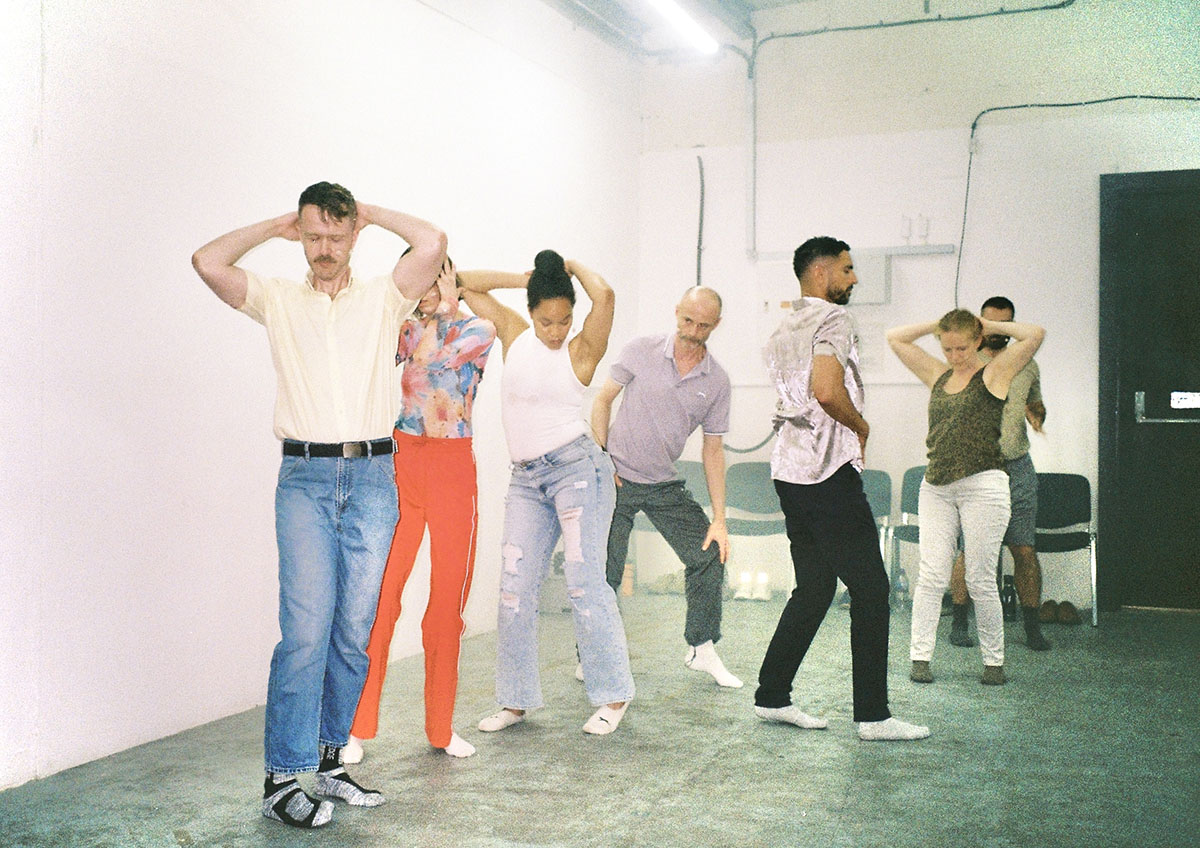
The Whole Routine is self-defined as a work about desire and control, about trying and failing to synchronise, and in doing so, scrutinising our need to try at all. Seven people present the daily dilemma of authentic self-expression in a world that continually demands convention. The performers are dressed in street clothes. Though mostly untrained, they sing earnestly and loudly, while the choreography is frontal, and confronting. The result is a fragile, exhilarating atmosphere. This is essentially a musical, though not in the gleaming, polished way that we know it. The cast proceed through a series of songs, paired with awkward steps both sensual and pedestrian, in unison, and interspersed with solos. As heightened as the musical elements become, there remains a blank-faced straightforwardness to the piece. In fact, Thomasson worked explicitly with the cast on not-performing the emotions of a piece that somehow, despite its directness, evokes surprising tenderness, and yet the cast remain distant to this effect on the audience. ‘I think the work is interesting for me when it’s ambivalent emotionally, because that’s much more how I experience life,’ says Thomasson. ‘It’s always two things or more at the same time, and I’m interested in those feelings.’
The boundary between performance and non-performance is slippery. Choreographed dance seems the ideal medium for exploring behavioural patterns, and yet dance is inherently performative, and in daily life we often rely on conventional etiquette to not stand out. The Whole Routine therefore presents a paradox. To Thomasson, repeating the status quo – that is, acting ‘normally’ – in order to disappear, as well as the sudden visibility that comes from deviating, are political acts. Visibility is associated with shame for many, and The Whole Routine stages, in the broad daylight of the white cube, the shame of failing to fit in, of desiring more for our bodies: ‘What does it mean to explore these awkward social feelings that you want to hide, but make them the material?’ Through a choreographed sequence with the memorable lyrics – ‘Can we just get back in line’ – the cast pump their limbs into sameness, while literally ‘stamping out’ shameful desires.
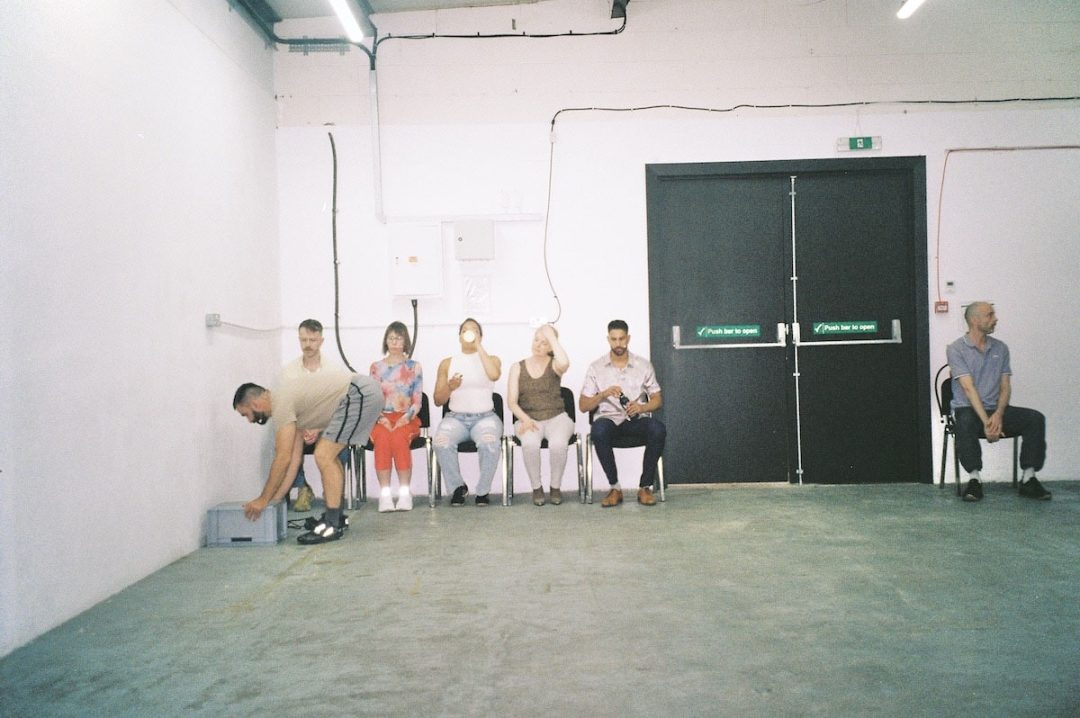
Is a partially amateur cast what makes it feel un-performative? It is structurally a performance, but their authentic efforts to unify as an ensemble disrupts any easy consumption of a song and dance. Thomasson and the cast purposefully don’t rehearse this piece collectively. The result is that their coming together possesses the inevitable bumps and discrepancies of awkward, ‘first time’ social encounters. Ironically, even after dispersing and exploring their own movement, and then returning to unison, they are still not synchronised. Arms bounce at slightly different heights, spines pitch at different angles, and expressions do not share one consistent emotion, but many. There is once again a political statement in the presentation of differences that fail to, and more so choose not to, unify. ‘In this moment when things are changing politically,’ says Thomasson, ‘one of the things that I find exciting about the group is not necessarily that they are untrained, it’s more that they all do it so differently… How beautiful that can be, and exciting and thrilling, to be able to experience these specificities – and they become more clear because we are all doing it at the same time.’
‘
I wanted to make something that contains its own collapse
The beautiful imperfections of The Whole Routine reflect daily failures and dangerous desires but also a new way of working for Thomasson. Following an intense stint on a tightly choreographed piece, he wished to make a different kind of work, one that wasn’t reliant on such precise, high staked form: ‘I wanted to make something that contains its own collapse.’ From this initial thought stemmed the development of each song in turn (created with songwriter Robbie Ellen and composer Charlotte Harding), each workshopped with the general public, a three-year process that resisted norms for making, completing and measuring the success of an artistic work. The creative process was also influenced by Thomasson’s own experience of addiction recovery, and the strange mechanicality of daily interactions without the lubrication of intoxicants.
A string of ‘performances’, with more to come, will surely lead to more predictability and closer synchrony for its dancers, just as acquaintances lose their awkward hugs and gaping silences with time. Might this risk losing something real and authentic? ‘That is something that we are talking about,’ says Thomasson. ‘In a way, the choreographies are actually quite awkward to perform regardless… They do kind of jangle… and then some of the instructions for the more improvised parts are deliberately contradictory, so that there’s always a bit of a wobble in the performing of it.’
A moment that epitomises these contradictions, and the tension around the desire to deviate, is when the cast traverse the stage, slowly improvising. They close their eyes and relax into themselves as the stage and audience float away, only to panic internally when they sense the person next them doing something different. So they conform, and in doing so revert to performance and to pretending. Though there is comfort in the choreography so explicitly presented in this piece, in knowing the steps, what speaks louder is the urge for the freedom to break time, to bravely explore and to fail in order to find new ways of moving through the world.
In one solo, a performer tells himself through song to ‘push it down, keep it in’. His knees squirm as he squeezes into an uncomfortably small shape, repeating the line over and over, only to explode with confetti; to fail, feel humiliation, and make a mess. Joined by the others, he resumes the dance of conformity. All at once, the moment carries a desperation to return to an invisible state, the strain of forcing yourself not to behave like yourself for fear of being othered or rejected, and a poignant sadness for the futility of this.
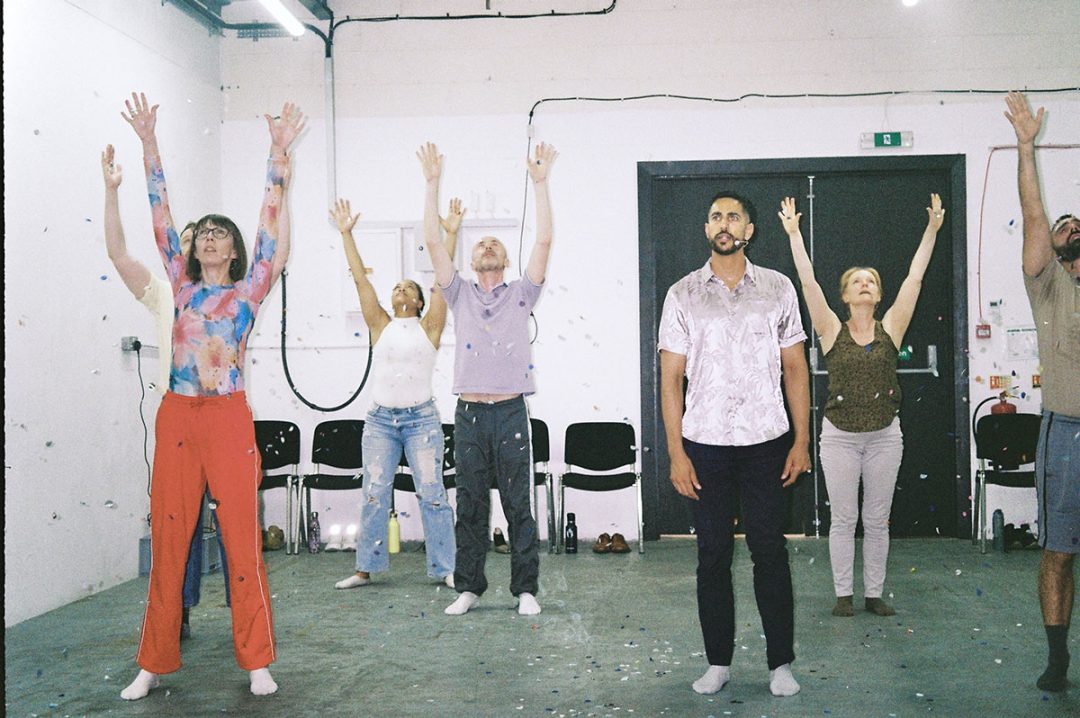
Though comical, the off-key desperation of The Whole Routine strikes exactly the right (pitchy) tone for conveying the absurdity of our attempts to appear ‘normal’ within safe but suffocating etiquette. In this case, the etiquette is a series of songs and steps that nevertheless describe, through lyrics, a desire to feel things differently despite the ‘sometimes alarming awkwardness’ in doing so . To be able to laugh, too, is a relief amidst the heavy realisation of how much self is suppressed when seeking social fluidity.
The Whole Routine is moved by the realness of trying, and brims with the very interpersonal awkwardness we seek to avoid. Amidst this discomfort, rejection and embarrassment, there lies a glimmer of hope in its bravery to voice a desire for something new, free from the many social choreographies that contain us. ●
29–30.05/2026, London Performance Studios, London, UK