

I am welcomed to Prague by a heatwave and by Yvona Kreuzmannová, founder and director of Tanec Praha’s international dance festival, this year reaching its 38th edition. She picks me up midtown with her green Peugeot, apologising for the malfunctioning air conditioning, and we rush to her office so she can attend National Public Radio for an interview. She talks fast, laughs generously, and is constantly ‘on’. In those ten minutes filled with traffic and hot air we briefly go through the programme of my press trip, we stumble upon our shared love for the French language and we talk about the influence of ‘Orbanism’ (and the worrying surge of subsidy cuts for culture that comes with it) in the Czech Republic and elsewhere (see also Art as political strategy by Ingeborg Zackariassen, Springback Assembly 2024). She is worried, also because of the particular struggle the platform she runs is currently facing. Tanec Praha includes the festival, the Ponec Theatre (main dance house of the city) and the Czech Dance Platform (the ‘vitrine’, as Yvona calls it, aiming to internationally promote local choreographers). This final weekend of the festival also marks the deadline to deliver paperwork for a vital, four-year municipal subsidy for the theatre they were unexpectedly denied some weeks ago.
‘
I have met people like her before.… People who, in time, have become inseparable from the landscape they helped create
She is worried, she is busy – but she also shrugs her shoulders, steps on the gas pedal and shouts ‘come on!’ Her allure feels familiar – I have met people like her before. Women (and men, but mainly women) who have fought for a place for contemporary dance amongst the ‘bigger artforms’ for decades, scraping corners from different budgets and seeking connections beyond their local contexts to ascertain their strength. People who, in time, have become inseparable from the landscape they helped create, and who in the face of inevitable criticism along the way have defended their vision and position tooth and nail. As Lydia Wharf wrote in her article from Tanec Praha 2024, such an internal conflict exploded in Prague as well, and according to Yvona the echo of that division is still felt in the air. From an outsider’s perspective I can only express my sadness. In the face of larger threats, it’s hard to imagine how these Caïnite quarrels can help in the fight for everyone’s cultural subsistence.
The festival itself is slow paced and stretches over the full month of June. I’ll only see two shows a day, so in between I plan to walk, cycle and use several trams of Prague’s stunning public transport network to discover the city. Except for Saturday, when I’ll travel with Yvona to Plzen to catch two of the pieces touring with the festival beyond the capital. This has been another one of her obsessions: to use Tanec Praha to support local programmers, like Roman Černík, founder and artistic director of the Moving Station, a gem of a train station reclaimed, refurbished and devoted to the alternative performing arts scene of Plzen.
Besides strengthening and supporting ties between the capital and the regions, it’s also a way to make the journey of some of the pieces more sustainable, as they get to perform two or three times in a row in a little tour around the lush Czech countryside. In Plzen, for example, I saw Mizu by Company Furinkaï against the stunning backdrop of an old quarry, having been performed in a riverbed just outside Prague two days before. I also saw Adriano Bolognino’s Come Neve in front of the baroque altar of Kladruby Monastery, a bohemian building surrounded by greenery – as well as in Prague the next day, a very different, urban setting.
This edition was bookended by well-known names – Guy Nader and Maria Campos, Christos Papadopoulos. In between, alongside several other familiar names of the European dance scene, several of Aerowaves’ yearly selected artists got the opportunity to show their work, as well as several local artists in pieces seeking to establish cross-cultural dialogues, co-produced by the Czech platform.
What bound the shows I saw during my three days here, seemed to be a shared care for the impact of their visual aesthetic. They were all crafty, in one way or the other – some with a more activist and literal goal, others to befit and befall specifically young audiences, and yet others to choreographically or physically dress up universal feelings of pain, anguish, anger, sadness – and hope.
As history has continuously shown us in its cycles, and as I also remembered while walking through the halls of Prague’s Museum of Decorative Arts, aesthetically pleasing doesn’t necessarily have to mean shallow, sheep-like or escapist. Beyond (or meshed into) the form, the performances I saw combined good taste for visuals and strong choreographic scores (ranging from harrowing and in-your-face to enticing in their subtle simplicity) with a healthy level of complexity and clearly sensed political intent.
Dancehood / Yana Reutova: The Secret Of Moonlight
Made for young audiences and under the principles of Safe Place – a pedagogic approach promoting that environments should adapt to the child, not the other way around – The Secret of Moonlight is a progressively open invitation to wonder and wander around. Low placed elastic stripes of cloth set the tone upon entry, as adults have to crouch to get past them. Inside, several soft mats organise the open space and organically indicate where we are or will be welcome to sit. Different objects hang from the ceiling: nets with more stripes of cloth hanging from them, or large elastic pantyhoses filled with cylinders at different heights. Colour coding: bright.
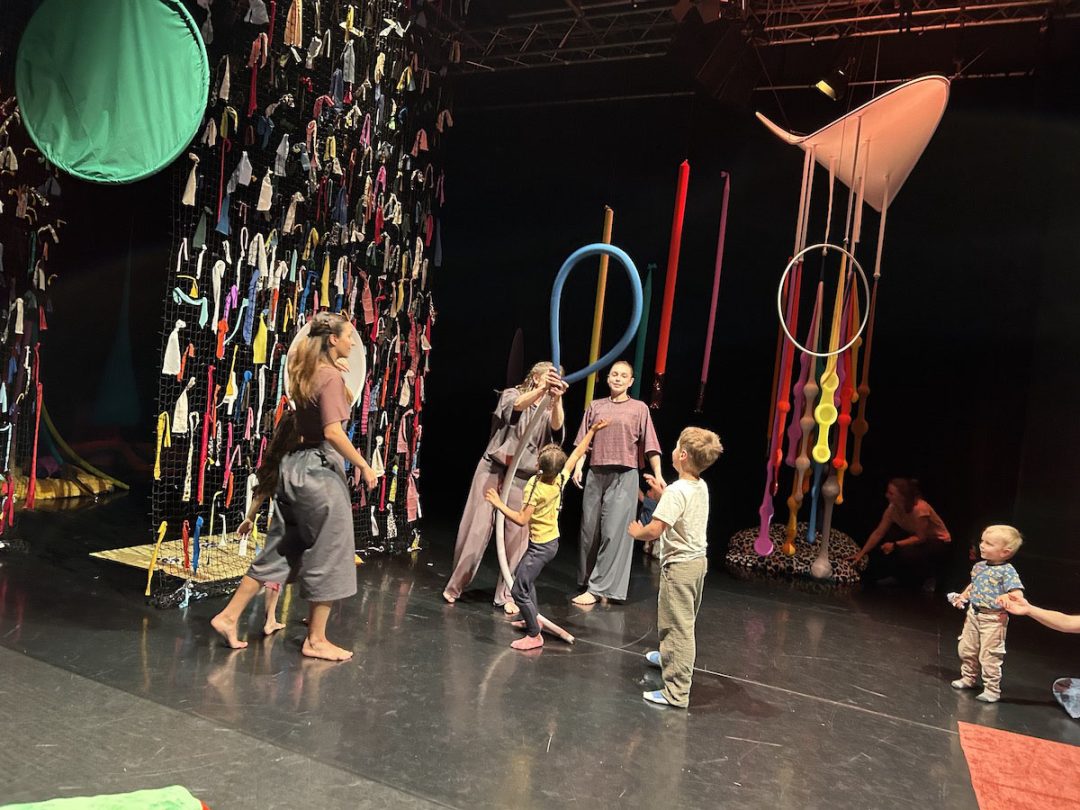
The whole setup holds the promise of interaction, but before we can travel we might need help to get in the mood. Because: a space like this one can feel scary at the beginning, and so Tereza Moulisová, Anastasiia Pavlovska and Karolina Šnajderová dance for us, playing with soft tubular objects to support one another, to create forms and shapes, or to evoke fantastic creatures who – first carefully, then cheekily – approach the kids among us to incite them to action, one step at a time. And it works. Not least thanks to Milli Janatková, who feeds this landscape with an impromptu and harmonious soundscore, accompanying the movements in real time and making their power of suggestion even bigger. The children in the room relax, smile and giggle. Short of an hour later, they jump, run, and bounce.
The Secret of Moonlight thus successfully puts the Ukrainian Yana Reutova on the track of other inspiring, European makers for the very young (like Makiko Ito in The Netherlands or Desplegándose Collective in Spain) who put the play, autonomy and imagination of children at the core of their practice to create, paraphrasing Virgina Woolf, rooms of their own.
Rootlessroot: Mountain
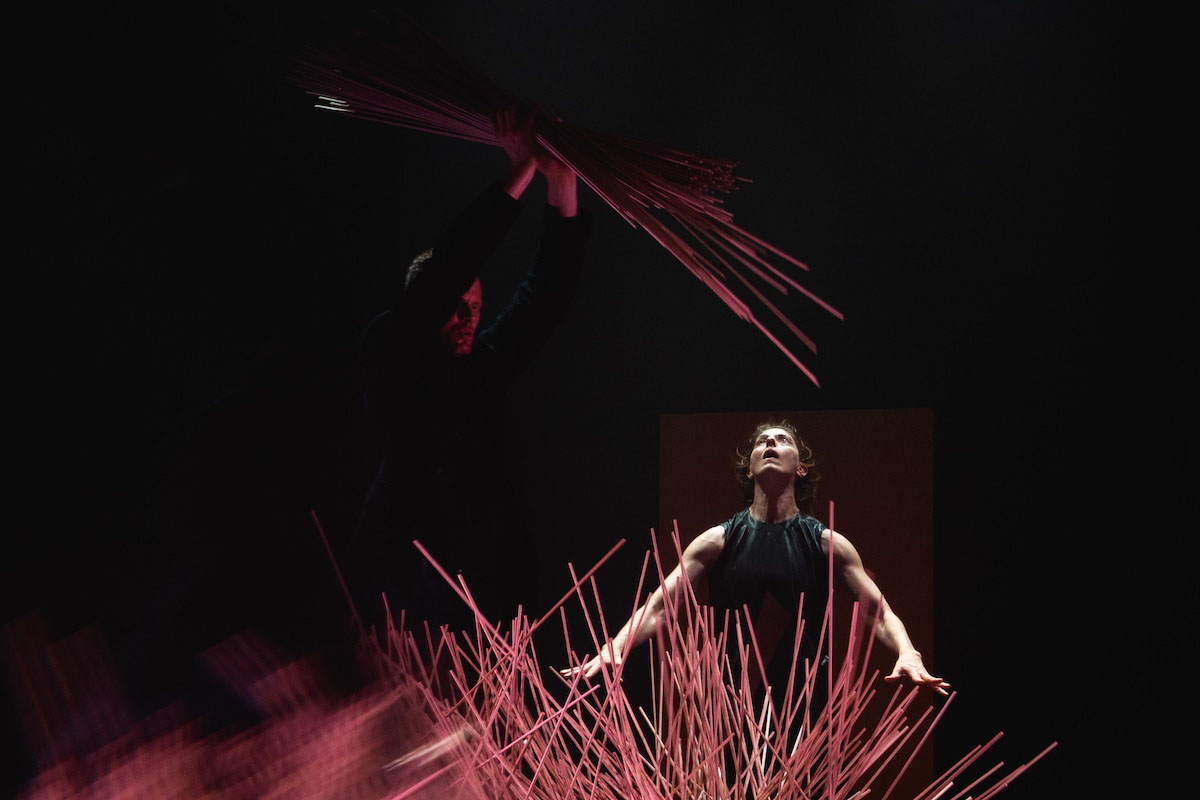
Dressed in long, thick black costumes, two characters move slowly through the stage. Now and again, one of them makes sounds with a chain of small bells, or by manipulating a large bunch of thin canes, wriggling them around or spreading them on the floor like a carpet. There is a small square wooden altar in the back, which at a certain point is briefly lifted up only to be suddenly dropped, creating a shockwave of silence and dust through the room. If anything, Mountain is visually daunting. The music by Vasilis Mantzoukis, ominous and epic from beginning to end, enhances the doom-like, ritualistic feel of the performance, which revolves around grief and death as indelible parts of the human condition.
Experienced and internationally acclaimed Jozef Fruček and Linda Kapetanea have worked together for over twenty years under the name Rootlessroot. They are also the developers of the very up-and-coming ‘Fighting Monkey’ dance method, which offers a way into movement more focused on play and adaptability than on the learning of a specific movement vocabulary. And in Mountain, through Kapetanea’s movement, the depth of this particular craft was very much lo, there, a gift of a presence to behold. Her subtle way of apparently creating ever-changing rules and loopholes in her body to dynamically and immediately circumvent them enthralled me – her movements an effect rather than a cause, making a labyrinth in and of herself. Within the ritualistic aesthetic (and with the cycle of life hanging in the air as a theme), her personal way of moving became also very life-confirming, feisty and just.
The exquisite light design by Perikilis Mathiellis, the play with the canes (which at the end were vertically thrown on the floor to create an anguished, peaky sculpture), the music and the orange dust through which the drama of movement and theme was underscored: it all came together well. Except for the text. Written and spoken out loud by Fruček himself, it didn’t level up to the finesse invested in the other elements at play. Hoping for it to be raw and of-the-moment (as he explained during the aftertalk), in a piece where the care for craft and detail was otherwise paramount, his words were so superfluous and badly written that they kept pushing me out of the world the rest was working so hard to create. For illustrative purposes only, a literal quote: ‘There she is, this is here, this is how she moves, and she moves me.’
Furinkaï / Satchie Noro: Mizu
Mizu (water, in Japanese – also covered in this year’s Springback Academy) combines puppetry, dance and visual art in a strongly symbolic duet between a human body (dancer and choreographer Satchie Noro) and another body made of ice. Around them, puppeteer Élise Vigneron is constantly at play, transparently manipulating the cords which bring the doll to life. This floating installation, which can be performed on any given body of natural water, is very easy to read. Once the doll appears, after hearing a clear, recorded introduction explaining how the melting of the icecaps under climate change works from a scientific perspective, the poetic and political goal of the whole set-up becomes evident: since one of the problems facing the fight against climate change is that for many it (still) feels too abstract to grasp, Furinkaï has chosen to give the ice-caps a human-like face. This gives Noro the opportunity to literally hug it and (make us) feel sadness for its slow disappearance, not just as a natural phenomenon but as an old friend. Because yes, indeed: the doll melts away while it moves.
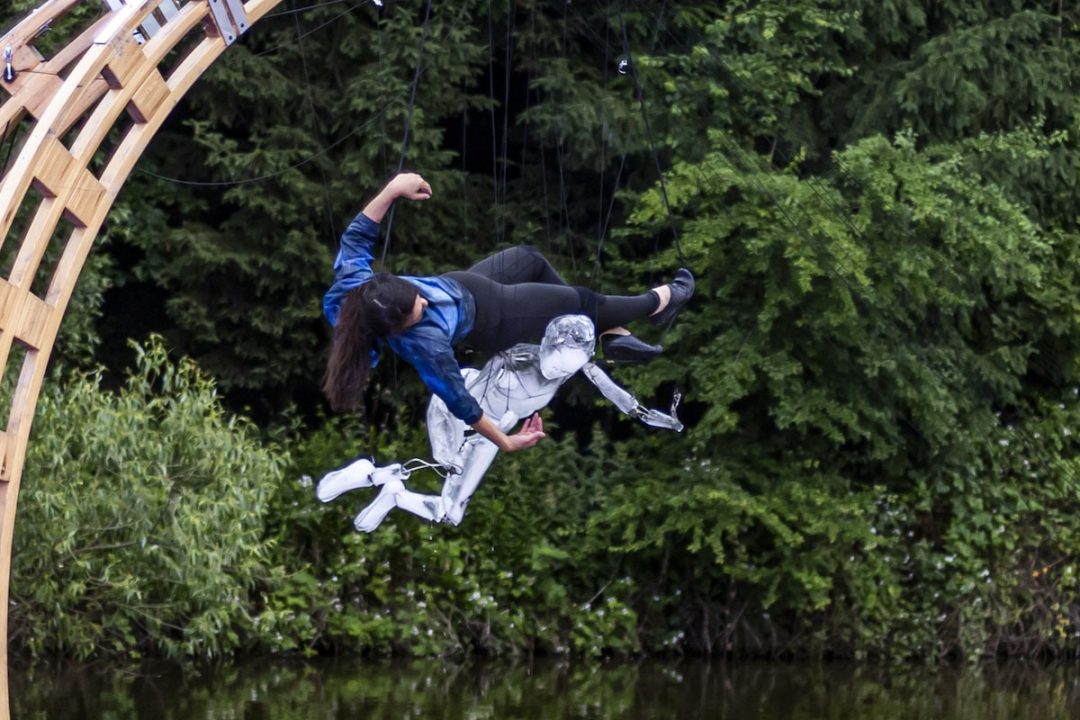
Through this humanising strategy, another point Mizu addresses is the symbiotic nature of our relationship with nature. The dancer manipulates the doll, and the doll the dancer; they dance in sync and they both initiate or break off movements, and contact with one another. That is the magic within the craft of puppeteering. Ice becomes more than just matter, the doll feels more than alive, a fantastic creature that can fly as the dancer crawls and climbs the half-moon like wooden structure from which the cords holding it together are hanging.
As the doll melts, the awe its aliveness awakens is progressively taken over by the terrible and uncanny feeling of doom being upon us. In Plzen, teenagers jumping from the ten-metre stonewall serving as a backdrop, seemingly without a single care in the world, accentuated this feeling even further.
Adriano Bolognino: Come Neve
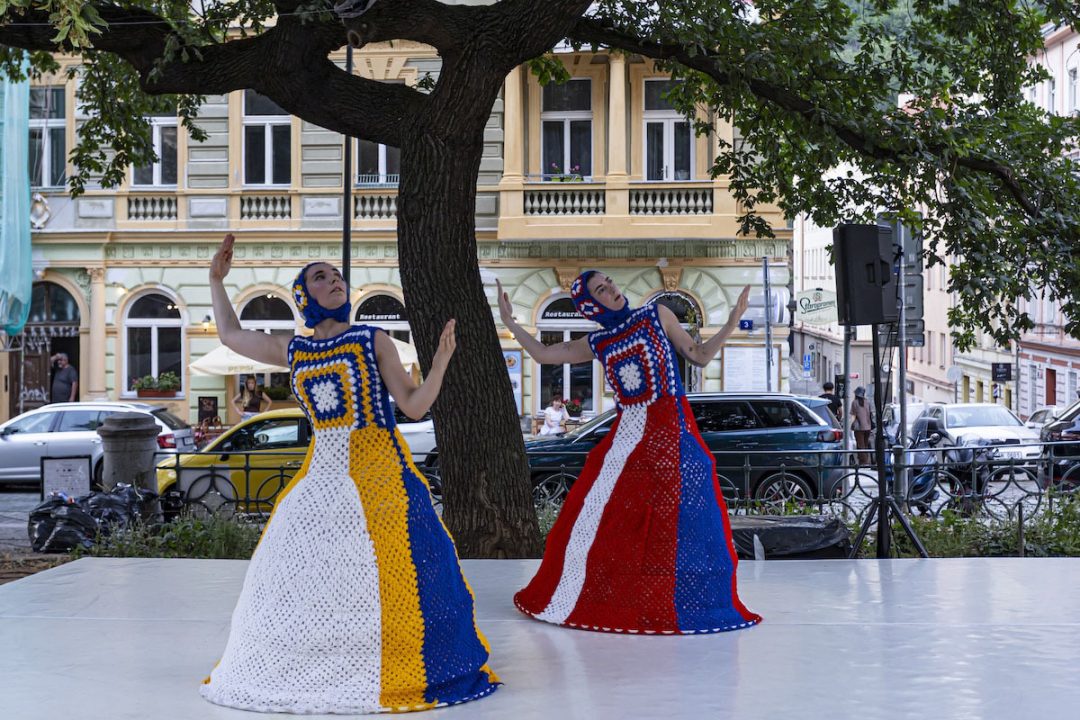
Premiered in 2023, Adriano Bolognino’s 20-minute, minimalistic and curiously choreographed duet is a caress for the eye. Two women crouch mid stage, their backs turned towards us, on a low, squared podium covered with white linoleum. They each wear a colourful knitted casket covering their head and ears, and a dress to match. During the aftertalk we’ll learn that the colours of the dresses (red-blue and white, and blue-white and yellow) are those of Napoli, Bolognino’s homeland, and that they were handcrafted by elderly Neapolitan women during the pandemic.
The first part, accompanied by one of the distinctly emotional and minimalistic tunes by Ólafur Arnalds, is filled with small sharp gestures by the two dancers, Laura Miotti and Sofia Galvan. Mainly executed by their hands and arms, their moves first bring forward associations ranging from colibris, synchronised swimmers, or parts of a clockwork engine. The sharpness of their ‘ticking’, contrasted with some more soft and slow movements, puts an accent on the value of everything small, as they also resemble the small and pointed actions that brought their costumes into being. Actions which, not to forget, also brought solace, comfort and sense of community to the women who sat down to make them.
You don’t need much more to have me hooked. The craft here celebrated was that of those women and, with them, of the larger meaning of everything we do when we patiently put care and love for detail into something inefficient. After exploring their bodies, each other, and the space around them in this fashion for a while, the choreography comes at a stop. A long silence follows, during which we have time to wait, and to appreciate the waiting, as well as the echo of their movements spreading against the given backdrop of the day. I heard nothing in the monastery of Kladruby; the next evening in Prague, it was birds and passers-by laughing in the park. When the second song finally hits – this one an even more cinematic and emotionally loaded score by Nils Frahm – Miotti and Galvan enter into a new dynamic phase. They start to swivel quickly over the floor, their arms still moving around themselves. It strongly resembles the slavic Beryozka-style dances: yet another reference to an activity wherein poetic power is achieved by a combination of attention and condensation. The dancers’ steps, controlled and very close to one another, generate a strong impression as we see them floating over the floor in their long and heavy dresses.
A final swirl for the mind, a gush of wind, before it all ends. Judging by the warmth and length of their applause, the audiences both in Kladurby and in Prague, loved this small, simple and moving jewel as much as I did.
Unity In Motion / Yana Reutova & Clara Da Costa: Paradise Birds
I saw a general rehearsal of the triptych Paradise Birds the day before it was officially premiered as such during the festival. It consists of two separate and already existing solos by Clara da Costa and Yana Reutova, and a choreographic dialogue between the two which unites them both.
As they laughingly confirm after the rehearsal, the two dancers are in many ways very different from one another. All they have in common is their astrological sign – and the experience of being (and identifying as) a woman, of course. Yanitsa Atanasova, the dramaturg of this assemblage, also identified this difference as the most prominent red thread to explore in their collaboration.
Where Da Costa’s solo, involving a costume of a brown dog, rowdy choreographic material and a fierce, in-your-face attitude that breaks the fourth wall and puts the audience at sharp from the get-go, Reutova’s practice and presence is much more contained and built around strong movement technique, a love for abstraction and for the use of different symbolic layers in display.
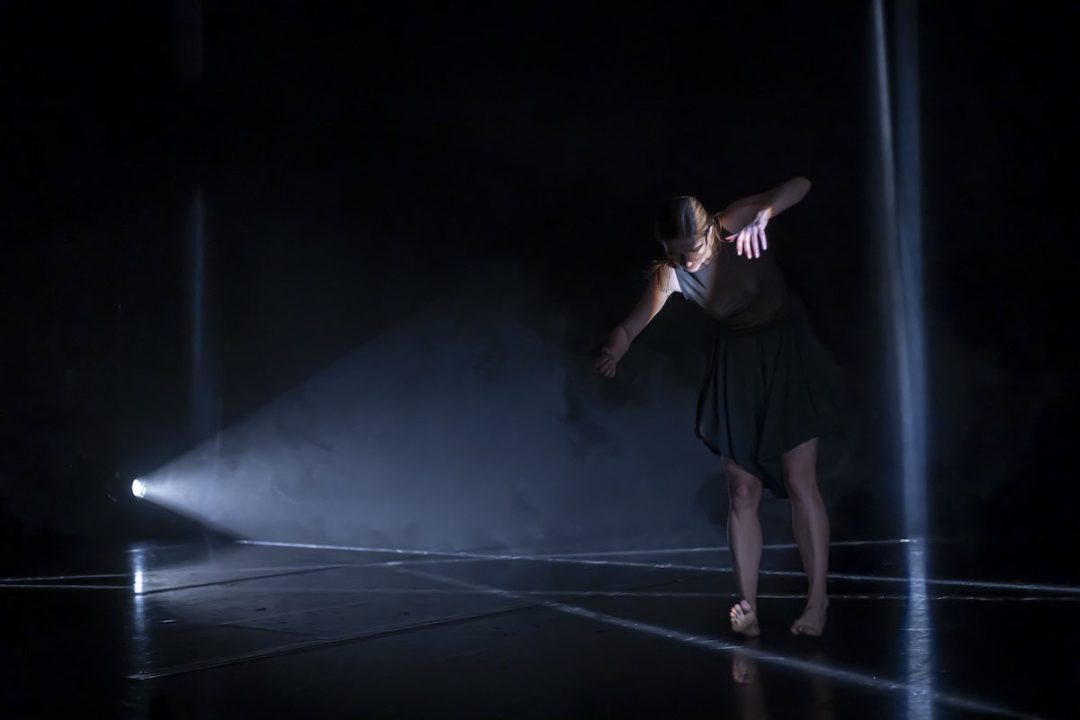
Taking the archetypes of Eva and Lillith as a reference, Reutova and Da Costa symbolically come to embody the energy of these biblical opposites of femininity. While they both do their thing in their own way, both solos thus also clearly express different versions of the same frustration and rebellion: that of the expectations and objectification they have to suffer under the dominating male gaze. One does so with a don’t-give-a-damn-attitude, dressed up like the playful dog the patriarchy would want her to be. The other, by revolting against the ‘Barbification’ of her body in a journey travelling from the repurposing of elegance and grace into a tool for female empowerment to a very direct exploration of her naked upper body, at discomfortingly close range of the first rows.
The danced dialogue connecting both solos felt funky and fresh. In a time where algorithms and the desire to fend off discomfort encloses us more and more in our own bubbles, this inevident pairing resulted in an attempt at something brave and increasingly rare: the craft of getting close to one another, within or despite their differences. ●
Jordi Ribot Thunnissen’s trip to Prague was provided by Tanec Praha
01–26.06.2026, Czechia