

What happens when two artistic worlds collide?
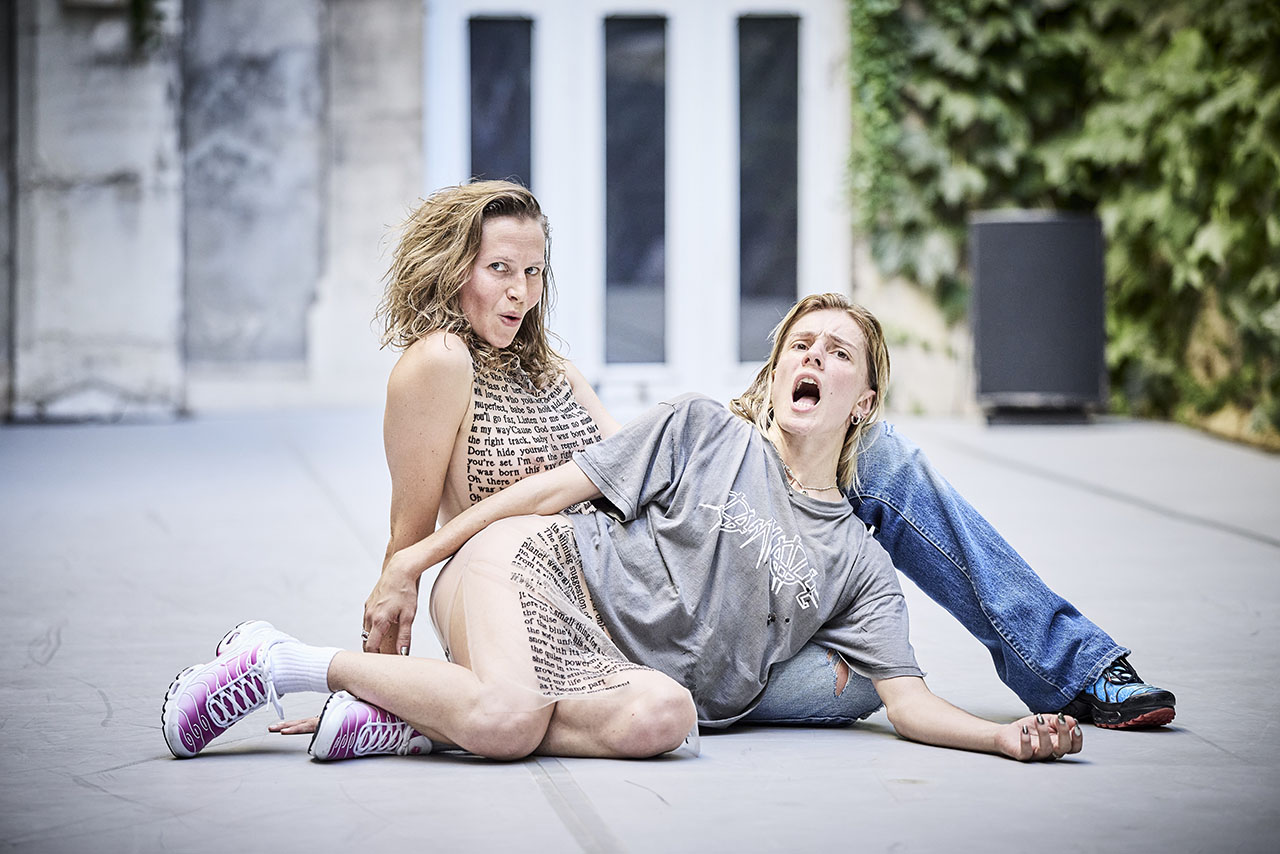
Confidently entering the stage, Fritz wears a mesh see-through top with black handwriting that matches Wachter’s skirt. Zombie by The Cranberries and something resembling a traditional folk song overlap as the pair sing over the top of each other, setting the tone for the rest of the piece. Britney Spears meets classical music, while Tik-Tok dances and headbanging mix with repetitive post-modern arm movements to hiphop beats. The choreography is energetic and repetitive, and Wachter and Fritz cast cheeky smirks and glances towards the audience.
Logbook is a cacophony of clashing expressions and fragments of familiar references. They all come together in a chaotic, yet surprisingly harmonious mash up, the duo’s insisting presence on stage holding it all together. Both having worked with Anne Teresa De Keersmaeker, their performative qualities are strikingly similar. It begs the question: Are two worlds really colliding here?
‘I’m Solene Wachter, she’s Bryana Fritz and we’re going to share the stage for 30 minutes,’ Wachter states to the audience, like a headliner opening a festival.
The ‘sharing’ that follows is a cacophonous collision of content. Club bangers and liturgical singing layer as the pair flit between movement languages, everything from karate kicks to sensual self-caresses to caricatured lip syncing. There are postmodern dance-like passages, too, where Fritz and Wachter (both accomplished movers who have worked with Anne Teresa De Keersmaeker) bounce and skip playfully in direct pathways, appearing to follow lines on an invisible grid.
Is it a comment on the dissonant references artists bring to the table when collaborating? Or the endless barrage of information vying for our attention online? Fritz later exposes the work’s inspiration in a somewhat on-the-nose speech about the history of polyphony, contemplating whether it inspires confusion or complexity. In Logbook, it does neither. While the work clearly deals with overwhelming accumulation, a literal, bombastic exploration of the concept means an answer as to ‘why?’ struggles to cut through the noise.
Solène Wachter and Bryana Fritz open Logbook by singing together. Well, not together exactly, but certainly simultaneously: they sing in different, keys, languages, rhythms, moods and styles. Separately they’re coherent; together they clash.
Yet we learn to accept such dissonances as the scenes accumulate: the sound of rock colliding with that of baroque, springy steps combined with stiff arms, grand gestures with picky ones, stage-hogging solos with falls off its edges.
There’s method in the madness, which Wachter illuminates with a story about the 14-century dual papacy (two Popes trying to occupy one position) and the consequent rise of polyphonic (many-voiced) music. Logbook leans into similar terrain, though it’s far more redolent of the clamorous tonalities of modern life than the subtle blendings of medieval polyphony.
There’s method, too, in the deft staging, lighting and pacing, in the exactitude of action and timing. If the content is messy, the form is clean. Moreover, the tone is often leavened with zany humour. Civilisations may clash, but you gotta laugh.
Arms slash like scythes, legs hopscotch as if cruising a chessboard, and faces contort like melting rubber. This is Logbook, a work in which Solène Wachter and Bryana Fritz – both with links to postmodern choreographer Anne Teresa De Keersmaeker – phase in and out of sync on an exposed stage. Power poses; slow-motion writhing; and bouncy, full-bodied phrases cross-fade and compete for attention. Iconic pop hooks slide over droning beats. Lights flash as if in a stadium, then lower to a moody glow. Dancing is intermittently punctuated with live song – French, Spanish, German and English spill over each other without hierarchy.
Inspired by 14th-century debates over polyphonic and ‘plainsong’ liturgical music, Logbook styles the secular and sacred in ripped jeans and a see-through top. By layering multiple registers across movement, lights and sound, the piece challenges distinctions between ‘low’ and ‘high’ art. In an age of algorithmic curation, it treats both as viable material for live performance.
Logbook poses a question – can dance hold everything at once? That’s worth asking.