

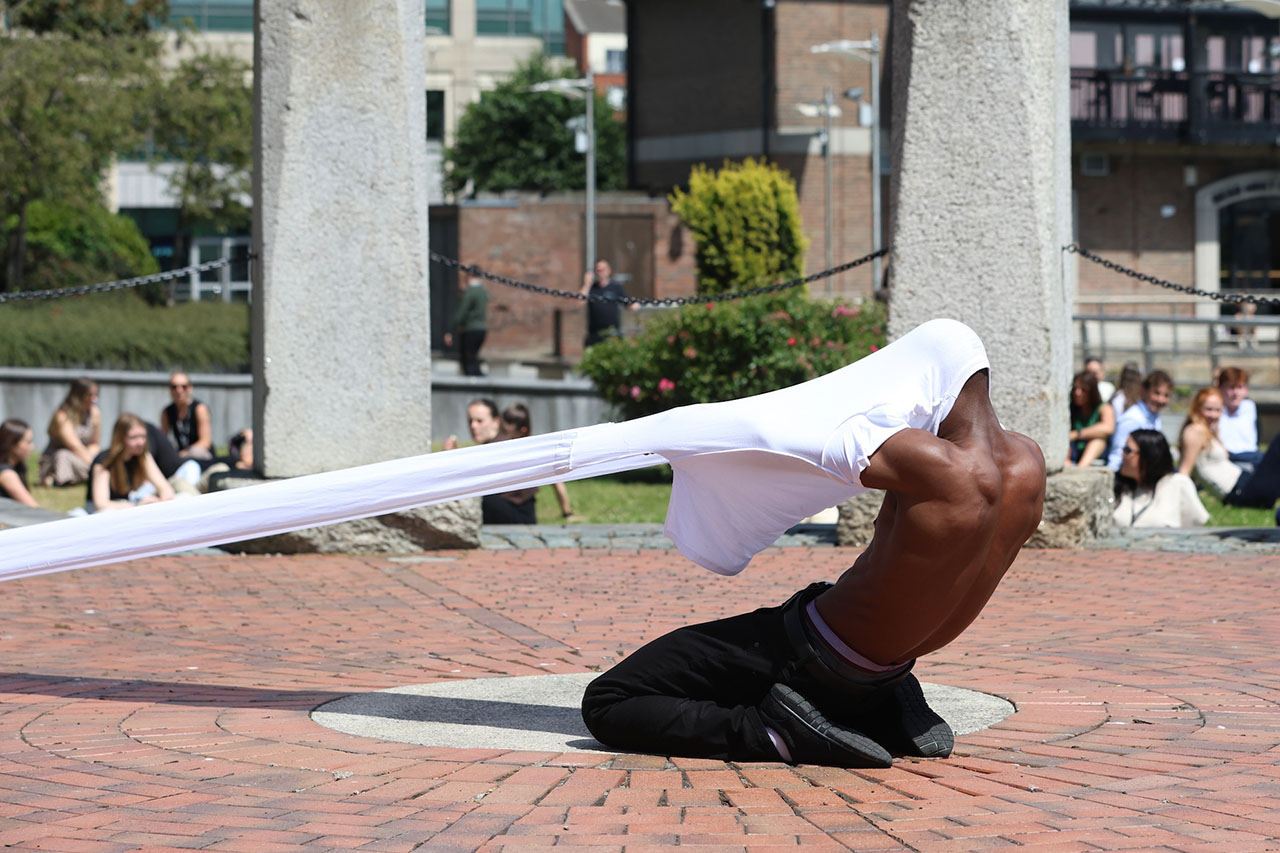
Dancer Mutufau Yusuf departs from the rubble of the past, but Proses On Neither Here Nor There gives us materials to build a better future. Tethered to a pile of bricks by a white t-shirt extended into a cord, the Nigeria-born artist stretches in attempts of liberating himself. But as the movement fails against confinements and fragmentations, it is turning back and hunching below the clothing that facilitates escape; in order to let go, one must address what oppresses. Freedom brings convulsions: a collapse follows each outburst. But doesn’t every accomplishment involve defeat?
The soundtrack’s raw vocals and drums permeate with intensity, while the choreography’s ritualised gestures and spasms confront us with political gravitas. While the ending is somewhat anticlimactic, Yusuf compensates with effective use of the outdoor space. As he turns back to the audience and observes the landscape ahead, we too embody his gaze, tinted with a desire for breaking free.
Proses on neither here nor there was one of the highlights of the Spring Forward Festival. Nigerian-born Irish dance artist Mufutau Yusuf delivered a poetic performance, which left us thinking about human struggle for dignity and liberation.
Crouching, barefoot, wearing a white t-shirt, Yusuf contemplates the landscape. He stands nearby a pile of bricks semi-covered by a white cloth part of his t-shirt. Initially, to the sound of what resembles a traditional African song, he will lay his arms down, open them up while on his toes, push himself further. We hear now a blues theme, a female voice strongly breathes in and out. Yusuf tries to set himself free from the cloth – torso, shoulders, arms, and finally head. He lays down. Cloth free, he looks up at the sky, raises his arms, falls to his knees and faces the audience. Closing the circle, he again contemplates the landscape.
Mufutau Yusuf is restrained by his own white t-shirt, its long elasticated train affixed to bricks piled on grass. To mournful and mysterious folk singing, he spasms and strains against the tether but cannot at first escape it (the symbolism of a white covering that masks black skin is, too, inescapable). Twisting the shirt inside out, he manages to release his arms, but his face stays covered. Drums pound and a voice soars and falls, echoing the tension between fixity and freedom.
Finally, Yusuf slips free – but it’s not a liberation: he carries the traces of his struggle in his faltering steps, his sudden staggers. Shrieks and shouts on the soundtrack give voice to inner torment, and only finally does he circle, still cautiously, beyond the bricks and tether, setting his sights upon the horizon.
Through a deft division of labour between body, costume, sound and setting, and with a slow, intense performative presence, Yusuf casts a powerful spell.