

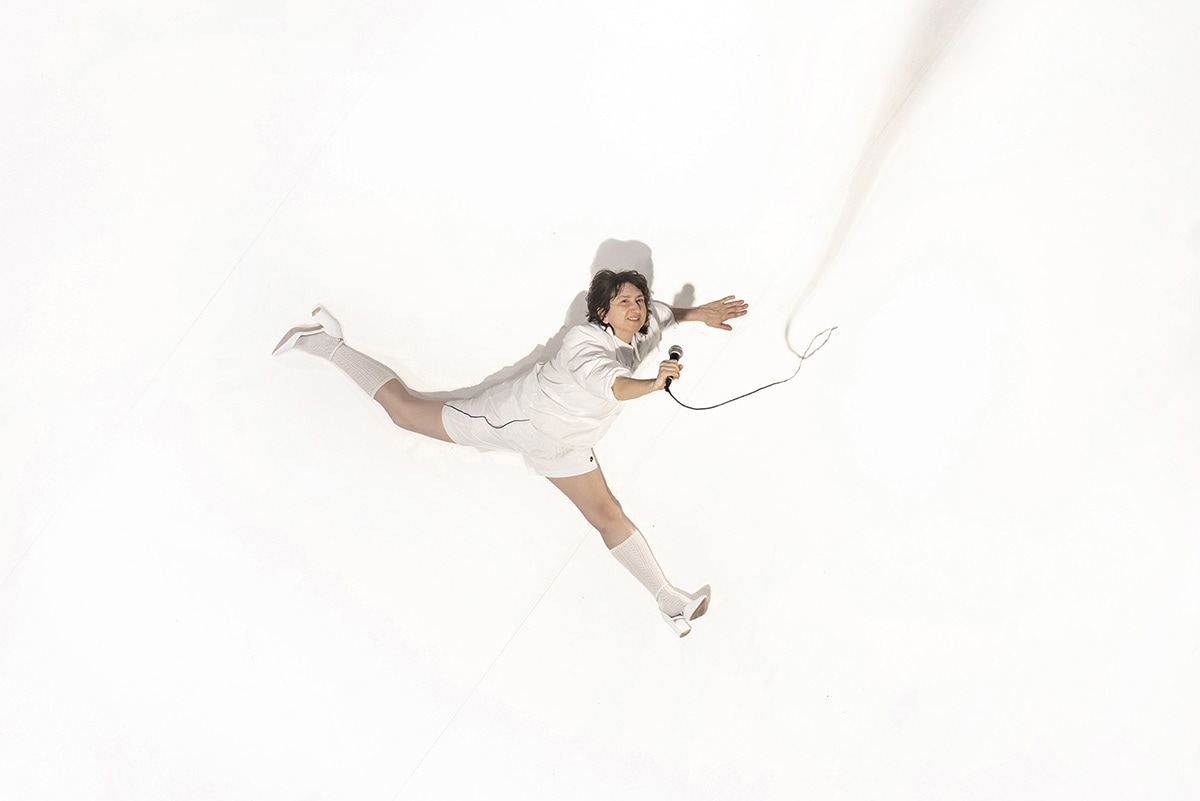
The 9th edition of the New Italian Dance (NID) platform (1–4 October 2025) took place in Civitanova Marche amidst pro-Palestinian mobilisations across Italy. With artists making their own pro-Palestinian statements on stage at the conclusion of their performances (reading letters, bowing with the Palestinian flag, projecting the motto ‘Free Palestine’) and with a collective one-minute silence, NID participated in its own way in this wave. More officially, NID also provided the opportunity for dancers and choreographers, producers, curators and critics to come across the current Italian dance scene as promoted abroad through the platform’s state and regional funding.
Under the title ‘Dance, Singular Plural’, the NID platform featured 6 open studios pitching nascent choreographic ideas and 18 solo and group works in both theatrical venues and alternative spaces, predominantly individual expressions of contemporary dance. In an effort to become ‘plural’ in terms of genres and styles, NID also embraced participatory formats, outdoor performances as well as urban dance mixed with theatricality, as in the case of the guest performance Pre-Giudizio by Ilenja Rossi/UDA company. The programme also represented contemporary ballet in Forma Mentis by Jacopo Godani/Spellbound Contemporary Ballet, and Wolf Spider by Mattia Russo and Antonio de Rosa/ResExtensa Centro di Produzione della Danza.
Here are some impressions structured around the idea of singularity-plurality in relation to solos, duets, trios and ensemble choreography.
Singularity#1: alone on stage and in public space
Opening NID was Op.22 No.2 by Alessandro Sciarroni (Golden Lion for Lifetime Achievement in Dance, 2019), a solo performed by one of the most engaging Italian performers, Marta Ciappina (Ubu Award 2023). Op. 22 No.2, a guest production during last year’s NID, is a pure dance piece inspired by Jean Sibelius’ symphonic poem The Swan of Tuonela. It is built on the performative skills of the elegant and enchanting Ciappina, who handles effortlessly, yet powerfully, a non-codified and idiosyncratic movement material that invites the audience to discover the mystery of gesture and expression in the emotional journey of a lonely woman. Also swan-related, conceptual choreographer Gaetano Palermo created a solo inspired by Michel Fokine’s legendary The Dying Swan. However, Palermo’s Swan aims to critique selfie-culture. At the centre of the piece, performed outdoors, is roller-skater Rita di Leo, overloaded with a long blonde wig, a silicon mask and headphones. Rolling and attempting demanding skate figures, she remains isolated in her own world and attached to her self-image, admiring herself through her own smartphone. To the sound of gunshots, her continuous falls on the ground and the slow deconstruction of her self-image in front of the public’s eyes become a poignant reflection on the vanity of solipsism, and by extension of our own existence.

Another solo work, where the roles of performer and choreographer overlap, was Superstella (also reviewed here) by emerging choreographer Vittorio Pagani. Inspired by Federico Fellini’s masterpiece 8½ and the crisis of artistic creation, the work captures the angst of creativity, exploring various options for commencing, developing and finishing a choreography. Building a cohesive whole that allows ideas to circulate between the body, the screen and a recorded text, Superstella becomes simultaneously conceptual and ironic, sensitive and objective. Pagani engages in a multi-stylistic performative and choreographic approach in search not only of exploring artistic identity but also audience acceptance. The various choreographic proposals that emerge – the Superdance, the Superdark, the Supervoice, the Supernova – render Superstella capable of criticising the demands of the mainstream performing arts market from within.
Singularity#2: alone seeking relationality
Suspended Chorus by and with Silvia Gribaudi is another solo work (also reviewed here and here), yet it is conceived to construct a relational environment with the audience and among the spectators. Moving her curved and flexible body, Gribaudi playfully fuses anger with sensuality, and manipulates us into directing her in a short piece of choreography but also acknowledging those sitting next to us. Physically exhausting herself, she employs her familiar hilarious and unique ways of dismantling female stereotypes, questioning beauty and combating body shaming with self-irony, orchestrating our collective breathing into a suspended chorus that supports her towards the achievement of this objective.
Still participatory, Le classique c’est chic by Anna Basti is a practice that aims to democratise ballet through collective training in urban sites. Through a show and repeat approach, participants with no former training experience end up dancing in a ballet class, reclaiming and activating public space, affirming that ballet can happen anywhere, but above all that it may be suitable for all, no matter their gender, body type, origin or social status. Le classique c’est chic captures the essence of dance as an embodied practice that has the potential to build togetherness and self-acceptance through joy and fun. It is a solo practice turning collective through transmission, creating an impromptu and urban corps de ballet, choreographed instantly.
Joined singularities#1: duets, trios and more
Based on a free adaptation of Shakespeare’s poem Venus and Adonis, pioneer choreographer Enzo Cosimi, who made his debut in the Italian dance panorama in the 1980s, creates a duet for Alice Raffaelli (Danza e Danza award 2024 for Best Performer) and combat athlete Leonardo Rosadini. Divided into four chapters, Cosimi’s Venere versus Adone explores the limits between lust and devotion, desire and suffering, unfulfilled love and revenge, fusing and embodying strong queer aesthetics, especially in the choices of costumes and props. Adapting literature in dance is usually very choreographically challenging, especially in balancing text and narration with the expressive potential of dance and performance. Yet Cosimi moulds myth through evocative and provocative imagery in a work that gradually topples traditional gender roles and sheds light on the complexity of unrequited love.
Raffaelli’s second appearance in the programme is Elisa Sbaragli’s Se domani (If tomorrow), a male-female duet, initially presented as a work in progress during the Open Studios of NID 2024. Completed in its choreographic form during NID 2025, the duet with Raffaelli and Lorenzo De Simone embodies the process of two worlds gradually coming together in tender reconciliation. Initially, the two bodies, frontal in orientation and apart from each other, walk slowly back and forth like two strangers in a narrow corridor. They gradually become uncoordinated, like toys running out of battery, until they reach a complementary relation in proximity with one another: an embrace transformed into a configuration that recalls Michelangelo’s Pietà. Passing through a clear spatial pattern, Se domani is a journey where two individuals gradually leave their egocentric worlds to reach a balanced yin-yang connection.
Simona Bertozzi’s Sista is a duet featuring Marta Ciappina, once more, alongside Viola Scaglione. Exploring female friendship, it is crafted on two different characters – one gestural, soft and laconic, the other fast, secure and verbose in terms of movement. Yet both are fragile in their own way, in need of each other to share the struggles and joys of life. Micro-jealousness alternates with admiration and empathy to shape an intense and at times playful duet. Bertozzi signs a work of female power that threads the biographical and the fictional in a piece that captivates for its simplicity and human resonance.

RAVE.L by Virginia Spallarossa/Déjà Donné unfolds through a series of solos, duets and trios combining an abstract movement language with a cold austerity. Despite the evocative light design by Giacomo Gorini, his conic spectrum often competes with the dancers, deliberately or not, making them oscillate between presence and absence, appearance and disappearance. The overall outcome is a formal, introspective and rather impermeable choreography that sways between poetic and abstract images. Inspired by the character of Pinocchio, Pupo by Sofia Nappi (Komoco) is an ensemble work (also reviewed here) where the seven dancers wave and groove to the folkloric sounds of a music collage – loosely following the notes of an accordion or a trumpet. With humped backs and baggy clothes, they enter and exit from a stylised movement, sometimes with audacity, other times with seductiveness. This shapes a choreographic writing enriched but also restricted by the imperatives of music, prioritising movement over choreographic composition.
‘
Oscillates between memory, reality and dream in an eerie and absurd atmosphere where everything is possible
Presented inside a nightclub, Redrum (Ubu Award 2024 ex-aequo in the category of Best Dance Performance) is a six-person choreographic installation by Gruppo Nanu (Marco Valerio Amico-Rhuena Bracci) where the audience members, at times mixed with the performers, can come and go as they wish. Spectators can change their position in space and choose their distance from the performers – mysterious characters of a surrealistic world where time is momentarily suspended. True to its source of inspiration (the book and film The Shining by Stephen King and Stanley Kubrick respectively), Redrum playfully and unexpectedly oscillates between memory, reality and dream in an eerie and absurd atmosphere where everything is possible.
Plurality in need of singularity
So far so good, one could dare to say, but the overall impression from NID is somewhat bittersweet, highlighting a curatorial approach that turns NID into a platform with little international reverberation. Since it became an annual platform in 2024, NID has attracted fewer foreign programmers – which might well be also a matter of curation.
‘Plurality’ – the other half of this year’s curatorial lens – featured ensemble choreographies of strong formality, technical discipline and homogeneity, whereas the singularity of their individual performers was hard to notice. Moreover, some of these pieces felt less innovative, countering the platform’s mission, as implied by its title, to promote the ‘new’. In the overall programme, similarities across works – the frequent use of black costumes and artificial smoke, the close programming of two pieces employing masks – gave the impression of narrow creativity among choreographers, something that appears to be more of a curatorial issue than an artistic one.
‘
I was left longing for a plurality of stranger practices by artists who challenge conventional understandings of dance and choreography through artistic risk
During NID 2025, I also missed the singularity that dance scholar André Lepecki distances from individuality and associates with ‘strangeness’, where dance becomes ‘strange’ to its modern identification as movement and choreography as composition of steps. Through this lens, I was left longing for a plurality of stranger practices by artists who challenge conventional understandings of dance and choreography through artistic risk. These kinds of practices, on both curatorial and artistic levels, have been strongly hit in regards to state subsidy – with some even excluded or downgraded in the evaluation scale for the Italian National Fund for Live Performance. Is it perhaps time for the NID platform to find its curatorial autonomy from the government’s imperatives? Compare the title for NID 2026 – Coregrafie del possibile (Choreographies of the possible), that will take place in early September in Torino – with that of the 35th Biennale de São Paulo: The Choreographies of the Impossible (2023), clearly positioning itself in support of experimental choreography that encourages the ‘radical imagination about the unknown’. The shift of focus from dance to choreography and from technique to composition is surely positive, but the contrast between the two platforms is telling. ●
1–4.10.2025, Civitanova Marche, Italy
The New Italian Dance (NID) platform is an initiative of the General Direction of Live Arts of the Italian Ministry of Culture and R.T.O. – the Temporary Grouping of Performing Arts Programmers, who make part of ADEP (Associazione Danza Esercizio e Promozione) and FEDERVIVO-AGIS (Federazione dello Spettacolo dal Vivo – Associazione Generale Italiana dello Spettacolo). The 9th edition of the NID platform was also supported by AMAT (Associazione Marchigiana Attività Teatrali), a performing arts association based in the Italian region of Marche.