

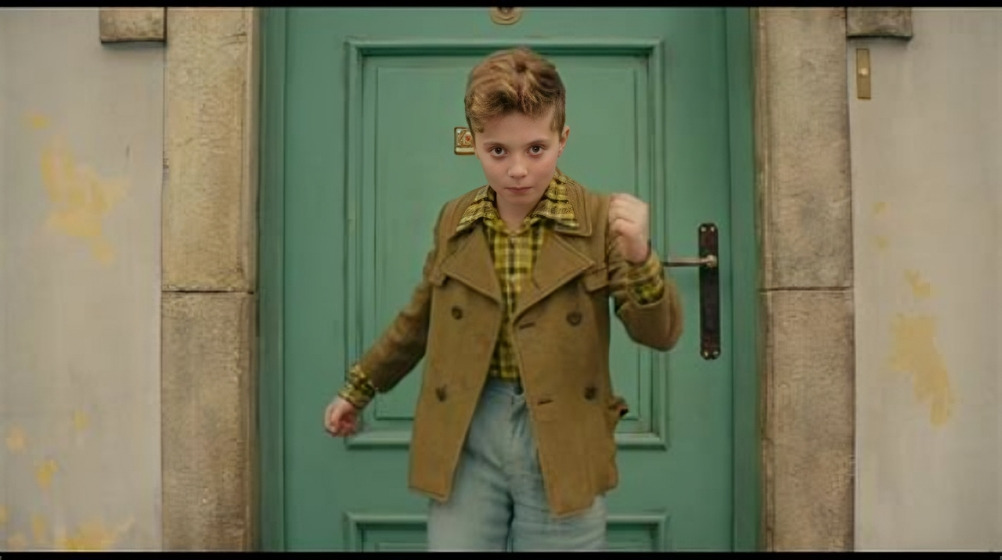
Taika Waititi’s Jojo Rabbit (2019) stands out for its daring satire, pastel-coloured aesthetics, and the absurd image of Adolf Hitler as a child’s imaginary friend (played by Waititi himself). Beneath the humour and political commentary lies a subtler emotional language that gives the film its deepest resonance: dance.
The film follows Jojo (Johannes Betzler, played by Roman Griffin Davis), a lonely German boy immersed in Nazi propaganda and desperate to belong, during the final days of World War II. In a world that grows increasingly violent and paranoid, Jojo becomes increasingly confused as to what is right and wrong. Despite the cruelty surrounding him, two women soften his worldview through their compassion and, interestingly, through dance.
The first is his mother Rosie Betzler (Scarlett Johansson), a warm and free-spirited woman, who dances through city streets and riverbanks, refusing to let fear and loss harden her. Rosie’s philosophy is simple but profound: people dance because they are alive. In a regime obsessed with marching, saluting and conformity, her dancing is an act of rebellion: her movement, loose and playful, and her loud laughter, stand in a stark contrast to the stiff militarism around them. One of the film’s recurring ideas is that authoritarianism fears joy as much as it fears dissent. Fascist ideology depends upon discipline, uniformity, and obedience. Throughout the film, Waititi contrasts Rosie’s movement with the regimented physical language of Nazism: children are taught to move in unison and to perform loyalty through synchronised gestures. Bodies become instruments of ideology. Dance interrupts that logic. Dance is personal, emotional and spontaneous, and through dancing, Rosie teaches Jojo to value imagination, humour and tenderness, precisely because these qualities resist indoctrination.
‘
Authoritarian systems do not merely seek to control thoughts or politics; they also attempt to control movement, intimacy and joy
During a walk beside the river, Rosie talks to Jojo about the times when the place was filled with lovers, singing and dancing, a recollection of community before hatred consumed public life in the country. Now, the riverbank is empty and lifeless, reflecting a society stripped of warmth and connection. Under fascism, all celebration disappears: people no longer gather or move joyfully together. The absence of dance signals the erosion of communal life itself.
Rosie’s dancing feet in a pair of bright red-and-white heels, become a recurring visual motif in the film. And it makes for a devastating moment, when we later see Jojo recognising those same shoes, on Rosie’s hanging body.
Amongst other, subtler acts of resistance, Rosie bravely hides a Jewish girl Elsa Korr (Thomasin McKenzie) in her deceased daughter’s room. After Jojo discovers her living hidden in their home, the two youngsters form a complex bond, somewhere between friendship and romance, as often happens in adolescence. Jojo learns to undo his misguided preconceptions on Jews and the world as he gets to know Elsa, who is opinionated and fierce, but full of compassion. Like Rosie, Elsa also connects dance to freedom: ‘What will you do when you are free?’ he asks. Her succinct answer: ‘I will dance.’ Confined and living under constant threat, Elsa dreams of dance, movement and music, as a primary act of reclaiming her body, of restoring her identity and her ability to exist freely in the world again.
And so she does: in the film’s final scene, after Germany’s surrender and Hitler’s death, Jojo and Elsa step outside into a world that is still numb, but free. Elsa is now wearing Rosie’s red-and-white shoes. They stand facing each other, the camera framing each one in frontal shots, and hesitantly, they begin to dance. There is no dramatic outburst of joy though, no triumphant choreography, no pzazz. Their dance is quiet and uncertain, as if they take turns trying out for the first time how their bodies can move. But they seem hopeful and happy, and they are definitely having fun, as they briefly get caught in the rhythm of David Bowie’s Heroes, just before the screen fades to black and Rilke’s heartening quote appears:
Let everything happen to you.
Beauty and terror.
Keep going.
No feeling is final.
Jojo Rabbit suggests that authoritarian systems do not merely seek to control thoughts or politics; they also attempt to control movement, intimacy and joy. That is why the final dance matters so deeply. It is not simply celebration. It is recovery. A reclaiming of humanity after a world built on fear tried to crush it. ●